Bebb’s willow - Species Profile
Conservation • Wetland • Description • Habitat • Ecology • Use • Distribution • Taxonomy
Conservation Status
IUCN Red List
LC - Least Concern
NatureServe
N5 - Secure
SNR - Unranked
Minnesota
not listed
Wetland Indicator Status
Great Plains
FACW - Facultative wetland
Midwest
FACW - Facultative wetland
Northcentral & Northeast
FACW - Facultative wetland
Description
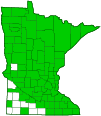
Bebb’s willow is a common and widespread tall shrub or small tree. It occurs in Europe, Asia, and North America. In the United States it occurs in the east from Maine to New Jersey, west to Washington State and Oregon, and south along the Rocky Mountains to Arizona and New Mexico. It occurs throughout Canada and Alaska. It is found in marshes, swamps, and other wetlands; in prairie swales and wet thickets; on stream margins and lake shores; and in ditches and disturbed areas. It grows under full or partial sun in moist to wet soil. It is fast growing, quick to colonize new wet areas, and capable of forming dense thickets.
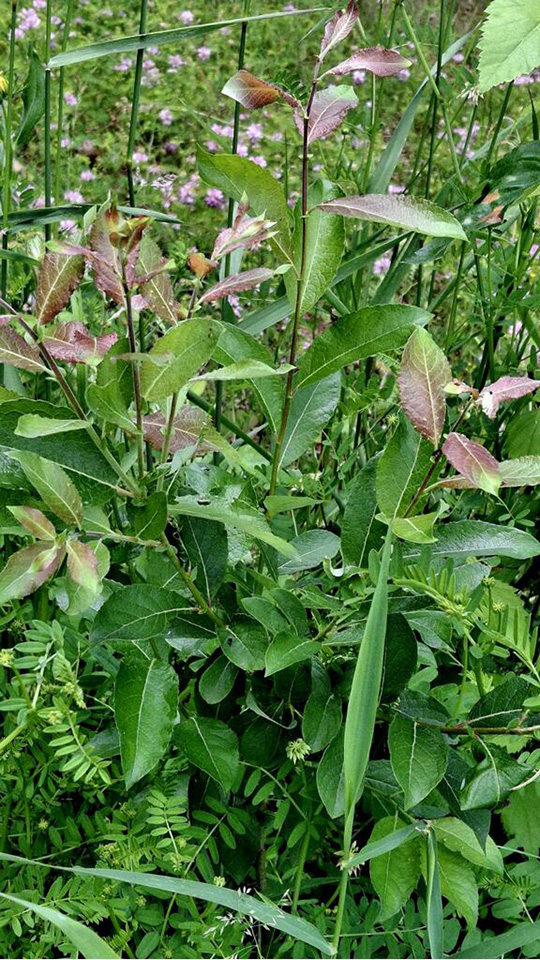
Bebb’s willow is usually a tall shrub with a few upright stems up to 60″ or 80″ (1.5 to 2 m) tall. It is sometimes a shrubby tree up to 23′ (7 m) tall with a trunk 6″ to 12″ (15 to 30 cm) in diameter. The crown is broad and rounded.
The bark is gray and smooth on young stems, becoming rough and furrowed on older stems and deeply furrowed on older trees.
The branchlets are greenish, slender, and hairy in the first year, becoming reddish brown and hairy or almost hairless in the second year.
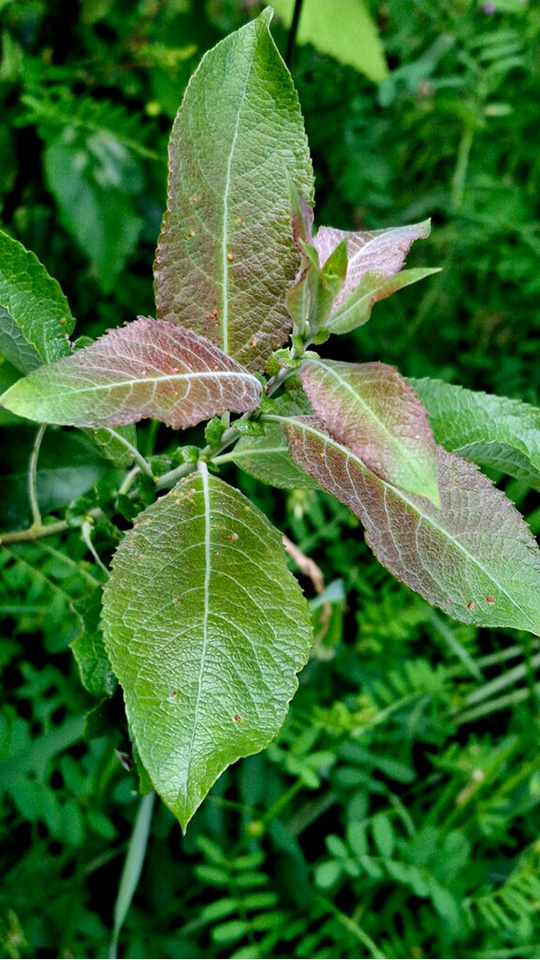
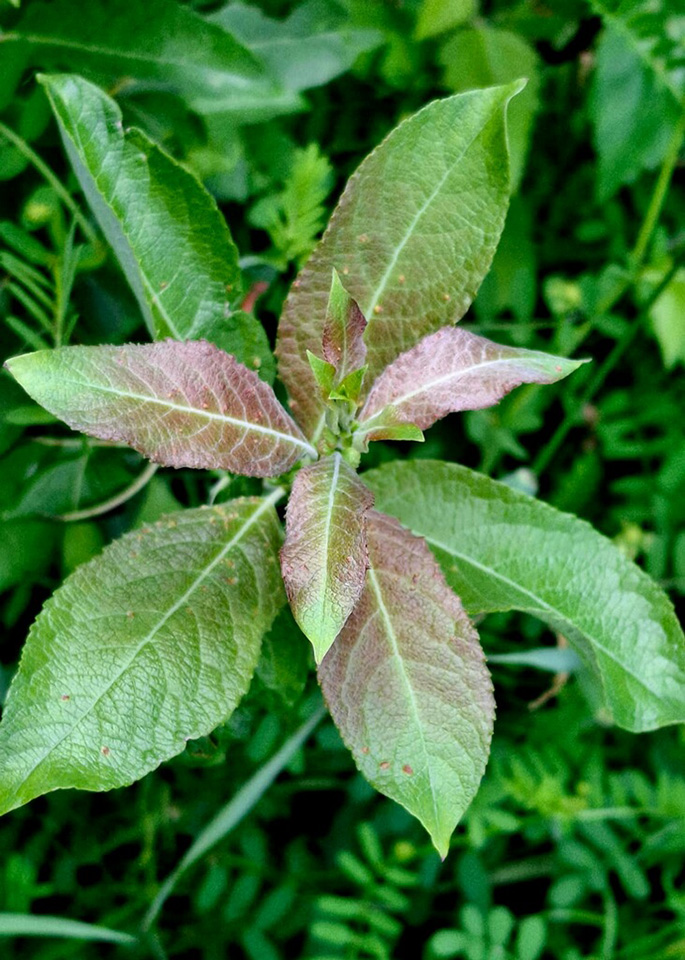
The leaves are alternate and are on minutely hairy, 3⁄16″ to ½″ (5 to 13 mm) long stalks (petioles). The leaf blades are ¾″ to 3½″ (20 to 87 mm) long and ⅜″ to 1¾″ (10 to 44 mm) wide, averaging 1¾″ (44 mm) long and ⅝″ (16 mm) wide. They are elliptic to narrowly elliptic, widest at or above the middle, inversely egg-shaped or inversely lance-shaped, and tapered to a point at the tip. The upper surface is dark green and dull or slightly glossy. It may be moderately densely hairy, sparsely hairy, or almost hairless. The secondary veins are deeply impressed, giving the surface a puckered appearance. The lower surface is moderately densely hairy to almost hairless, and is covered with a whitish, waxy bloom (glaucous). The margins are slightly rolled under and may be untoothed, have rounded teeth (crenate), or have irregular sharp, forward pointing teeth (serrate). Young foliage is often reddish.
Male and female flowers are borne in cylindrical clusters (catkins) on separate plants. Male catkins flower just before the leaves emerge. They are globe-shaped, ⅜″ to 1⅝″ (10 to 42 mm) long, and ¼″ to ⅝″ (7 to 16 mm) wide, and they are on 1⁄64″ to 7⁄16″ (0.5 to 11 mm) long branchlets. The anthers on male flowers are yellow or purple turning yellow.
Female catkins flower as the leaves emerge. They are slender or almost round, ⅝″ to 3¼″ (16.5 to 85 mm) long, and ⅜″ to 1¼″ (9 to 32 mm) wide, and they are on 1⁄32″ to 1″ (1 to 26 mm) long branchlets. The flowers are up to ¼″ (6 mm) long, inversely club-shaped, and rounded at the base with a long beak.
The fruit is a hairy, ⅛″ to ⅜″ (4 to 9 mm) long seed capsule with a short, rounded base and a long beak. Seeds are released from mid-May to early July and are dispersed by wind.
Height
5′ to 23′ (1.5 to 7 m)
Flower Color
Similar Species
Habitat
Moist to wet. Full to partial sun. Marshes, swamps, and other wetlands, prairie swales, wet thickets, stream margins, lake shores, ditches, disturbed areas.
Ecology
Flowering
Early April to late June
Pests and Diseases
Use
Distribution
Sources
Biodiversity occurrence data published by: Minnesota Biodiversity Atlas (accessed through the Minnesota Biodiversity Atlas Portal, bellatlas.umn.edu. Accessed 8/21/2026).
Midwest Herbaria Portal. 2026. https://midwestherbaria.org/portal/index.php. Accessed 8/21/2026.
Salix bebbiana Sarg. in Bánki, O., Roskov, Y., Döring, M., Ower, G., Hernández Robles, D. R., Plata Corredor, C. A., Stjernegaard Jeppesen, T., Örn, A., Pape, T., Hobern, D., Garnett, S., Little, H., DeWalt, R. E., Miller, J., Orrell, T., Aalbu, R., Abbott, J., Abreu, C., Acero P, A., et al. (2026). Catalogue of Life (2026-07-17 XR). Catalogue of Life Foundation, Amsterdam, Netherlands. https://doi.org/10.48580/dgykv
Smith, Welby R. 2008. Trees and Shrubs of Minnesota: The Complete Guide to Species Identification. The University of Minnesota Press, Minneapolis, MN.
Nativity
Native
Occurrence
Common and widespread
Taxonomy
Kingdom
Subkingdom
Pteridobiotina
Phylum
Tracheophyta (Vascular Plants)
Class
Order
Malpighiales (Nances, Willows, and Allies)
Family
Salicaceae (Willow)
Tribe
Saliceae
Genus
Salix (Willows)
Subgenus
Vetrix (Sallows and Osiers)
Section
Vetrix
Subordinate Taxa
Synonyms
Salix bebbiana f. capreifolia
Salix bebbiana f. luxurians
Salix bebbiana var. bebbiana
Salix bebbiana var. capreifolia
Salix bebbiana var. depilis
Salix bebbiana var. luxurians
Salix bebbiana var. perrostrata
Salix bebbiana var. projecta
Salix cinerascens
Salix depressa
Salix depressa f. cinerascens
Salix depressa ssp. rostrata
Salix depressa var. cinerascens
Salix floderusii
Salix floderusii f. manshurica
Salix floderusii var. fuscescens
Salix geminata
Salix hsinganica
Salix ilectica
Salix ilectica var. integristyla
Salix livida var. cinerascens
Salix livida var. occidentalis
Salix livida var. rostrata
Salix macropoda
Salix orotchonorum
Salix perrostrata
Salix rostrata
Salix rostrata var. capreifolia
Salix rostrata var. luxurians
Salix rostrata var. perrostrata
Salix rostrata var. projecta
Salix starkeana ssp. bebbiana
Salix starkeana ssp. cinerascens
Salix starkeana var. cinerascens
Salix vagans f. manshurica
Salix vagans ssp. cinerascens
Salix vagans var. cinerascens
Salix vagans var. glabrescens
Salix vagans var. intermedia
Salix vagans var. linnaeana
Salix vagans var. rostrata
Salix xerophila
Salix xerophila f. manshurica
Salix xerophila var. fuscescens
Salix xerophila var. ilectica
Common Names
beak willow
beaked willow
Bebb willow
Bebb’s willow
diamond willow
gray willow
long-beaked willow