



Bladder campion
(Silene vulgaris ssp. vulgaris)
Conservation • Description • Habitat • Ecology • Use • Distribution • Taxonomy
Conservation Status |
|
|||||||
| IUCN Red List | not listed |
|||||||
| NatureServe | NNA - Not applicable SNA - Not applicable |
|||||||
| Minnesota | not listed |
|||||||
Description |
||
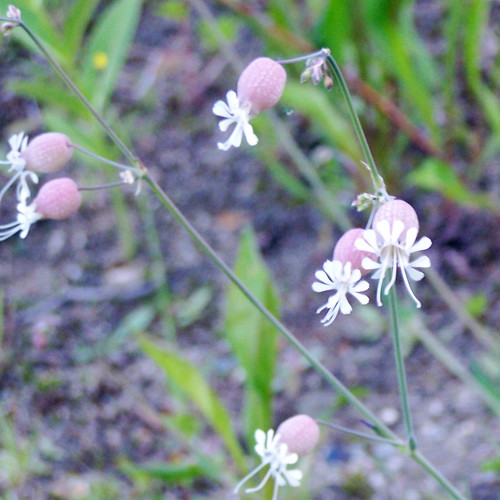
Bladder campion is a 8″ to 32″ tall, erect, short-lived perennial, that rises on several stems from a stout taproot. When in flower the plant tends to lean to one side under the weight of the flowers. The stems are erect or reclining on the ground at the base then upright. They are branched, rarely unbranched. They are usually hairless and are covered with a whitish, waxy coating (glaucous). Stem leaves are in opposite pairs. They are oblong to inversely lance-shaped with the attachment at the narrow end, ¾″ to 3⅛″ long, less than ¼″ to 1⅛″ wide, smaller near the inflorescence. They have a rounded, almost clasping, base. They taper gradually to a pointed tip with straight or concave sides along the tip. They are attached to the stem without a leaf stalk. They are hairless on the upper and lower surfaces. The margins are untoothed. The inflorescence is open, much-branched cluster in which each axis produces an opposite pair of lateral axes. There are 5 to 40 flowers in the inflorescence. Some plants have both male and female flowers. Other plants have female flowers only. Both flowers are ⅔″ to ¾″ wide when fully open, and are on stalks that are less than ¼″ to 1⅛″ long. The sepals are fused at the base into a tube (calyx) terminating in short lobes. The calyx is ⅓″ to ½″ long when in flower, ½″ to ¾″ long when in fruit, inflated, ¼″ to ½″ wide, and is not contracted at the mouth or the base. It is pale green, rarely purplish, papery, hairless, and smooth, not ridged. There are 20 obscure, equal veins with a network of veins between them. The veins are green at first, then become pinkish. The petals are white, about two times longer than the calyx. They can be slightly indented at the tip, two-lobed, or deeply two-lobed and appearing as 10 petals. They are inversely egg-shaped with the attachment at the narrow end, horizontally spreading, with a stalk-like narrow base (claw). The flowers are fragrant. They open during daytime. On male flowers 10 stamens protrude beyond the calyx. Female flowers have 3 styles which are 2 times longer than the calyx. The fruit is a green, hairless, egg-shaped, 3-chambered capsule the same size as the calyx, with 6 teeth at the top. |
||
Height |
||
8″ to 32″ |
||
Flower Color |
||
White |
||
Similar Species |
||
The pinkish swollen calyx with its network of veins distinguishes this plant from all other Silene species. Balkan catchfly (Silene csereii) has long, raceme-like primary branches in its inflorescence. The calyx is smaller, constricted at both ends, and only slightly inflated. It has 10 long and 10 short veins and does not have an obvious network of veins between them. The stalks of the stamens that support the anthers (filaments) are purple. Drummond’s campion (Silene drummondii var. drummondii) has narrow, ⅜″ wide stem leaves. Night-flowering catchfly (Silene noctiflora) male and female flowers appear on the same plant. The flowers open at night. The fruit has 6 teeth at the top. Starry campion (Silene stellata)stems are unbranched. The leaves are in whorls of 4. The petals have 4 to 12 frilly lobes. White campion (Silene latifolia ssp. alba) stems and leaves are hairy. The stems are covered with minute, short, glandular hairs near the top. Male and female flowers are borne on separate plants. The calyx is prominently veined, and hairy, the veins often accented with purple. Female flowers have 5 styles which project barely beyond the calyx. The flowers open at night. The fruit has 5 upright teeth (appearing as 10) at the top. |
||
Habitat |
||
Disturbed sites. |
||
Ecology |
||
Flowering |
||
June to October |
||
Pests and Diseases |
||
|
||
Use |
||
|
||
Distribution |
||||
|
Sources |
|||
| 2/22/2023 | ||||
Nativity |
||||
Native to Asia, Europe, Northern Africa, Macaronesia, and the Indian subcontinent. Introduced and naturalized in North America. |
||||
Occurrence |
||||
|
||||

Taxonomy |
|||
| Kingdom | Plantae (Plants) | ||
| Subkingdom | Pteridobiotina | ||
| Phylum | Tracheophyta (Vascular Plants) | ||
| Class | Magnoliopsida (Dicots) | ||
Order |
Caryophyllales (Pinks, Cactuses, and Allies) | ||
Family |
Caryophyllaceae (Pink) | ||
| Subfamily | Caryophylloideae | ||
| Tribe | Sileneae | ||
Genus |
Silene (Catchflies) | ||
| Subgenus | Behenantha | ||
| Section | Behenantha | ||
| Species | bladder campion (Silene vulgaris) | ||
Subordinate Taxa |
|||
Ten subspecies of Silene vulgaris have been described. Only ssp. vulgaris, the nominate subspecies, occurs in North America. Some sources, including ITIS, GRIN, USDA Plants, and Flora of North America, omit the subspecies or variety in the scientific name if the nominate species or variety is the only one occurring in North America. |
|||
Synonyms |
|||
Behen angustifolius Behen fabarius Behen glareosus Behen oleraceum Behen puberulus Behen trachiatus Behen vesicarium Behen vesicarius Behen vulgaris Behenantha glaucescens Behenantha inflata Behenantha inflata var. ovalifolia Behenantha saponariifolia Behenantha wallichiana Cucubalus angustifolius Cucubalus behen Cucubalus behen var. arvensis Cucubalus behen var. sylvestris Cucubalus inflatus Cucubalus inflatus var. hirsutus Cucubalus latifolius Cucubalus littoralis Cucubalus montanus Cucubalus personii Cucubalus rotundifolius Cucubalus saponariifolius Cucubalus scaber Cucubalus venosus Cucubalus viridis Oberna behen ssp. angustifolia Oberna pubicaulis Oberna wallichiana Oncerum globosum Physocarpon arvense Physocarpon capitatum Physocarpon vespertinum Silene alpina Silene amoena Silene angustifolia Silene angustifolia ssp. vulgaris Silene behen var. cucubalus Silene boraeana Silene brachiata Silene brachyantha Silene breviflora Silene campanulata Silene capsiriensis Silene commutata var. angustifolia Silene coulteriana Silene cucubalus Silene cucubalus f. marginata Silene cucubalus f. rubriflora Silene cucubalus ssp. vesicaria Silene cucubalus ssp. vulgaris Silene cucubalus var. brachiata Silene cucubalus var. breviflora Silene cucubalus var. ciliata Silene cucubalus var. latifolia Silene cucubalus var. maritima Silene cucubalus var. oleracea Silene cucubalus var. stenocalyx Silene delphinensis Silene fabaria Silene fimbriata Silene fischeri Silene glauca Silene inflata Silene inflata f. luxurians Silene inflata ssp. angustifolia Silene inflata ssp. puberula Silene inflata ssp. vesicaria Silene inflata ssp. vulgaris Silene inflata var. alpina Silene inflata var. angustifolia Silene inflata var. apetala Silene inflata var. brachiata Silene inflata var. breviflora Silene inflata var. castrata Silene inflata var. ciliata Silene inflata var. colorata Silene inflata var. foliosa Silene inflata var. intricata Silene inflata var. latifolia Silene inflata var. laurifolia Silene inflata var. minor Silene inflata var. puberula Silene inflata var. pubescens Silene inflata var. rubriflora Silene inflata var. spathulata Silene inflata var. tubiflora Silene inflata var. undulatifolia Silene inflata var. viridiflorus Silene inflata var. vulgaris Silene inflata var. zapateri Silene latifolia Silene latifolia var. pubescens Silene linearis Silene maritima Silene microloba Silene oenantha Silene oleracea Silene persoonii Silene pseudobehen Silene puberula Silene saponariifolia Silene stenocalyx Silene stylosa Silene uniflora Silene venosa Silene venosa f. angustifolia Silene venosa f. diluterosea Silene venosa f. dolichopetala Silene venosa f. laeviuscula Silene venosa f. latilaciniata Silene venosa f. paradoxa Silene venosa f. sublaevis Silene venosa ssp. vulgaris Silene venosa var. angustifolia Silene venosa var. carpatica Silene venosa var. crassifolia Silene venosa var. intricata Silene venosa var. micrantha Silene venosa var. oreophila Silene venosa var. ovalifolia Silene venosa var. rubra Silene venosa var. vistulensis Silene vesicaria Silene vespertina Silene vulgaris f. colorata Silene vulgaris f. fallacina Silene vulgaris f. grandifolia Silene vulgaris f. intermedia Silene vulgaris f. ivanovicii Silene vulgaris f. latifolia Silene vulgaris f. macrophylla Silene vulgaris f. polypetala Silene vulgaris f. pubescens Silene vulgaris ssp. ovalifolia Silene vulgaris ssp. paniculata Silene vulgaris var. alpina Silene vulgaris var. brachiata Silene vulgaris var. latifolia Silene vulgaris var. oleracea Silene vulgaris var. oreophila Silene wallichiana Silene willdenowii Silene zawadskii |
|||
Common Names |
|||
bladder campion bladder silene cowbell maiden’s tears maiden’s-tears maidenstears rattleweed |
|||
Glossary
Calyx
The flower cup. May be the group of outer floral leaves (sepals) collectively, or a tube with lobes.
Clasping
Describing a leaf that wholly or partly surrounds the stem but does not fuse at the base.
Claw
A stalk-like narrowed base of some petals and sepals.
Glandular hairs
Hairs spread over aerial vegetation that secrete essential oils. The oils act to protect against herbivores and pathogens or, when on a flower part, attract pollinators. The hairs have a sticky or oily feel.
Glaucous
Pale green or bluish gray due to a whitish, powdery or waxy film, as on a plum or a grape.
Raceme
An unbranched, elongated inflorescence with stalked flowers. The flowers mature from the bottom up.
Visitor Photos |
|||||
Share your photo of this plant. |
|||||
| This button not working for you? Simply email us at info@MinnesotaSeasons.com. Attach one or more photos and, if you like, a caption. |
|||||
|
|||||
MinnesotaSeasons.com Photos |
|||||
|
|||||

Slideshows |
||
| Bladder Campion (Silene cucubalus) Andree Reno Sanborn |
||
|
||
Visitor Videos |
|||
Share your video of this plant. |
|||
| This button not working for you? Simply email us at info@MinnesotaSeasons.com. Attach a video, a YouTube or Instagram link, or a cloud storage link. |
|||
Other Videos |
|||
| Bladder Campion (Silene Vulgaris) - 2012-08-11 W3stlander |
|||
About
Published on Aug 21, 2012 Silene vulgaris, Silene cucubalus or Bladder Campion is a plant species of the genus Silene of the Pink Family (Caryophyllaceae). ---------------------- |
|||

Visitor Sightings |
|||||
Report a sighting of this plant. |
|||||
| This button not working for you? Simply email us at info@MinnesotaSeasons.com. Be sure to include a location. |
|||||
|
|||||
MinnesotaSeasons.com Sightings |
|||||
|
Created: Last Updated: © MinnesotaSeasons.com. All rights reserved. |