crisped pincushion - Species Profile
Conservation • Description • Habitat • Ecology • Use • Distribution • Taxonomy
Conservation Status
IUCN Red List
LC - Least Concern (Europe)
NatureServe
NNR - Unranked
SNR - Unranked
Minnesota
not listed
Description
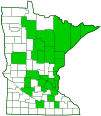
Crisped pincushion is a common, small to medium-sized moss. It occurs in Europe, Asia, and North America. In the United States and southern Canada, it occurs east of the Great Plains and on the West Coast, with disjunct populations around major metropolitan areas in between. It is common in Minnesota.
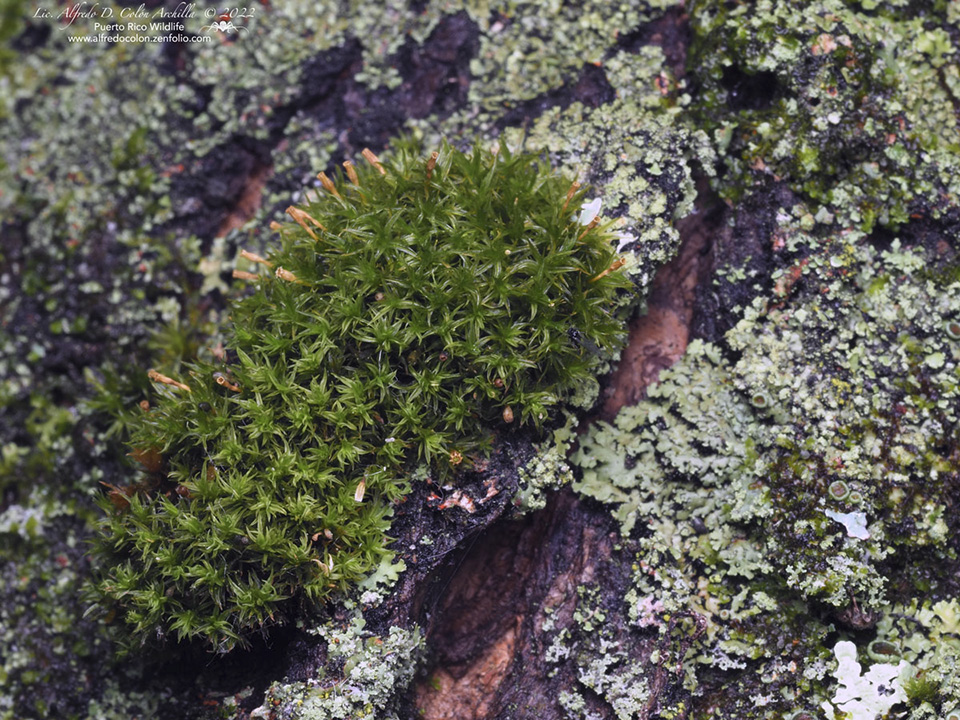
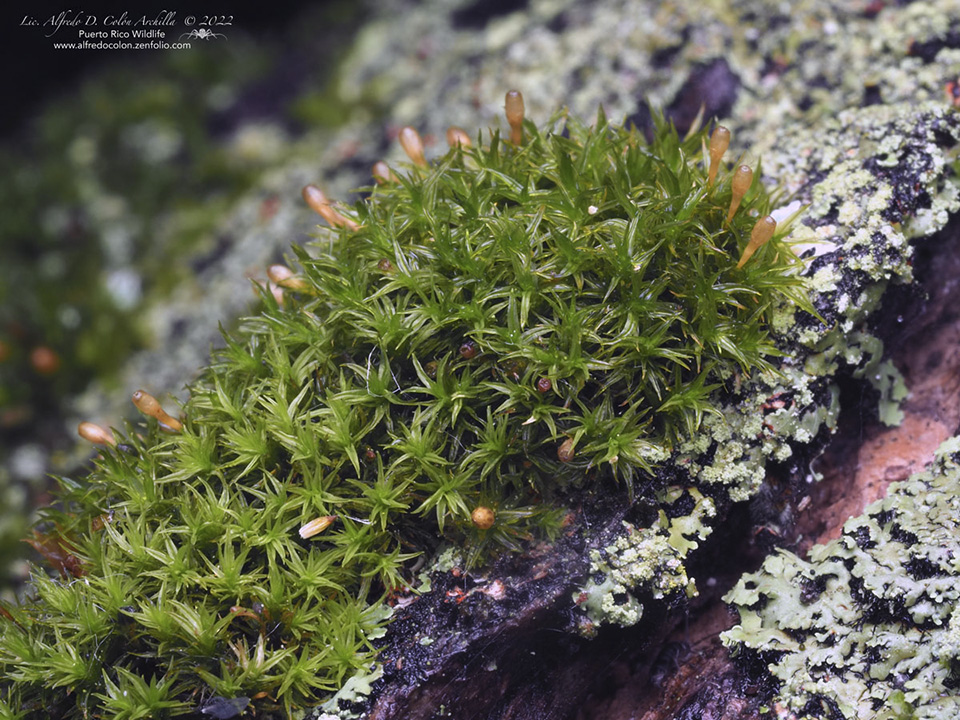
Crisped pincushion grows on the trunks of trees. It usually appears as a neat, dense, circular tuft ¾″ to 1″ (2.0 to 2.5 cm) in diameter, though it can spread out. If it grows larger it often merges with an adjacent tuft and the combined colony loses that perfectly round symmetry.
The stems are erect, 1⁄64″ to 1″ (0.5 to 2.5 cm) long, and sparsely branched.
The leaves are erect, narrowly lance-shaped to linear and 1⁄16″ to ⅛″ (1.7 to 3.0 mm) long. The base is broadened, egg-shaped, and concave, like a spoon; the tip is sharply pointed; and the margins are flat or bent downward (reflexed), at least near the base. The leaves are widely spreading when moist. When dry, they become very contorted, crisped, and twisted, but they do not wrap around the stem.
The fruiting body is a relatively large capsule on a relatively short stalk (seta). The seta is 1⁄32″ to ⅛″ (1.0 to 3.0 mm) long, raising the capsule slightly above the leaves. When young and moist, the capsule is short-oblong to oblong and green. The protective cap covering the young capsule (calyptra) is oblong, smooth, and hairy. The hairs on the calyptra extend upward, a distinguishing feature for the family Orthotrichaceae. At maturity, the calyptra drops away, revealing the bare capsule. The mature capsule is reddish brown, hairless, cylindrical, and 1⁄32″ to 1⁄16″ (0.8 to 2.0 mm) long. It has 8 strong ribs extending from the base for up to three-quarters of its length. The mouth is wide and the capsule is constricted below the mouth. Around the opening there are two rings of teeth, each with 8 teeth. The outer (exostome) teeth are lance-shaped, are covered with short, rounded bumps (papillae), and are bent backward (reflexed).
Growth Form
Acrocarpous
Height
Up to 1″ (2.5 cm)
Similar Species
Habitat
Tree trunks
Ecology
Phenology
Capsules mature year-round
Use
Distribution
Sources
Biodiversity occurrence data published by: Minnesota Biodiversity Atlas (accessed through the Minnesota Biodiversity Atlas Portal, bellatlas.umn.edu. Accessed 5/13/2026).
Midwest Herbaria Portal. 2026. https://midwestherbaria.org/portal/index.php. Accessed 5/13/2026.
Biodiversity occurrence data published by: Bryophyte Portal (accessed through the Bryophyte Portal Portal, https://bryophyteportal.org/portal). Accessed 5/13/2026.
Ulota crispa (Hedw.) Brid. in GBIF Secretariat (2023). GBIF Backbone Taxonomy. Checklist dataset https://doi.org/10.15468/39omei accessed via GBIF.org. Accessed 5/13/2026.
Janssens, Joannes A., and The Minnesota County Biological Survey, Minnesota Department of Natural Resources, State of Minnesota. County Atlas of Minnesota Mosses. May, 2000. www.dnr.state.mn.us/plants/flm/mossatlas/index.html.
Nativity
Native
Occurrence
Common
Taxonomy
Kingdom
Subkingdom
Bryobiotina (Non-vascular Plants)
Phylum
Class
Bryopsida (Joint-toothed Mosses)
Subclass
Bryidae
Superorder
Bryanae
Order
Orthotrichales
Family
Orthotrichaceae
Genus
Ulota
Subordinate Taxa
Synonyms
Bryum crispum
Grimmia sylvatica
Neckera ulophylla
Orthotrichum connectens
Orthotrichum crispum
Orthotrichum crispum var. macrocarpon
Orthotrichum crispum var. minus
Orthotrichum flexifolium
Orthotrichum ulophyllum
Systegium crispum
Ulota camptopoda
Ulota cervina
Ulota connectens
Ulota crispa ssp. crispa
Ulota crispa var. crispa
Ulota crispa var. propagulifera
Ulota crispa var. subcalvescens
Ulota laticiliata var. flexifolia
Ulota macrocarpa
Ulota ulophylla
Weissia crispa
Weissia crispula var. lutescens
Weissia ulophylla
Common Names
crisped pincushion
crisped pincushion moss
ulota moss