false spiraea - Species Profile
Conservation • Weed • Description • Habitat • Ecology • Use • Distribution • Taxonomy
Conservation Status
IUCN Red List
not listed
NatureServe
NNA - Not applicable
SNA - Not applicable
Minnesota
not listed
Weed Status
Sorbaria sorbifolia is listed as an invasive species in New Hampshire. It is not listed in Minnesota.
Description
False spiraea, also called ash-leaved spiraea or sorbaria, is a coarse, deciduous shrub native to eastern Russia, China, Japan, and Korea. Cultivated widely across Europe and North America as an ornamental, it frequently escapes to become naturalized and is occasionally invasive. In the United States, it is established from Maine to Virginia, west to Minnesota and Missouri, and from the Pacific Northwest east to Montana and Idaho. Outside of these core regions, it appears as sporadic escapes surrounding major urban centers. It also occurs across southern Canada and northward into Alaska.
False spiraea is found in meadows and fields, at forest edges, on riverbanks, along railroads, at old homesites, and in disturbed areas. It spreads rapidly by suckers, often forming large, dense colonies that crowd out native sun-loving plants. It is often planted on roadsides, where it helps to stabilize the soil, and at the edges of fields, where it acts as a hedgerow, a shelterbelt, and a windbreak. A garden-friendly cultivar called “Sem” is less aggressive and reaches no more than 3 to 4 feet in height. The foliage in the spring is fern-like and pink to red, later becoming chartreuse with bronze tips, and eventually solid green at maturity.
False spiraea is an erect, perennial shrub that rises on 1 to 10 or more stems from a dense, shallow root system and long, creeping, underground stems (rhizomes). It often forms dense colonies by producing aerial shoots (suckers) along the rhizomes.
The stems are erect to widely arching and sparsely branched. They may be 40″ to 120″ (100 to 300 cm) long, though they are usually no more than 80″ (200 cm) long. The bark is gray. When young, the stems are sparsely covered with fine, simple or star-shaped hairs. Mature stems are hairless or almost hairless. The leaf buds are egg-shaped and purplish brown.
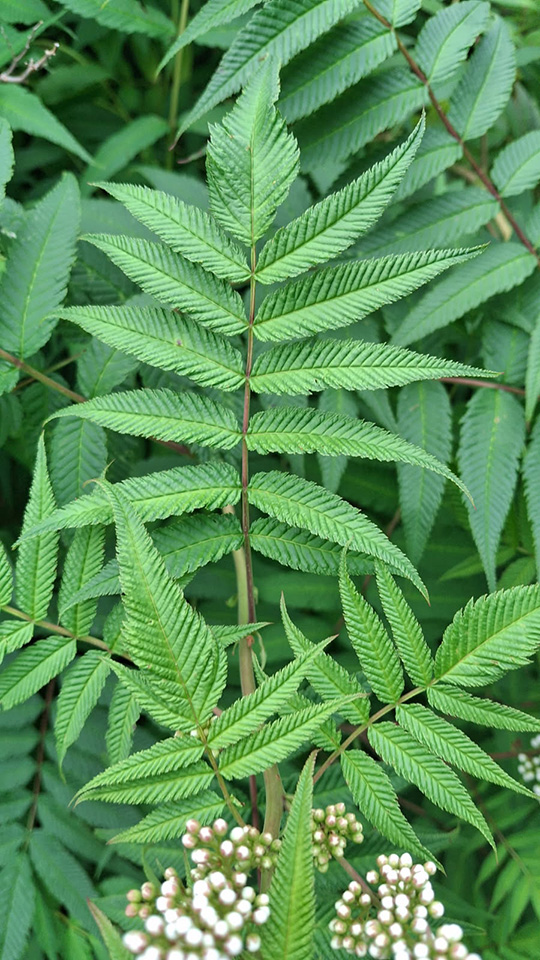
The leaves are 5½″ to 12″ (14 to 30 cm) long, 2″ to 6¾″ (5 to 17 cm) wide, oblong oval in outline, and stalked. They are pinnately compound, divided into usually 11 to 21 leaflets. At the base of each leaf there is a pair of persistent, small, leaf-like appendages (stipules).
The leaflets are oblong egg-shaped to elliptic and usually 1⅜″ to 3″ (35 to 75 mm) long, and ½″ to ¾″ (12 to 20 mm) wide. The upper surface has some simple hairs near the margins but is otherwise hairless. The lower surface may be hairless or sparsely covered with stalked star-like hairs. The leaves turn reddish in the fall.
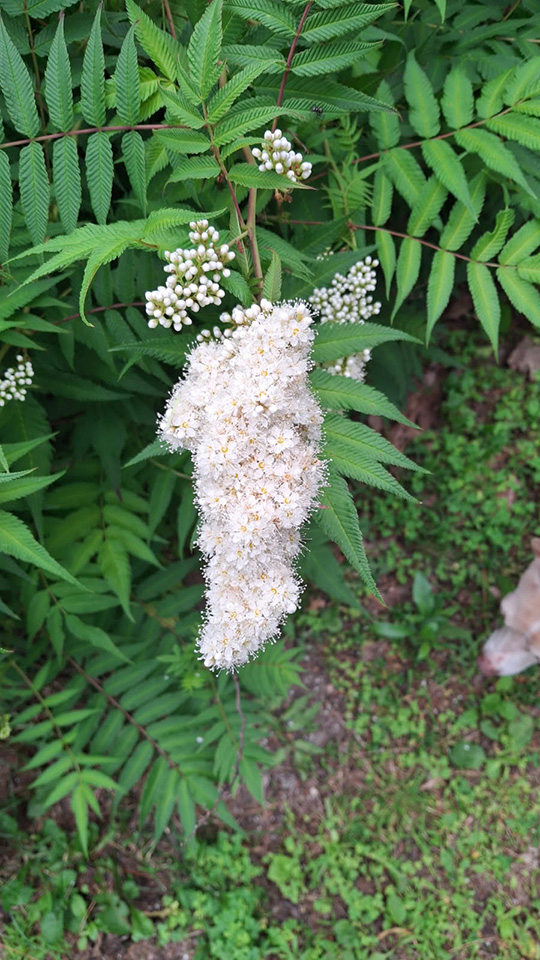
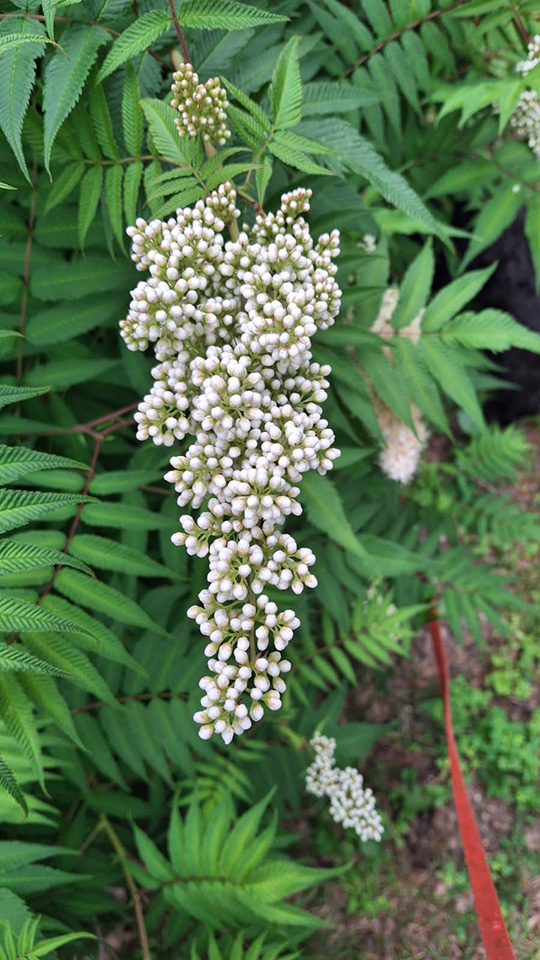
The inflorescence is a pyramid-shaped, dense, branched cluster (panicle) of 15 to 1,100 or more small flowers at the end of each branch. The panicle is usually 4″ to 6″ (10 to 15 cm) long and 1½″ to 2¾″ (4 to 7 cm) wide but it can be much larger. Large panicles hang downward. The flowers bloom in June and July.
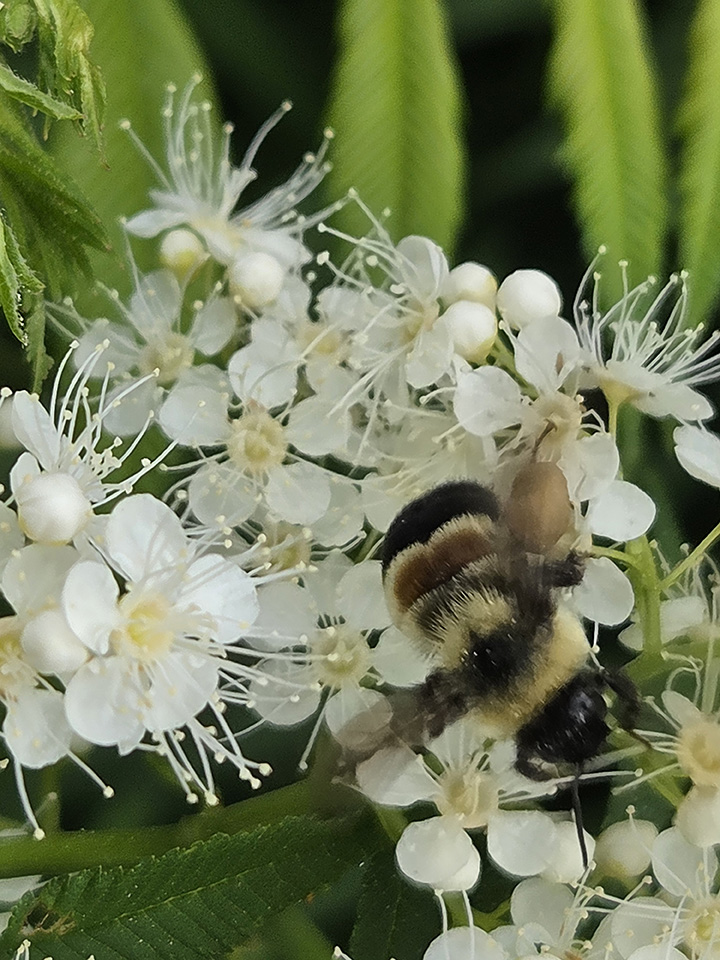
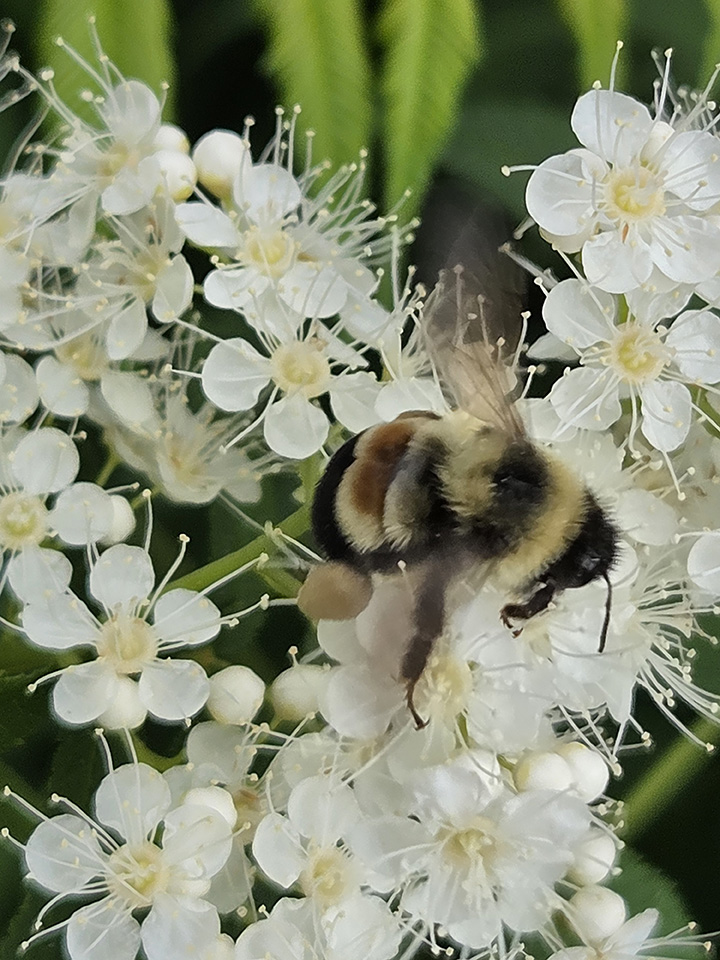
The flowers are ⅜″ to 9⁄16″ (10 to 14 mm) in diameter. Each flower has 5 outer floral leaves (sepals), 5 petals, 20 to 35 or more stamens, and 5 styles. The bases of the sepals, petals, and stamens are fused into a cup-like structure (hypanthium) at the base of the flower. The sepals are egg-shaped to oblong egg-shaped and are strongly bent backward (relfexed). The petals are white, ⅛″ (2.7 to 4.3 mm) long, 3⁄32″ to ⅛″ (2.1 to 3.4 mm) wide, egg-shaped to circular, and with an abruptly narrowed, short, stalk-like base (clawed). The stamens vary in length from 1⁄16″ to ¼″ (2 to 6.5 mm) on a single flower, most of them projecting well above the petals. The styles are 1⁄16″ to ⅛″ (1.3 to 3.5 mm) long.
The fruit is a dry, 3⁄16″ to ¼″ (4.5 to 6 mm) long pod (aggregate follicle) containing 4 to 8 seeds.
Height
40″ to 80″ (10 to 20 dm)
Flower Color
White
Similar Species
Habitat
Meadows, fields, forest edges, river banks, roadsides, railroads, old homesites, and disturbed areas.
Ecology
Flowering
June and July
Pests and Diseases
Use
Distribution
Sources
Biodiversity occurrence data published by: Minnesota Biodiversity Atlas (accessed through the Minnesota Biodiversity Atlas Portal, bellatlas.umn.edu.2026-07-12).
Consortium of Midwest Herbaria. 2026. https://midwestherbaria.org/portal/index.php. Accessed on July 12.
Sorbaria sorbifolia (L.) A.Braun in Bánki, O., Roskov, Y., Döring, M., Ower, G., Hernández Robles, D. R., Plata Corredor, C. A., Stjernegaard Jeppesen, T., Örn, A., Pape, T., Hobern, D., Garnett, S., Little, H., DeWalt, R. E., Miller, J., Orrell, T., Aalbu, R., Abbott, J., Abreu, C., Acero P, A., et al. (2026). Catalogue of Life (2026-06-19 XR). Catalogue of Life Foundation, Amsterdam, Netherlands. https://doi.org/10.48580/dgy8b
EDDMapS. 2026. Early Detection & Distribution Mapping System. The University of Georgia - Center for Invasive Species and Ecosystem Health. Available online at http://www.eddmaps.org/; last accessed July 12, 2026.
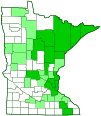
The counties in light green on the map represent citizen science observations from GBIF and Pl@ntNet, which may or may not be plants “outside of cultivation.”
Nativity
Native to Asia. Introduced, cultivated, and sometimes naturalized.
Occurrence
Taxonomy
Kingdom
Subkingdom
Pteridobiotina
Phylum
Tracheophyta (Vascular Plants)
Class
Order
Rosales
Family
Rosaceae
Subfamily
Amygdaloideae
Tribe
Sorbarieae
Genus
Sorbaria (Sorbaria)
Subordinate Taxa
Sorbaria sorbifolia var. glandulifolia
Sorbaria sorbifolia var. sorbifolia 
Sorbaria sorbifolia var. stellipila
Synonyms
Basilima sorbifolia
Schizonotus sorbifolius
Spiraea sorbifolia
Sorbaria sorbifolia var. glabra
Sorbaria sorbifolia var. glandulosa
Sorbaria sorbifolia var. typica
Spiraea floribunda
Spiraea pinnata
Spiraea sorbifolia var. sorbifolia
Common Names
ash-leaved spiraea
false spiraea
sorbaria