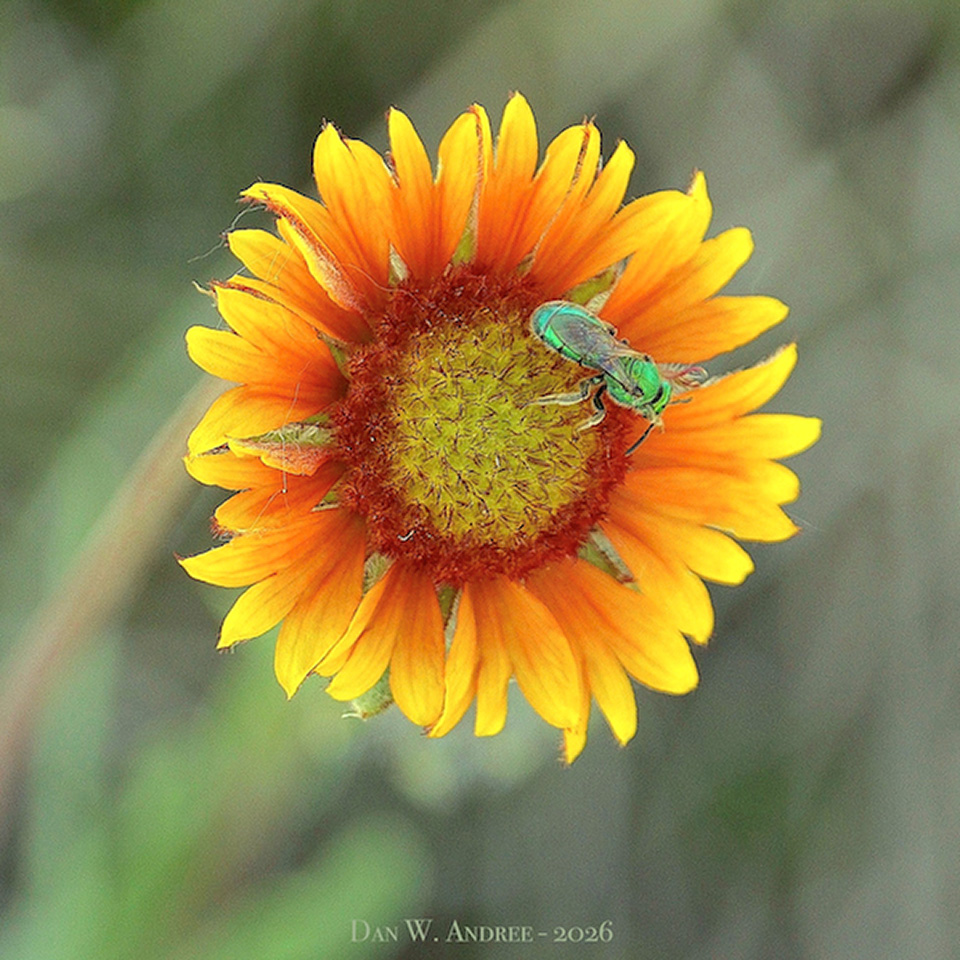
great blanketflower - Species Profile
Conservation • • Description • Habitat • Ecology • Use • Distribution • Taxonomy

Conservation Status
IUCN Red List
not listed
NatureServe
N3N5 - Vulnerable to Secure
S3 - Vulnerable
Minnesota
Special Concern
Description
Great blanketflower, more commonly known simply as blanketflower, is a native prairie wildflower. It occurs throughout the United States and southern Canada. It is native in the U.S. from Washington State to northern Oregon, east to northwestern Minnesota and Colorado. It is often cultivated. Where it occurs in other parts of the country it may have escaped cultivation and become naturalized.
Great blanketflower is found in open places, including prairies, meadows, and grassy forest openings. It is also frequently found on roadsides. It grows under full sun in dry, well drained, loamy, rocky, or gravelly-sandy soil.
Great blanketflower is an erect, perennial forb that rises usually on several stems from a slender taproot.
The stems are unbranched, hairy, and 8″ to 32″ (20 to 80 cm) tall.
There are leaves rising from the base (basal leaves) and stem leaves, but the leaves are mostly basal. Basal leaves have a 2″ to 6″ (5 to 15 cm) long, petiole-like (petiolar) base. The leaf blades are narrow, inversely lance shaped to lance shaped, 2″ to 6″ (5 to 15 cm) long, and 3⁄16″ to 1 3⁄16″ (5 to 30 mm) wide. They may be coarsely toothed, pinnately lobed (pinnatifid), or untoothed and unlobed (entire). Individual plants often have all of these – entire leaves, lobed leaves, and leaves with a few coarse teeth. The upper and lower surfaces may be rough to the touch due to minute, stiff hairs, or be sparsely to densely covered with angled (jointed) hairs. Stem leaves are alternate. They are similar to basal leaves but smaller.
The inflorescence is usually a single flower head, sometimes 2 or more flower heads, each one on a leafless, 8″ to 14″ (20 to 35 mm) long or longer flower stalk (peduncle) at the end of each stem.
There is a hemispherical, ⅜″ to ¾″ (9 to 30 mm) in diameter whorl (involucre) of 24 to 40 or more bracts (phyllaries) at the base of the flower head. The phyllaries are ⅜″ to ⅝″ (10 to 15 mm) long. They are egg shaped to lance shaped and are gradually tapered to a narrow tip. The margins have a fringe of hairs (ciliate). The surface is covered with straight, stiff, sharp, appressed hairs, and it is dotted with glands.
The flower head has 12 to 18 or more ray florets and a disc with 60 to 120 or more disc florets. The ray florets are ⅝″ to 1⅜″ (15 to 35 mm) long or longer and are cut into three lobes at the tip. They are yellow and are usually reddish purple at the base. At least the outer half of the ray is yellow or yellow tinged with red. The disc florets are usually reddish purple, at least at the tip, but they are sometimes entirely yellow. They are tubular, with a 1⁄64″ to 1⁄16″ (0.5 to 1.5 mm) long throat, a 3⁄16″ (4.5 to 5.5 mm) long tube, and five 1⁄32″ to 1⁄16″ (1 to 2 mm) long lobes.
The fruit is a dry, ⅛″ to ¼″ (2.5 to 6 mm) long seed capsule (cypsela) with a single seed. The inner cypsela are inversely pyramidal, the outer ones are club-shaped, widest at the tip. There are 8 egg-shaped to lance-shaped, bristle-like scales (pappus) attached to the broad end.
Height
8″ to 28″
Flower Color
Yellow or yellow and purple ray florets, purplish-red disk florets
Similar Species
Indian blanket (Gaillardia pulchella var. pulchella) ray florets are purple from the base for at least half of their length. The achenes are much shorter.
Habitat
Dry. Prairie. Full sun.
Ecology
Flowering
Early June to mid-August
Pests and Diseases
Use
Distribution

Sources
Biodiversity occurrence data published by: Minnesota Biodiversity Atlas (accessed through the Minnesota Biodiversity Atlas Portal, bellatlas.umn.edu. Accessed 7/17/2024).
Midwest Herbaria Portal. 2026. https://midwestherbaria.org/portal/index.php. Accessed 7/17/2024.
Gaillardia aristata Pursh in GBIF Secretariat (2023). GBIF Backbone Taxonomy. Checklist dataset https://doi.org/10.15468/39omei accessed via GBIF.org. Accessed 7/17/2024.
Minnesota Department of Natural Resources, Division of Ecological Resources. 2008. Rare Species Guide: An online encyclopedia of Minnesota’s rare native plants and animals. Minnesota Department of Natural Resources, St. Paul, Minnesota. www.dnr.state.mn.us/rsg/index.html.
Nativity
Native
Occurrence
Uncommon in Minnesota
Taxonomy
Kingdom
Subkingdom
Pteridobiotina
Phylum
Tracheophyta (Vascular Plants)
Class
Order
Asterales (Sunflowers, Bellflowers, Fanflowers, and Allies)
Family
Asteraceae (Sunflowers, Daisies, Asters, and Allies)
Subfamily
Asteroideae
Tribe
Helenieae
Subtribe
Gaillardiinae
Genus
Gaillardia (Blanketflowers)
Subordinate Taxa
Synonyms
Galardia aristata
Gaillardia bicolor
Gaillardia bicolor var. aristata
Gaillardia bracteosa
Gaillardia hallii
Gaillardia perennis
Gaillardia richardsonii
Gaillardia roezli
Gaillardia rustica
Polatherus scaber
Virgilia grandiflora
Common Names
annual gaillardia
blanket flower
blanketflower
common blanketflower
common blanket-flower
common gaillardia
fire-wheel
fire-wheel blanket-flower
gaillardia
great blanketflower
great blanket-flower
great-flowered gaillardia
Indian blanket flower
rose-ring blanket-flower
rose-ring gaillardia