pearly everlasting - Species Profile
Conservation • Wetland • Description • Habitat • Ecology • Use • Distribution • Taxonomy

Conservation Status
IUCN Red List
not listed
NatureServe
N4N5 - Apparently Secure to Secure
SNR - Unranked
Minnesota
not listed
Wetland Indicator Status
Great Plains
FACU - Facultative upland
Midwest
FACU - Facultative upland
Northcentral & Northeast
FACU - Facultative upland
Description
Pearly everlasting is a 8″ to 32″ tall, erect, perennial forb that rises usually on a single stem from a slender, horizontal, underground stem (rhizome) and fibrous roots.
The stems are very leafy, usually erect, and often branched. They are densely and closely covered with white, woolly hairs. As the stem ages the hairs become tan to rust colored and less dense. There are no glands on the stem. The sap is not milky. The plant is not aromatic.
Stem leaves are alternate, numerous, stalkless, and linear to lance-shaped. Lower stem leaves are up to 4¾″ long and up to about ⅝″ wide. The leaf blade is bluntly to sharply pointed at the tip. It is wedge-shaped and sometimes slightly expanded and clasping at the base. The base of the blade extends down the stem. There is a prominent central vein and two faint lateral veins that arch toward the tip. The lower surface is densely covered with white woolly hairs, becoming less hairy with age. The upper surface is dark green and usually less hairy, becoming almost hairless with age. There are no glands on the leaf surfaces, or, if present, the glands are very sparse and inconspicuous. The margins are untoothed and are sometimes curled under.
Basal leaves are similar in size and shape to lower stem leaves. They are usually absent by flowering time.
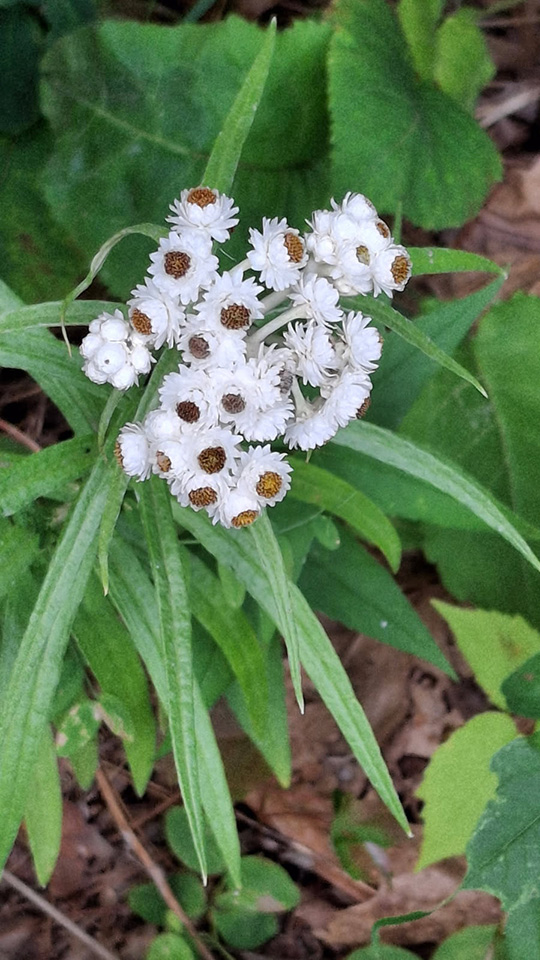
The inflorescence is a short, broad, rounded to almost flat-topped, branched cluster (panicle) of numerous crowded flower heads at the end of the stem and branches. The individual flower heads are no more than ⅜″ wide. They are globe-shaped and are on ⅛″ to 5 ⁄16″ long, densely hairy stalks. Male (staminate) and female (pistillate) flowers are borne on separate plants. Female flower heads usually have a few staminate flowers, however the plants are not self-fertile. Separate male and female plants must be present to produce seed.
The base of the flower head (involucre) is broadly egg-shaped to cup shaped and 3 ⁄16″ to ¼″ high. It is composed of 8 to 12 overlapping series of modified leaves (bracts). The involucral bracts (phyllaries) are egg-shaped to nearly linear, mostly bluntly pointed at the tip, and mostly loosely appressed. They are bright white, opaque, and usually slightly shiny, at least above the middle, and brownish at the base. When the pistillate flower is in fruit the bracts dry and spread widely.
Female flower heads have a compact disk-like arrangement of 50 to 150 or more pistillate flowers and usually 2 to 4 staminate flowers at the center. The flowers are yellow to greenish-yellow. Male flower heads have 30 to 55 all staminate flowers.
The fruit is a dry, brown, one-seeded, 1 ⁄64″ to 1 ⁄32″ long seed capsule (cypsela) with a tuft of 10 to 20 short bristles (pappus) attached to the end. The pappi fall off readily.
Height
8″ to 32″
Flower Color
White bracts, yellowish disk
Similar Species
Rabbit-tobacco (Pseudognaphalium obtusifolium) flower heads are narrow, twice as long as wide. All flower heads have marginal pistillate flowers and central perfect (with both staminate and pistillate parts) flowers.
Habitat
Dry. Woodland and forest edges and openings, fields, roadsides, and other disturbed sites. Full sun to partial shade.
Ecology
Flowering
July to September
Pests and Diseases
Use
Distribution

Sources
Biodiversity occurrence data published by: Minnesota Biodiversity Atlas (accessed through the Minnesota Biodiversity Atlas Portal, bellatlas.umn.edu. Accessed 8/6/2026).
Midwest Herbaria Portal. 2026. https://midwestherbaria.org/portal/index.php. Accessed 8/6/2026.
Anaphalis margaritacea (L.) Benth. in Bánki, O., Roskov, Y., Döring, M., Ower, G., Hernández Robles, D. R., Plata Corredor, C. A., Stjernegaard Jeppesen, T., Örn, A., Pape, T., Hobern, D., Garnett, S., Little, H., DeWalt, R. E., Miller, J., Orrell, T., Aalbu, R., Abbott, J., Abreu, C., Acero P, A., et al. (2026). Catalogue of Life (2026-07-17 XR). Catalogue of Life Foundation, Amsterdam, Netherlands. https://doi.org/10.48580/dgykv
Nativity
Native
Occurrence
Common
Taxonomy
Kingdom
Subkingdom
Pteridobiotina
Phylum
Tracheophyta (Vascular Plants)
Class
Order
Asterales (Sunflowers, Bellflowers, Fanflowers, and Allies)
Family
Asteraceae (Sunflowers, Daisies, Asters, and Allies)
Subfamily
Asteroideae
Tribe
Gnaphalieae (Paper Daisies)
Subtribe
Gnaphaliinae (Cudweeds, Everlastings, and Pussytoes)
Genus
Anaphalis (Everlastings)
Two subspecies and five varieties of Anaphalis margaritacea have been described. Only ssp. margaritacea, the nominate subspecies, occurs in North America.
Many sources, including ITIS, GRIN, USDA Plants, and Flora of North America, omit the subspecies or variety in the scientific name if the nominate species or variety is the only one occurring in North America.
Subordinate Taxa
Anaphalis margaritacea ssp. margaritacea 

Anaphalis margaritacea var. angustifolia
Anaphalis margaritacea var. cinnamomea
Anaphalis margaritacea var. margaritacea
Anaphalis margaritacea var. yedoensis
Synonyms
Anaphalis angustifolia
Anaphalis cinnamomea var. angustior
Anaphalis cinnamomea var. cinnamomea
Anaphalis cinnomomea
Anaphalis lanata
Anaphalis margaritacea ssp. angustior
Anaphalis margaritacea var. angustior
Anaphalis margaritacea var. intercedens
Anaphalis margaritacea var. occidentalis
Anaphalis margaritacea var. revoluta
Anaphalis margaritacea var. subalpina
Anaphalis occidentalis
Anaphalis sierrae
Anaphalis subalpina
Anaphalis timmua
Antennaria cinnamomea
Antennaria cinnamomea var. angustior
Antennaria cinnamomea var. cinnamomea
Antennaria margaritacea
Antennaria margaritacea var. margaritacea
Antennaria margaritacea var. subalpina
Antennaria plantaginea
Antennaria timmua
Chamaezelum margaritaceum
Gnaphalium americanum
Gnaphalium boreale
Gnaphalium hypophaeum
Gnaphalium margaritaceum
Gnaphalium margaritaceum var. margaritaceum
Gnaphalium margaritaceum var. timua
Gnaphalium timmua
Helichrysum margaritaceum
Margaritaria ramosa
Nacrea lanata
Common Names
Marguerite
pearly everlasting
western pearly everlasting
whitemargin pussytoes