starry bristle moss - Species Profile
Conservation • Description • Habitat • Ecology • Use • Distribution • Taxonomy
Conservation Status
IUCN Red List
not listed (U.S.)
VU - Vulnerable (Europe)
NatureServe
NNR - Unranked
SNR - Unranked
Minnesota
not listed
Description
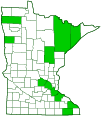
Starry bristle moss is a common, usually small, sometimes large, tuft-forming (acrocarpous) moss. It occurs in the United States from Maine to South Carolina, west to Minnesota and Arkansas, and in southern Canada from Nova Scotia west to Ontario. It also occurs in Europe, where it is rated by The IUCN Red List of Threatened Species as vulnerable.
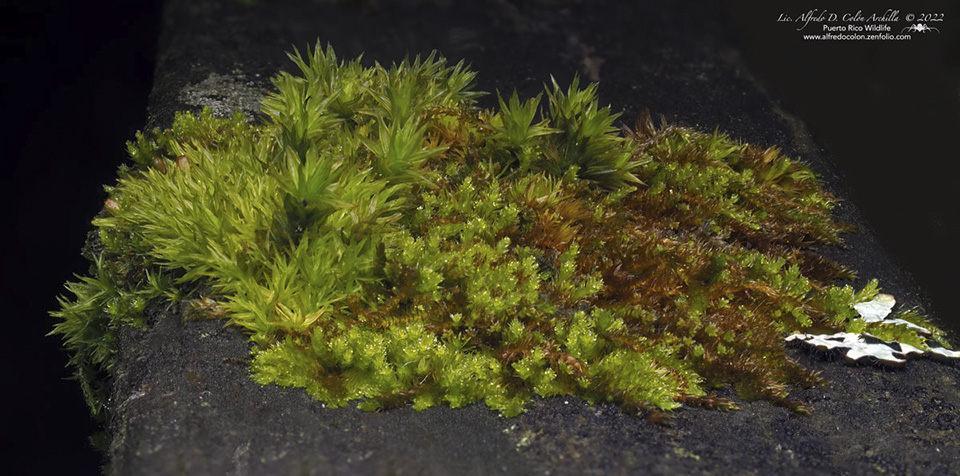
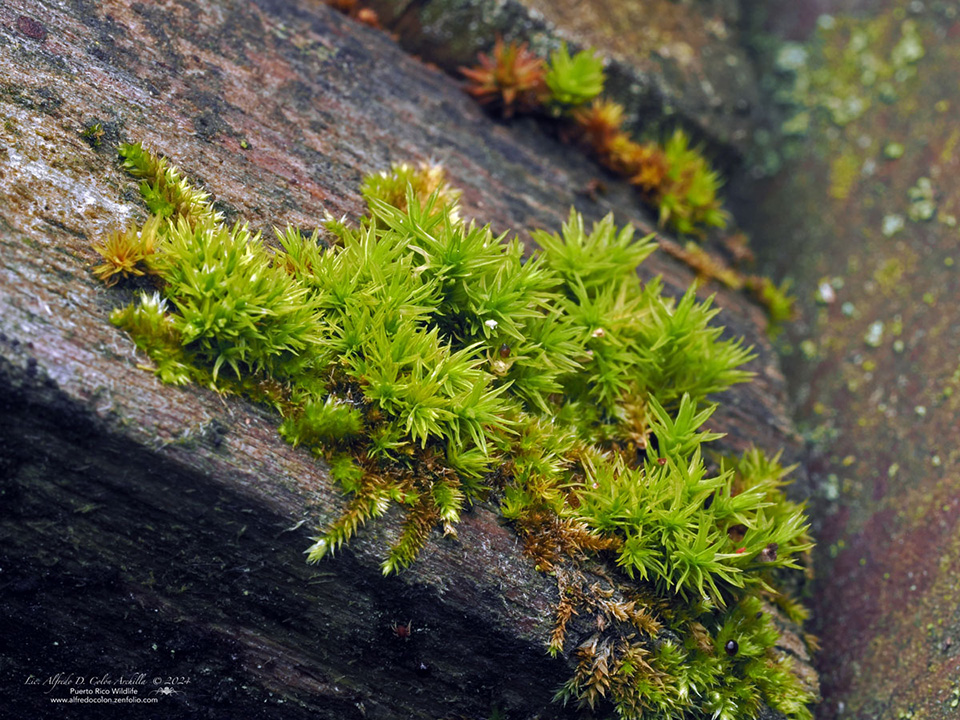
Starry bristle moss is found in moist forests on the bark of hardwood trees (corticolous) and occasionally on debarked (lignicolous) wood, including logs and timber structures. It appears as a small, dense, tuft or cushion of plants held to each other and to the substrate by brown, root-like filaments (rhizoids).
The stems are erect, ⅛″ to 5⁄16″ (3 to 8 mm) long, and branched. The branches may be upright and close to the stem (fastigiate) or grow outward at the base and curve upward (ascending).
The leaves are green, lance-shaped to oblong lance shaped, 1⁄16″ (1.8 to 2.2 mm) long, and up to 1⁄64″ (0.5 mm) wide. The tips are narrowly blunt to sharply pointed. The midvein (costa) is thick near the base and ends before the tip. The margins are untoothed (entire) and are curved inward only on the middle of the leaf, not at the tip. The leaves are arranged in a tight spiral around the stem. When moist, they spread widely, curve upwards, and radiate in all directions, giving the plant the appearance of a star when viewed from above. This is the feature that gives the species its common name. When dry, the leaves fold upward and are appressed to the stem, which then appears dark.
The fruiting body is a relatively large capsule on a short, 1⁄64″ to 1⁄32″ (0.4 to 1.0 mm) long stalk (seta). The capsule is hairless (smooth) and it has 8 or 16 prominent, longitudinal ribs. It is positioned low in the leaves, not overtopping the leaves (emersed) or barely overtopping the leaves (slightly exserted). When young and moist, it is globe-shaped to cylindric and green, soon becoming straw-colored to reddish-brown. The protective cap covering the young capsule (calyptra) is oblong, smooth, and hairless or sparsely hairy. When mature and dry, the capsule is reddish brown, cylindrical, and partially exserted. It is strongly contracted below the mouth, and below the constriction it is narrower than the opening of the mouth.
Growth Form
Acrocarpous
Height
Similar Species
Habitat
Moist forests on hardwoods
Ecology
Phenology
Capsules mature in spring and summer.
Use
Distribution
Sources
Biodiversity occurrence data published by: Minnesota Biodiversity Atlas (accessed through the Minnesota Biodiversity Atlas Portal, bellatlas.umn.edu. Accessed 5/5/2026).
Midwest Herbaria Portal. 2026. https://midwestherbaria.org/portal/index.php. Accessed 5/5/2026.
Biodiversity occurrence data published by: Bryophyte Portal (accessed through the Bryophyte Portal Portal, https://bryophyteportal.org/portal). Accessed 5/5/2026.
Orthotrichum stellatum Brid. in GBIF Secretariat (2023). GBIF Backbone Taxonomy. Checklist dataset https://doi.org/10.15468/39omei accessed via GBIF.org. Accessed 5/5/2026.
Janssens, Joannes A., and The Minnesota County Biological Survey, Minnesota Department of Natural Resources, State of Minnesota. County Atlas of Minnesota Mosses. May, 2000. www.dnr.state.mn.us/plants/flm/mossatlas/index.html.
Nativity
Native
Occurrence
Common
Taxonomy
Kingdom
Subkingdom
Bryobiotina (Non-vascular Plants)
Phylum
Class
Bryopsida (Joint-toothed Mosses)
Subclass
Bryidae
Superorder
Bryanae
Order
Orthotrichales
Family
Orthotrichaceae
Genus
Orthotrichum
Subordinate Taxa
Synonyms
Orthotrichum braunii
Orthotrichum strangulatum var. stellatum
Common Names
bald bristle moss
star bristle moss
starry bristle moss
stellate orthotrichum moss