western Canada violet - Species Profile
Conservation • Wetland • Description • Habitat • Ecology • Use • Distribution • Taxonomy

Conservation Status
IUCN Red List
not listed
NatureServe
NNR - Unranked
SNR - Unranked
Minnesota
not listed
Wetland Indicator Status
Great Plains
FACU - Facultative upland
Midwest
FACU - Facultative upland
Northcentral & Northeast
FACU - Facultative upland
Description
Western Canada violet, also called creepingroot violet, is a 8″ to 16″ tall, erect, perennial forb that rises from superficial underground stems (rhizomes). It is colonial by producing above-ground horizontal stems (stolons) that creep along the ground, rooting and sending up new plants at the nodes.
The stems are erect, leafy, and usually hairy. Leaves and flowers appear on the same stem.
Basal leaves large and on long stalks. They are heart-shaped at the base and taper to a point at the tip with straight sides along the tip. Stem leaves are alternate and are similar to the basal leaves only narrower. They are 2″ to 4″ long and usually wider than they are long. Lower stem leaves are widely spaced. Upper stem leaves are larger and more densely crowded. There are small, lance egg-shaped, untoothed stipules at the base of the flower stalks.
The inflorescence is a single flower rising on a slender stalk rising from the upper leaf axils.
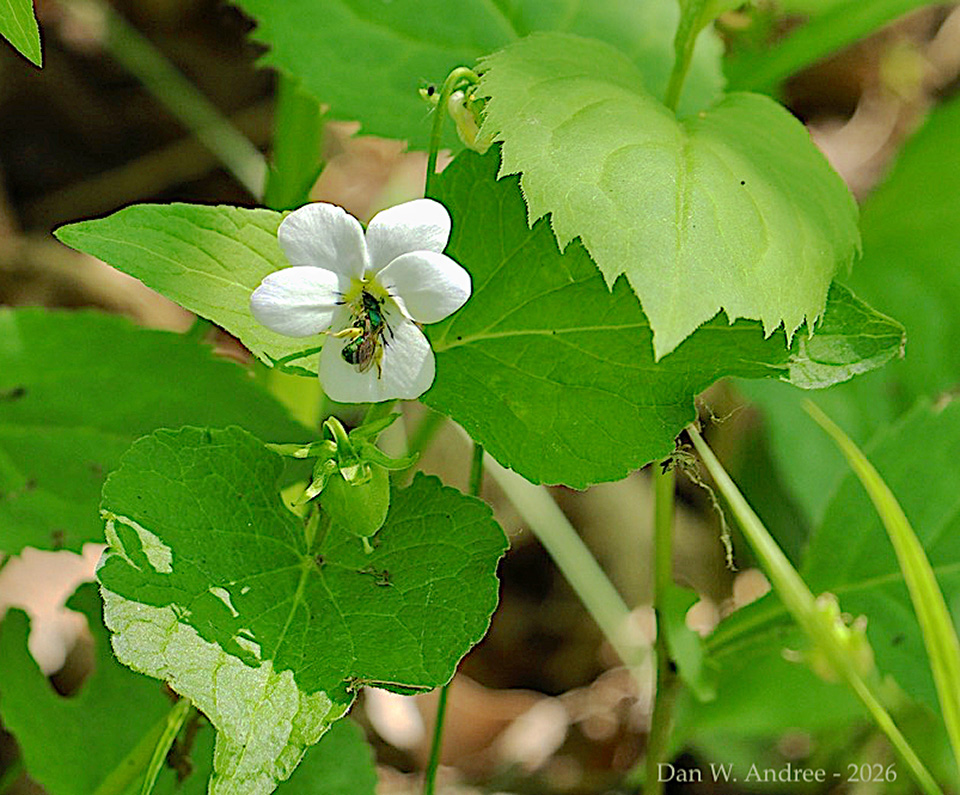
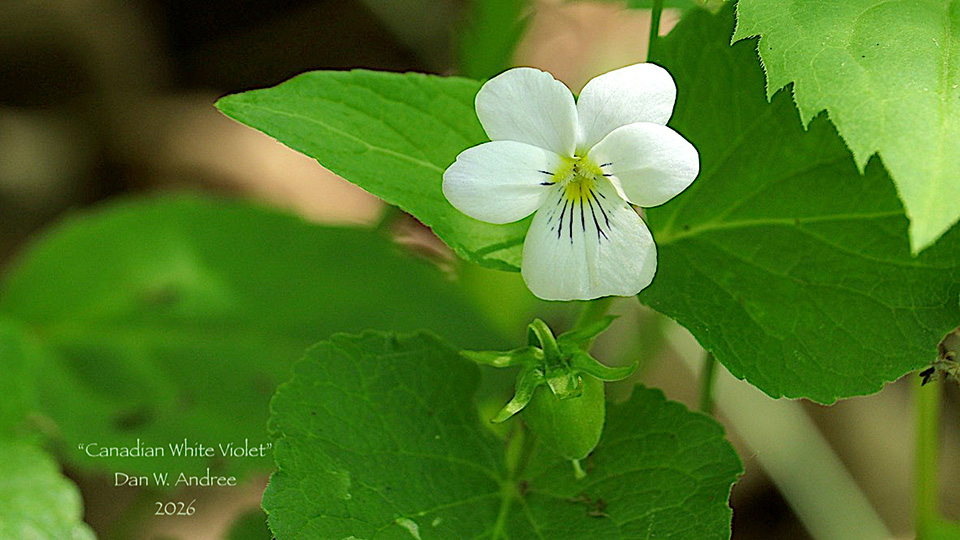
The flowers are 1″ to 1½″ wide. There are 5 white petals in an arranged typical of violets, two upper, two lateral, and a broad lower lip. The petals are yellow near the center. The lateral and lower petals have dark purple veins near the center. The lateral petals have tufts of hair near the center (bearded). All petals, but especially the two upper ones, are purplish on the outside.
The fruit is a capsule just under ½″ long. When the plant is in fruit the stipules dry and translucent.
Height
8″ to 16″
Flower Color
White with yellow centers
Similar Species
Habitat
Moderate moisture. Woods.
Ecology
Flowering
April to June
Pests and Diseases
Use
Distribution

Sources
Biodiversity occurrence data published by: Minnesota Biodiversity Atlas (accessed through the Minnesota Biodiversity Atlas Portal, bellatlas.umn.edu. Accessed 5/21/2025).
Midwest Herbaria Portal. 2026. https://midwestherbaria.org/portal/index.php. Accessed 5/21/2025.
Viola rugulosa Greene in GBIF Secretariat (2023). GBIF Backbone Taxonomy. Checklist dataset https://doi.org/10.15468/39omei accessed via GBIF.org. Accessed 5/21/2025.
Nativity
Native
Occurrence
Common
Taxonomy
Kingdom
Subkingdom
Pteridobiotina
Phylum
Tracheophyta (Vascular Plants)
Class
Order
Malpighiales (Nances, Willows, and Allies)
Family
Violaceae (Violet)
Subfamily
Violoideae
Tribe
Violeae
Genus
Viola (Violets)
Subgenus
Viola (Pansies and Violets)
Section
Chamaemelanium
Subsection
Canadenses
Species
Viola canadensis (Canada violet)
Species or subspecies?
A recent omprehensive taxonomic treatment of northeastern U.S. and Canadian violets (Ballard, 2020) proposed segregating Viola rugulosa from Viola canadensis as a distinct evolutionary species. The reasons given are persuasive, and the separation has been adopted just a few sources, but not by most. GBIF, Catalog of Life, and Plants of the World Online use the name Viola rugulosa. ITIS, GRIN, USDA PLANTS, NatureServe, iNaturalist, Flora of North America, and World Flora Online use the name Viola canadensis var. rugulosa.
Subordinate Taxa
Synonyms
Lophion rugulosum
Viola rugulosa
Common Names
Canada violet
Canadian violet
Canadian white violet
creeping-root violet
creepingroot violet
rugose violet
tall white violet
tall-white violet
western Canada violet
western Canada white violet
western tall white violet