wintergreen - Species Profile
Conservation • Wetland • Description • Habitat • Ecology • Use • Distribution • Taxonomy
Conservation Status
IUCN Red List
not listed
NatureServe
N5 - Secure
SNR - Unranked
Minnesota
not listed
Wetland Indicator Status
Great Plains
FACU - Facultative upland
Midwest
FACU - Facultative upland
Northcentral & Northeast
FACU - Facultative upland
Description
Wintergreen is a slow-growing, perennial, evergreen, 2″ to 8″ tall, dwarf shrub. It is common in most of its range from Maine to Minnesota and south along the Appalachian Mountains to Georgia. It is fairly common in northeast and northcentral Minnesota. It grows in dry or moist woodlands, in partial sun or light shade, in nutrient poor, acidic soil. It does not tolerate alkalinity and does not form mats.
Ascending branches rise from a creeping, woody, horizontal stem (rhizome). The rhizome may lay on the soil surface or be buried ¾″ to 1¼″ below it. The branches are themselves sparingly branched. They are semi-woody, light green or red, and either covered with white woolly hairs or almost hairless.
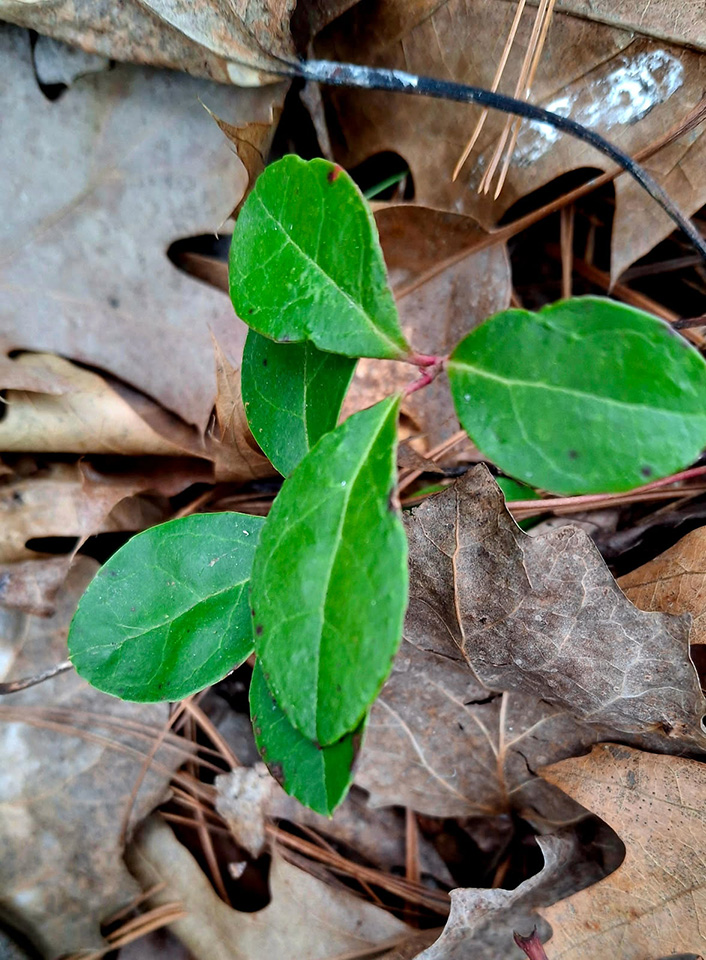
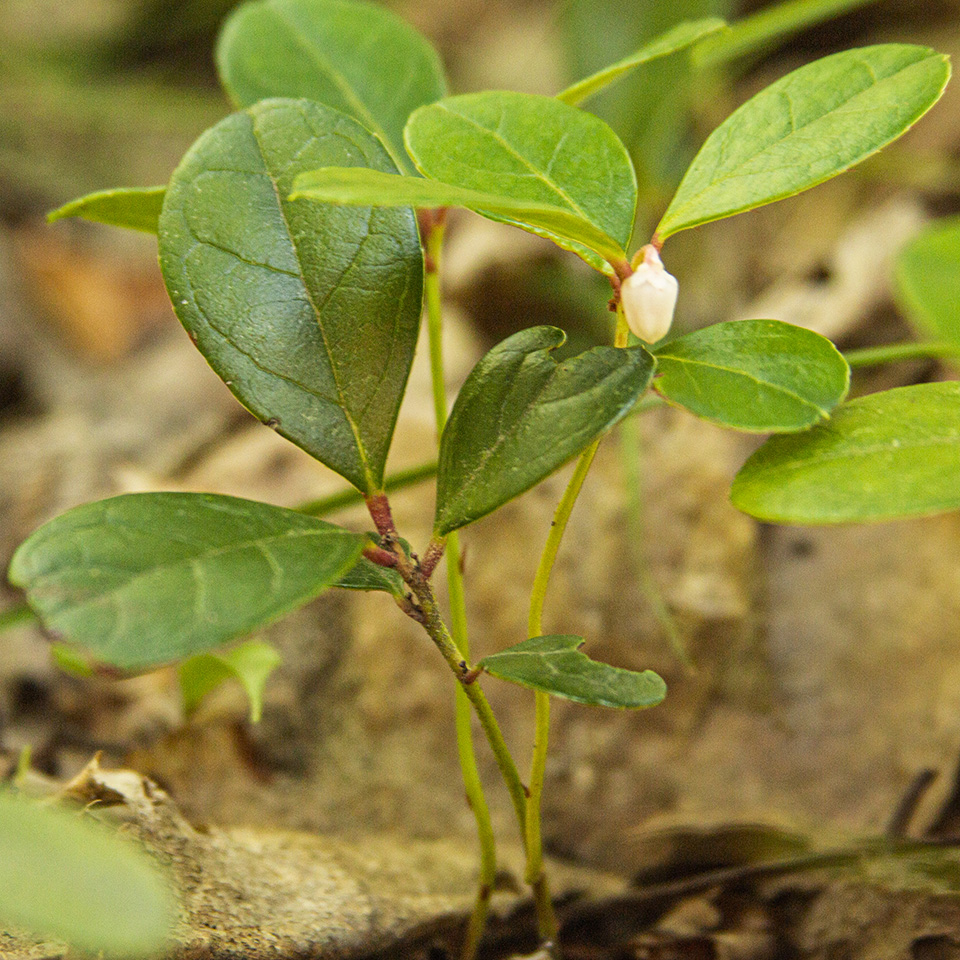
Two to five leaves are crowded at the end of each branch. The leaves are alternate, evergreen, ¾″ to 1¾″ long, and ⅝″ to 1″ wide. They are on light green or red, 1 ⁄16″ to 3 ⁄16″ long leaf stalks (petioles). The leaf blades are inversely egg-shaped, oval, elliptic, or rarely almost round. They are broadly or narrowly angled at the base and broadly angled or rounded at the tip. The upper surface is bright green or dark green, shiny, and hairless. The lower surface is pale green, hairless, and and covered with a whitish, waxy bloom (glaucous). The margins are slightly rolled backward toward the underside. They have widely-spaced teeth that are tipped with a bristle. The leaves have a minty (wintergreen) fragrance and taste. They turn purplish-red in winter,
The inflorescence is two or three flowers, each arising singly from an upper leaf axil. They droop at the end of a pinkish, hairy, 3 ⁄16″ to ⅜″ long flower stalk.
The flowers are about 5 ⁄16″ long and urn-shaped to broadly cylinder-shaped. They have have 5 sepals, 5 petals, 10 stamens, and 1 style. The sepals are white and much smaller than the petals. They are fused at their base and for more than half of their length into a saucer-shaped calyx, then separated into 5 lobes at the tip. The petals are white and 5 ⁄16″ to ⅜″ long. They are fused at the base and for almost their entire length, then separated at the tip into 5 very short rounded lobes. The stamens have pinkish stalks (filaments) and yellow forked anthers.
After the flower is fertilized, the petals turn brownish and drop off as a unit, leaving the developing fruit and a very long style. When ripe, the fruit is a bright red, ¼″ to ⅜″ in diameter, berry-like capsule that tastes like wintergreen. It has 20 to 80 seeds and often remains on the plant through winter.
Height
2″ to 8″
Flower Color
White
Similar Species
Habitat
Dry or moist. Forests, woodlands, bogs, and fens. Partial sun or light shade. Acidic soil.
Ecology
Flowering
Mid-June to late August
Pests and Diseases
Toxicity
Wintergreen contains the aromatic compound methyl salicylate. In the past, oil of wintergreen has been used as a natural flavor in chewing gum, candy, soft drinks, toothpaste, and snuff. Dried leaves have been used to make tea, giving it another common name “teaberry”. In large amounts oil of wintergreen is toxic. Today, methyl salicylate is produced artificially for commercial uses.
Use
Distribution

Sources
Biodiversity occurrence data published by: Minnesota Biodiversity Atlas (accessed through the Minnesota Biodiversity Atlas Portal, bellatlas.umn.edu. Accessed 4/20/2026).
Midwest Herbaria Portal. 2026. https://midwestherbaria.org/portal/index.php. Accessed 4/20/2026.
Gaultheria procumbens L. in GBIF Secretariat (2023). GBIF Backbone Taxonomy. Checklist dataset https://doi.org/10.15468/39omei accessed via GBIF.org. Accessed 4/20/2026.
Smith, Welby R. 2008. Trees and Shrubs of Minnesota: The Complete Guide to Species Identification. The University of Minnesota Press, Minneapolis, MN.
Nativity
Native
Occurrence
Common in northeastern and north-central Minnesota
Taxonomy
Kingdom
Subkingdom
Pteridobiotina
Phylum
Tracheophyta (Vascular Plants)
Class
Subclass
Dilleniidae
Order
Ericales (Heathers, Balsams, Primroses, and Allies)
Family
Ericaceae (Heath)
Subfamily
Vaccinioideae (Blueberries, Cranberries, Huckleberries, and Allies)
Tribe
Gaultherieae
Genus
Gaultheria (Wintergreens)
Synonyms
Brossaea procumbens
Gaultheria humilis
Gaultheria repens
Gautiera procumbens
Common Names
American wintergreen
checkerberry
creeping wintergreen
eastern teaberry
eastern wintergreen
mountain-tea
teaberry
wintergreen