Red-bellied Snake - Species Profile
Conservation • Description • Habitat • Ecology • Distribution • Taxonomy

Conservation Status
IUCN Red List
LC - Least Concern
NatureServe
N5 - Secure
S5 - Secure
Minnesota
not listed
Description
Red-bellied Snake is a small, nonvenomous, snake, the smallest snake found in Minnesota.
Adults can be 7″ to 16″ in length at maturity, though in the Upper Midwest they are described as being no more than 10″ long. Seen from above, these snakes are highly variable in appearance. They can be chestnut brown, olive-brown, tannish-brown, grayish-brown, gray, or black, but they fall generally into two color “phases”. The brown phase is brown to reddish brown or tan above (dorsally) with a broad pale mid-dorsal stripe bordered with narrow darker stripes. The gray phase has a medium gray background; a broad, light or medium gray mid-dorsal stripe bordered by narrow darker stripes; and a similar dark stripe on each side above the belly scales. Rarely, an individual will be mostly black.
The northern Red-bellied Snake has three pale spots at the nape of the neck, one above and one on each side. The Black Hills Red-bellied Snake has small faint spots or no spots at all. The head is usually darker than the rest of the body above and white below with a white neck.
The upper (dorsal) and lateral scales have a narrow, pale, raised ridge (keel) along the centerline. There are 15 rows of dorsal and lateral scales on the midbody. The anal plate is divided.
The belly is usually bright red. It is sometimes orange, salmon-colored, or pink, but it is always unmarked.
Size
Total length: 7″ to 10″
Similar Species
Dekay’s Brownsnake (Storeria dekayi) can be up to 18″ long. The middorsal stripe is bordered with a row of black spots. The belly is cream-colored or pinkish-white.
Habitat
Moist woodlands and areas adjacent to moist woodlands, lumber piles, trash dumps.
Ecology
Behavior
Individuals hide from predators under logs, rocks, and leaf litter.
Lifespan
Up to 4 years in captivity
Life Cycle
Adults usually mate in the spring or early summer. The female gives live birth to usually 7 or 8 but up to 23 live young. The offspring become sexually mature in their second year. In the winter they congregate with other snakes, often with other species of snakes, below the frost line in ant hills, animal burrows, and building foundations. They spend the winter in a reduced metabolic state (brumation), similar to hibernation in mammals.
Diet
Mostly slugs, earthworms, and snails, but also insect larvae and pill bugs
Distribution
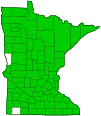
Sources
Biodiversity occurrence data published by: Minnesota Biodiversity Atlas (accessed through the Minnesota Biodiversity Atlas Portal, bellatlas.umn.edu. Accessed 1/7/2023).
Storeria occipitomaculata Storer, 1839 in GBIF Secretariat (2023). GBIF Backbone Taxonomy. Checklist dataset https://doi.org/10.15468/39omei accessed via GBIF.org. Accessed 1/7/2023.
HerpMapper. 2026. HerpMapper - A Global Herp Atlas and Data Hub. Iowa, U.S.A. Available http://www.herpmapper.org. (Accessed: 1/7/2023).
Occurrence
Common
Taxonomy
Class
Reptilia (Reptiles)
Order
Squamata (Snakes and Lizards)
Suborder
Serpentes (Snakes)
Infraorder
Alethinophidia
Parvorder
Caenophidia
Family
Colubridae (Colubrid Snakes)
Subfamily
Natricinae
Genus
Storeria (American Brown Snakes)
Subordinate Taxa
Black Hills Red-bellied Snake (Storeria occipitomaculata pahasapae) 
Florida Red-bellied Snake (Storeria occipitomaculata obscura)
Northern Red-bellied Snake (Storeria occipitomaculata occipitomaculata)
Synonyms
Coluber occipitomaculatus
Ischnognathus dekayi var. b
Ischnognathus occipitomaculatus
Storeria occipito-maculata
Tropidonotus occipito-maculatus
Common Names
Redbelly Snake
Red-bellied Snake


