common coral slime - Species Profile
Conservation • Description • Habitat • Ecology • Distribution • Taxonomy
Conservation Status
IUCN Red List
not listed
NatureServe
not listed
Minnesota
not listed
Description
Protostelid slime molds are relatively unknown and easily overlooked. They were first recognized in the early 1960s and have been little studied since. There are 36 currently accepted species, and possibly twice that number of undescribed species. Most are microscopic. Only a few are visible to the naked eye.
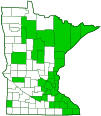
Common coral slime, also called simply coral slime, is the most commonly encountered protostelid slime mold and may be the most common slime mold of any kind in the world. It occurs on every continent except Greenland and Antarctica. In the United States it is common east of the Great Plains, including Minnesota, and west of the Rocky Mountains. It is absent in the arid west. It is found on shaded rotting wood of fallen logs and branches, in open, wet to moderately moist deciduous, coniferous, and mixed forests. It does not feed on the wood but on bacteria associated with the rotting wood. It can form extensive colonies one meter or more long. It is very short lived, appearing after a soaking rain and disintegrating in just a few days.
Common coral slime first appears as a thin, watery, translucent, mucus-like layer of protoplasm (plasmodium). It creeps across the substrate, engulfing bacteria, protozoa, and particles of nonliving organic matter. Eventually, the plasmodium fruits, converting to spore-bearing structures (sporocarps). The conversion takes about six hours.
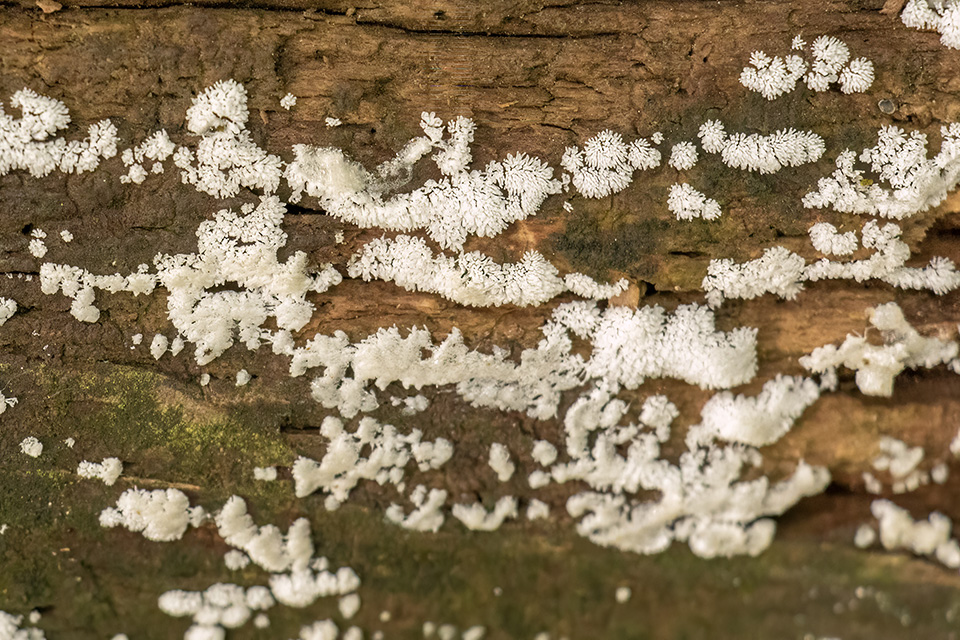
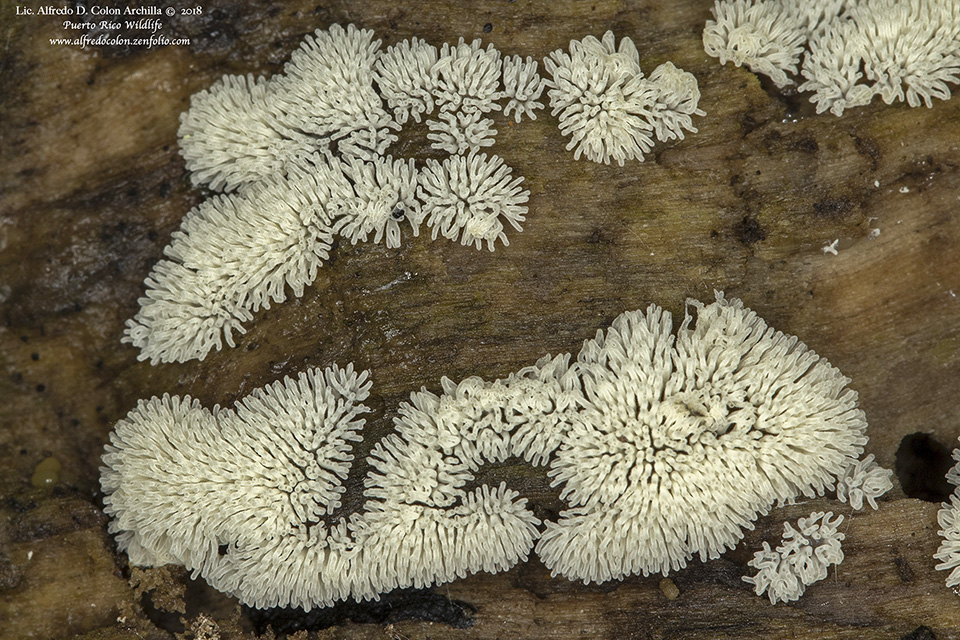
The sporocarps are erect, slender, translucent columns appearing usually in clusters of three or more. The clusters often form patches 4″ or more in diameter. The columns are 1 ⁄32″ to ⅜″ (1 to 10 mm) long, 1 ⁄64″ to 3 ⁄64″ (0.5 to 1.0 mm) in diameter, and tapered. They may be branched or unbranched. When they first appear they are slimy, translucent, and usually white, rarely pink or yellow. Later, they have a frosted or powdery appearance due to a dense covering of tiny, white, spores on long, thread-like stalks. The spores may actually be one-celled sporangia.
It is not edible.
Similar Species
No similar species in Minnesota
Habitat and Hosts
Open, wet to moderately moist, deciduous, coniferous, and mixed forests
Ecology
Season
June through October
Distribution
Sources
Biodiversity occurrence data published by: Minnesota Biodiversity Atlas (accessed through the Minnesota Biodiversity Atlas Portal, bellatlas.umn.edu. Accessed 6/23/2025).
Mycology Collections Portal (MyCoPortal) https://www.mycoportal.org/portal/collections/index.php). Accessed 6/23/2025.
Occurrence
Common and widespread
Taxonomy
Kingdom
Protozoa (Protozoans)
Phylum
Amoebozoa
Subphylum
Mycetozoa (Slime Molds)
Class
Protosteliomycetes
Subclass
Incertae sedis
Order
Protosteliales
Family
Ceratiomyxaceae
Genus
Ceratiomyxa (Coral Slimes)
Subordinate Taxa
Ceratiomyxa fruticulosa f. flava
Ceratiomyxa fruticulosa f. rosea
Ceratiomyxa fruticulosa var. arbuscula
Ceratiomyxa fruticulosa var. aurantiaca
Ceratiomyxa fruticulosa var. comata
Ceratiomyxa fruticulosa var. descendens
Ceratiomyxa fruticulosa var. flexuosa
Ceratiomyxa fruticulosa var. fruticulosa
The honeycomb variety of common coral slime has been officially raised to full species status as Ceratiomyxa porioides, separate from Ceratiomyxa fruticulosa, based on a 2024 molecular DNA analysis.
Synonyms
Byssus fruticulosa
Ceratiomyxa arbuscula
Ceratiomyxa caesia
Ceratiomyxa descendens
Ceratiomyxa freyana
Ceratiomyxa fruticulosa
Ceratiomyxa fruticulosa ssp. arbuscula
Ceratiomyxa fruticulosa ssp. aurea
Ceratiomyxa fruticulosa ssp. caesia
Ceratiomyxa fruticulosa ssp. descendens
Ceratiomyxa fruticulosa var. arbuscula
Ceratiomyxa fruticulosa var. caesia
Ceratiomyxa fruticulosa var. comata
Ceratiomyxa fruticulosa var. crustosum
Ceratiomyxa fruticulosa var. descendens
Ceratiomyxa fruticulosa var. flava
Ceratiomyxa fruticulosa var. flexuosa
Ceratiomyxa fruticulosa var. rosea
Ceratiomyxa fruticulosa var. rosella
Ceratiomyxa frutucilosa
Ceratiomyxa hydnoidea
Ceratiomyxa mucida
Ceratiomyxa mucida ssp. arbuscula
Ceratiomyxa mucida ssp. hydnoidea
Ceratiomyxa mucida var. arbuscula
Ceratiomyxa mucida var. flexuosa
Ceratiomyxa mucida var. hydnoidea
Ceratiomyxa plumosa
Ceratium arbuscula
Ceratium aureum
Ceratium crustosum
Ceratium filiforme
Ceratium fuscum
Ceratium hydnoideum
Ceratium hydnoideum var. ramossisimum
Ceratium mucidum
Ceratium pyxidatum
Ceratium pyxidatum var. cornutum
Ceratium pyxidatum var. flabellatum
Ceratium roseum
Ceratium rubicundum
Ceratium sphaeroideum
Clavaria byssoides
Clavaria puccinia
Corynoides byssoides
Famintzinia fruticulosa
Isaria mucida
Puccinia byssoides
Tremella hydnoidea
Common Names
common coral slime
coral slime
coral slime mold
white coral slime