dog vomit slime mold - Species Profile
Conservation • Description • Habitat • Ecology • Distribution • Taxonomy

Conservation Status
IUCN Red List
not listed
NatureServe
not listed
Minnesota
not listed
Description
Plasmodial slime molds are single-celled organisms, masses of protoplasm without cell walls (naked) and with thousands of nuclei. Like animals, they move and violently eject unwanted inorganic materials. Like amoeba, they feed by engulfing particles of food. Like fungi, they reproduce by producing fruit bodies containing spores that are distributed by wind. Formerly classified as fungi, plasmodial slime molds are now known to be unrelated.
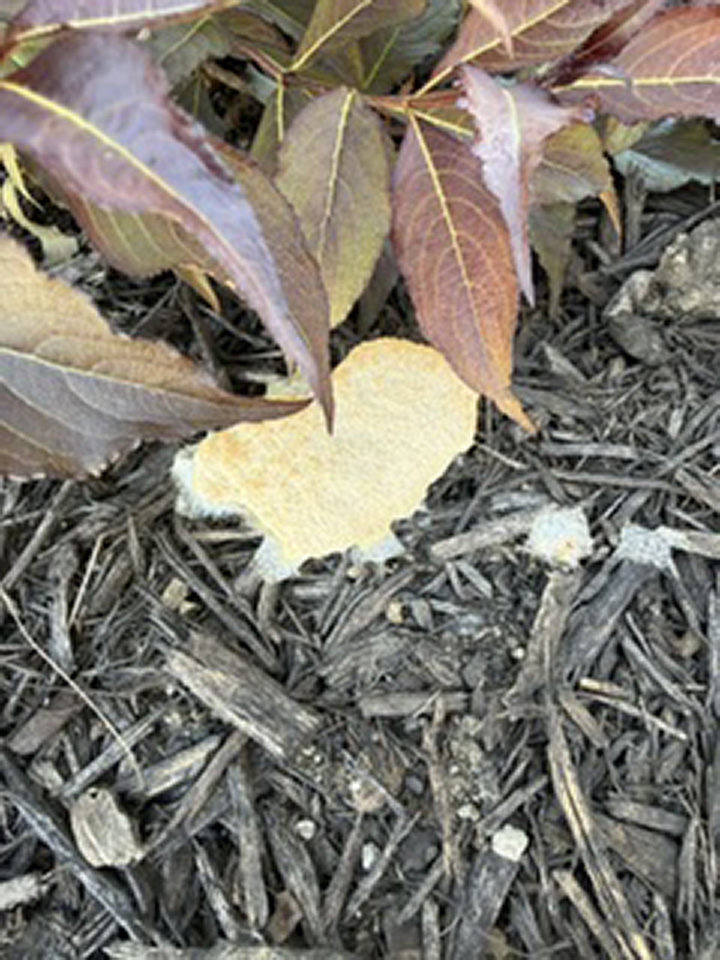
Dog vomit slime mold is a plasmodial slime mold. It has a worldwide distribution, occurring on every continent except Greenland and Antarctica. It is often found in urban areas from May to October. It grows on the rotten wood of stumps, logs, and wood mulches; on garden soil enriched with manure; and also on living plants. It may migrate one meter or more to nearby food sources. It feeds on bacteria, spores of fungi and non-flowering plants, protozoa, and nonliving organic matter. Its common name accurately describes its appearance. It is not edible.
Dog vomit slime mold may appear as an irregular cushion-like mass, a slimy sheet, or a crust-like sheet. When it first appears it is a white to yellow slimy sheet 1″ to 8″ (2.5 to 20 cm) long. At this stage it cannot reliably be distinguished in the field from other similar-looking slime molds. At some point the protoplasm transforms into a large, cushion-like, fruiting body (aethalium). At this stage the slime mold is easily identified in the field. The aethalium is ⅜″ to 1¼″ (1 to 3 cm) thick and may be white, yellowish, brownish-yellow, or reddish-brown. It is covered by a brittle crust. Breaking the crust away reveals a dull black spore mass.
Similar Species
Habitat and Hosts
Stumps, logs, wood mulches, garden soil, and living plants
Ecology
Season
May through October
Distribution

Sources
Biodiversity occurrence data published by: Minnesota Biodiversity Atlas (accessed through the Minnesota Biodiversity Atlas Portal, bellatlas.umn.edu. Accessed 8/28/2026).
Fuligo septica (L.) F.H.Wigg., 1780 in Bánki, O., Roskov, Y., Döring, M., Ower, G., Hernández Robles, D. R., Plata Corredor, C. A., Stjernegaard Jeppesen, T., Örn, A., Pape, T., Hobern, D., Garnett, S., Little, H., DeWalt, R. E., Miller, J., Orrell, T., Aalbu, R., Abbott, J., Abreu, C., Acero P, A., et al. (2026). Catalogue of Life (2026-07-17 XR). Catalogue of Life Foundation, Amsterdam, Netherlands. https://doi.org/10.48580/dgykv
Mycology Collections Portal (MyCoPortal) https://www.mycoportal.org/portal/collections/index.php). Accessed 8/28/2026.
Occurrence
Very common and widespread
Taxonomy
Kingdom
Protozoa (Protozoans)
Phylum
Mycetozoa (Slime Molds)
Class
Myxomycetes (True Slime Molds)
Subclass
Columellomycetidae
Superorder
Stemonitidia
Order
Physarales
Family
Physaraceae
Genus
Fuligo
Subordinate Taxa
Fuligo septica var. candida
Fuligo septica var. flava
Fuligo septica var. rosea
Fuligo septica var. rufa
Fuligo septica var. septica
Synonyms
Aethalium candidum
Aethalium ferrincola
Aethalium flavum
Aethalium rufum
Aethalium septicum
Aethalium septicum ssp. flavum
Aethalium septicum ssp. rufa
Aethalium septicum ssp. vaporaria
Aethalium septicum var. cinnamomeum
Aethalium septicum var. flavum
Aethalium septicum var. rufa
Aethalium septicum var. rufum
Aethalium septicum var. vaporaria
Aethalium septicum var. vaporarium
Aethalium vaporarium
Fuligo candida
Fuligo candida ssp. persicina
Fuligo carnea
Fuligo cerebrina
Fuligo flava
Fuligo flavescens
Fuligo hortensis
Fuligo ovata
Fuligo pallida
Fuligo rufa
Fuligo septica
Fuligo septica ssp. candida
Fuligo septica ssp. cinnamomea
Fuligo septica ssp. corticata
Fuligo septica ssp. flava
Fuligo septica ssp. rosea
Fuligo septica ssp. rufa
Fuligo septica ssp. vaporaria
Fuligo septica var. alba
Fuligo septica var. candida
Fuligo septica var. cinnamomea
Fuligo septica var. flava
Fuligo septica var. lapislazulicolor
Fuligo septica var. rosea
Fuligo septica var. rufa
Fuligo septica var. vaporaria
Fuligo tatrica
Fuligo vaporaria
Fuligo varians
Fuligo varians var. ecorticata
Licea lindheimeri
Mucor mucilago
Mucor ovatus
Mucor septicus
Reticularia carnea
Reticularia cerea
Reticularia hortensis
Reticularia lutea
Reticularia ovata
Reticularia rufa
Reticularia septica
Reticularia vaporaria
Tubifera lindheimeri
Tubulina lindheimeri
Common Names
dog vomit slime mold
flowers of tan
scrambled egg slime