


Western Tiger Salamander - Species Profile
Conservation • Description • Habitat • Ecology • Distribution • Taxonomy
Conservation Status
IUCN Red List
not listed
NatureServe
N5 - Secure
SNR - Unranked
Minnesota
not listed
Description
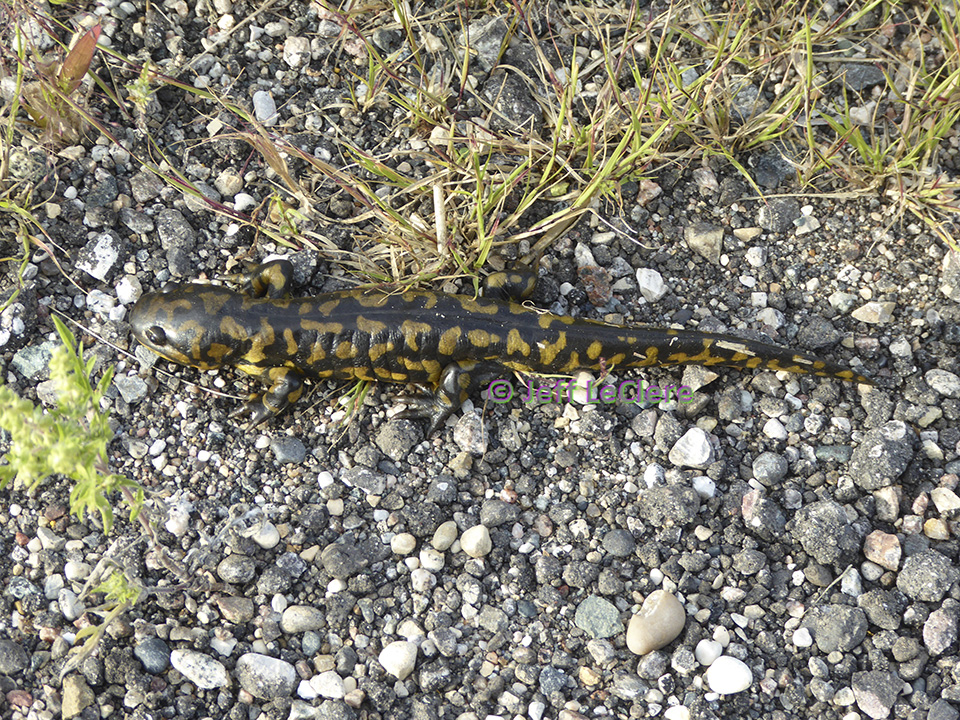
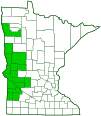
Western Tiger Salamander is a very large mole salamander. It is one of the largest salamanders in North America. It is common within its range but in Minnesota that range barely extends into the westernmost counties.
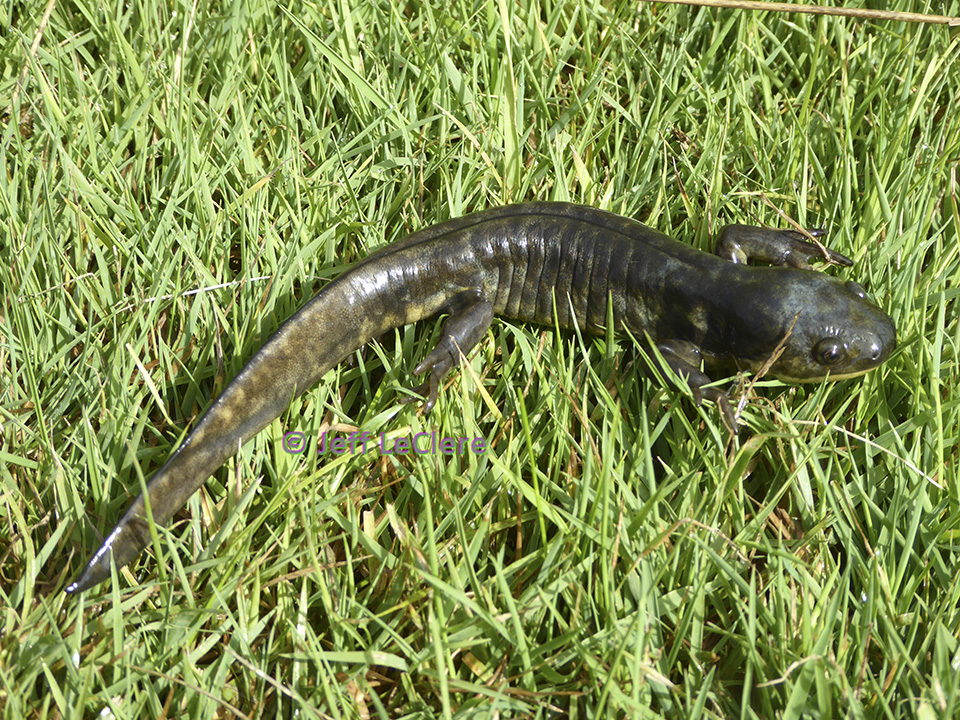
It has a broad head, a stout body, and a long tail. The skin is smooth and somewhat slippery. The color pattern varies significantly across the geographic range of the species, from a grayish-black background with brownish-yellow irregular blotches, to a brownish-yellow background with grayish-black irregular blotches. There are 11 to 14 vertical grooves on the side of the body. There are four toes on each front foot.
Size
Total length: 3″ to 6½″ (7.6 to 16.5 cm)
Similar Species
Habitat
Almost any habitat that includes a nearby lake, pond, stream, or pool in which to breed.
Ecology
Behavior
This salamander, like all salamanders, is rarely encountered. It spends the day in an rodent burrow, coming out at night to feed. It is sometimes seen in the spring or fall during or just after a heavy rain crossing a road between an upland site and a pond.
Lifespan
10 to 25 years
Life Cycle
Breeding takes place in the early spring, often before the ice has cleared from the surface of the pond. To initiate breeding, the male will nudge a female then deposit a sperm capsule on the pond bottom. The female picks up the sperm capsule. After fertilization the female lays up to 1,000 eggs, depositing them singly or in very small clusters on submerged vegetation.
The eggs hatch in 2 to 5 weeks. The larvae are usually about 5″ long. They have large external gills and a prominent tail fin (caudal fin) that extends from just behind the head on the upper side to the belly on the underside, wrapping around the tail. Larvae may metamorphose into sexually mature adults in their first or second summer, or they may become sexually mature without metamorphosis.
Adults overwinter in burrows or under logs or other debris.
Larva Food
Aquatic invertebrates, plankton, and other salamander larvae.
Adult Food
Earthworms, insects, and other invertebrates; occasionally small reptiles and amphibians; other salamanders.
Distribution
Sources
Biodiversity occurrence data published by: Minnesota Biodiversity Atlas (accessed through the Minnesota Biodiversity Atlas Portal, bellatlas.umn.edu. Accessed 12/29/2025).
USGS National Amphibian Atlas. https://armi.usgs.gov/atlas/. Accessed 12/29/2025).
Occurrence
Common and widespread
Taxonomy
Class
Amphibia (Amphibians)
Order
Caudata (Salamanders)
Family
Ambystoma (Mole Salamanders)
Genus
Ambystoma (Mole Salamanders)
Full Species
Until recently, this salamander was considered a subspecies of Eastern Tiger Salamander (Ambystoma tigrinum). Based on genetic analysis, that species was broken up and three of the subspecies were elevated to species rank, including Ambystoma mavortium. Most print resources and many online resources still classify this salamander Ambystoma tigrinum melanostictum.
Subordinate Taxa
Arizona tiger salamander (Ambystoma mavortium nebulosum)
barred tiger salamander (Ambystoma mavortium mavortium)
blotched tiger salamander (Ambystoma mavortium melanostictum) 
gray tiger salamander (Ambystoma mavortium diaboli)
Sonoran tiger salamander (Ambystoma mavortium stebbinsi)
Subspecies
When Ambystoma mavortium was separated from Ambystoma tigrinum, five subspecies of the former species came with it. The recognition of subspecies of Ambystoma mavortium is controversial and is likely to remain so. Some sources, including Society for the Study of Amphibians and Reptiles (SSAR), AmphiaWeb, and iNaturalist, recognize all five subspecies, Other sources, including Amphibian Species of the World 6.2, ITIS, and GBIF, recognize no subspecies. Both sides have compelling reasons for their stance.
Synonyms
Amblystoma mavortium
Amblystoma prosperpine
Amblystoma trisruptum
Ambystoma nebulosum
Ambystoma proserpine
Ambystoma tigrinum diaboli
Ambystoma tigrinum mavortium
Ambystoma tigrinum melanostictum
Ambystoma tigrinum nebulosum
Ambystoma tigrinum proserpine
Ambystoma tigrinum slateri
Ambystoma tigrinum stebbinsi
Ambystoma tigrinum utahense
Siredon lichenoides
Siredon lichenoides melanostictum
Siredon melanostica
Sirenodon lichenoides
Common Names
Barred Tiger Salamander
Western Tiger Salamander