Eastern Pygmy Shrew - Species Profile
Conservation • Description • Habitat • Ecology • Distribution • Taxonomy
Conservation Status
IUCN Red List
LC - Least Concern
NatureServe
N5 - Secure
SNR - Unranked
Minnesota
not listed
Description
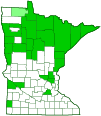
Eastern Pygmy Shrew, also called American Pygmy Shrew, is a small, long-tailed shrew. It occurs in the United States from Main to Tennessee, west to Minnesota and Washington state, and in Alaska. It occurs across Canada from Newfoundland and Labrador and Nova Scotia, west to Yukon Territory and British Columbia. It is common across northern Minnesota.
Eastern Pygmy Shrew is found in a variety of habitats, including deciduous and coniferous forests, swamps, bogs, floodplains, grassy clearings, and at the edges of tundra. It is usually found in moist habitats, but it is also found in dry habitats. It is never far from a slow stream or other source of water.
Eastern Pygmy Shrew has a high metabolic rate, and it eats constantly, every hour, day and night, or it dies. It feeds mostly on insects and insect larvae, including ants, beetles, caterpillars, earthworms, flies, grubs, and spiders.
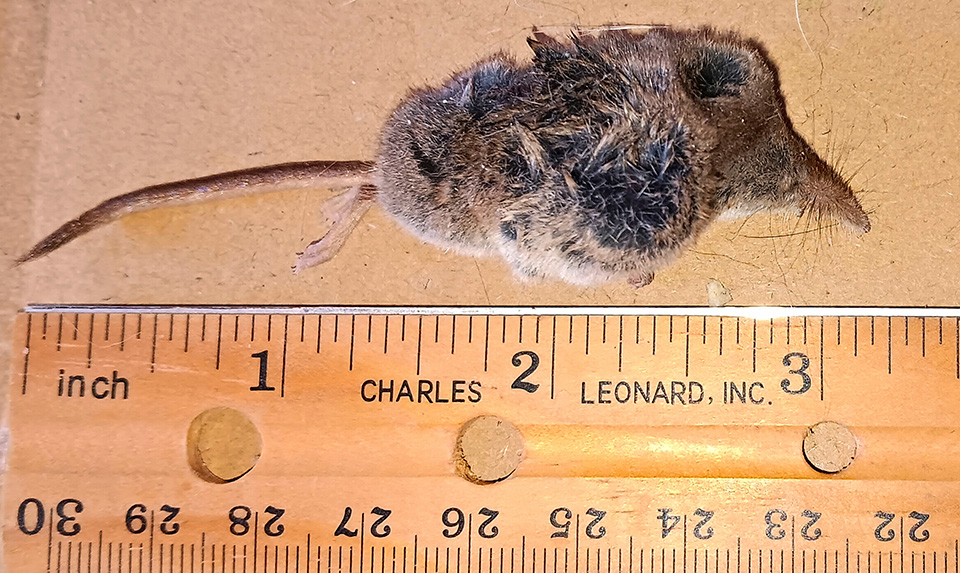
Eastern Pygmy Shrew is the smallest mammal in North America, but its size range overlaps that of Masked Shrew. Adults are 3″ to 3½″ (75 to 91 mm) in total length. The head and body is 2″ to 2⅜″ (51 to 61 mm) long and the tail is 1″ to 1 7⁄16″ (25 to 36 mm) long, about one-third the total length. At just 0.10 to 0.14 oz (3 to 4 g), about the weight of a dime, it is probably the smallest living mammal by weight.
The head is narrow, the nose is long and pointed, and there are prominent whiskers. The eyes are small and are covered with soft, short fur, making them inconspicuous. The skull is delicate, rounded, and less than 7⁄16″ (11 mm) wide. The teeth are brown at the tips. There are five upper unicuspids, which are teeth with a single pointed projection. The last unicuspid is minute. When examining the skull, only three of the five upper unicuspids are visible from the side. The dental formula is 3/1, 1/1, 3/1, 3/3 × 2 = 32.
The fur (pelage) is dark grayish brown above and lighter gray below.
Size
Total length: 3″ to 3½″ (75 to 91 mm)
Head and body: 2″ to 2⅜″ (51 to 61 mm)
Tail: 1″ to 1 7⁄16″ (25 to 36 mm)
Weight: 0.10 to 0.14 oz (3 to 4 g)
Sign
Similar Species
Masked Shrew (Sorex cinereus) and Eastern Pygmy Shrew cannot be reliably distinguished without examining the teeth. When examining the skull, four of the five upper unicuspids are visible from the side.
Habitat
A variety of habitats, including deciduous and coniferous forests, swamps, bogs, floodplains, grassy clearings, and at the edges of tundra
Ecology
Behavior
Lifespan
Unknown but probably about two years in the wild.
Life Cycle
Food
Insects and insect larvae
Distribution
Sources
Biodiversity occurrence data published by: Minnesota Biodiversity Atlas (accessed through the Minnesota Biodiversity Atlas Portal, bellatlas.umn.edu, 1/19/2026).
Timm, R. M. 1975. Distribution, natural history, and parasites of mammals of Cook County, Minnesota. Occasional Papers, Bell Museum of Natural History, University of Minnesota 14:1–56.
Hazard, Evan B. 1982. The Mammals of Minnesota. University of Minnesota Press, Minneapolis, Minnesota. 280 pp.
The counties in light green lack modern records but have historic county or township specimens or records.
Occurrence
Taxonomy
Class
Subclass
Theria
Infraclass
Placentalia (Placental Mammals)
Magnorder
Boreoeutheria
Superorder
Laurasiatheria (Ungulates, Carnivorans, and Allies)
Order
Eulipotyphla (Shrews, Moles, Hedgehogs, and Allies)
Suborder
Erinaceota (Shrews, Moles, and Hedgehogs)
Superfamily
Soricoidea
Family
Soricidae (Shrews)
Subfamily
Soricinae (Red-toothed Shrews)
Tribe
Soricini (Long-tailed Shrews)
Genus
Sorex (Long-tailed Shrews)
Subgenus
Otisorex
Subordinate Taxa
The Eastern Pygmy Shrew (Sorex hoyi) was recently involved in a major taxonomic split. Historically, all pygmy shrews across North America were considered a single species. However, a recent comprehensive study (Hope et al., 2020) using multiple DNA loci and morphological analysis demonstrated that pygmy shrews are actually two distinct species: the Eastern Pygmy Shrew (Sorex hoyi), which occurs in Minnesota, and the Western Pygmy Shrew (Sorex eximius), found in the western half of the continent.
Furthermore, this genetic research found that traditional subspecies designations (such as S. h. thompsoni) do not accurately reflect the animal's evolutionary history. Consequently, the Mammal Diversity Database (MDD) recognizes Sorex hoyi as a single, monotypic species (no subspecies) in the eastern part of its range until further research can clearly define any internal groupings.
Synonyms
Microsorex hoyi
Microsorex hoyi hoyi
Microsorex hoyi intervectus
Microsorex hoyi thompsoni
Microsorex hoyi winnemana
Sorex hoyi hoyi
Sorex hoyi thompsoni
Sorex hoyi winnemana
Sorex thompsoni
Common Names
American Pygmy Shrew
Eastern Pygmy Shrew
Pygmy Shrew
