


Tricolored Bat - Species Profile
Conservation • Description • Habitat • Ecology • Distribution • Taxonomy
Conservation Status
IUCN Red List
VU - Vulnerable
NatureServe
N2N3 - Vulnerable to Imperiled
S3 - Vulnerable
Federal
Proposed Endangered
Minnesota
Special Concern
Species in Greatest Conservation Need
Description
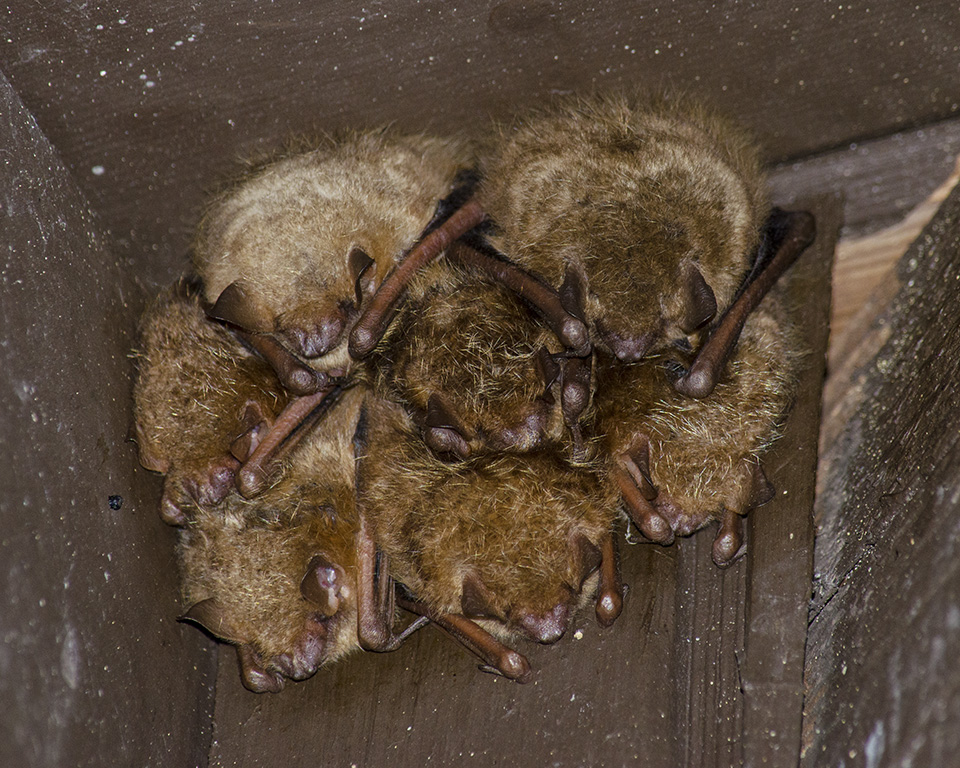
Tricolored Bat, formerly called eastern pipistrelle, is a small vesper bat. It occurs in the United States east of the Great Plains, in southern Canada from Nova Scotia to Ontario, and in Mexico. It was once thought to be one of the most common bats within its range. Its numbers have declined significantly since 2006 due to spreading of the fungal disease white nose syndrome, and to mortality from wind turbines.
Tricolored Bats are found in woodlands near water. They tend to avoid deep forests and open fields. They roost alone, often in trees, but also in rock crevices and in buildings. They hibernate from October to April in caves and mine tunnels, usually in the deeper parts with higher temperatures.
Tricolored Bat is one of the smallest bats in eastern North America and is the smallest bat in Minnesota. Adults are 3″ to 3½″ (77 to 89 mm) in length, have an 8⅝″ to 10″ (220 to 250 mm) wingspan, and weigh 0.16 to 0.28 oz (4.6 to 7.9 g). Females are larger than males. Like most bats, they have two mammae.
The fur (pelage) is usually yellowish-brown overall, but individual hairs are distinctly tri-colored: dark gray at the base, yellowish-brown in the middle, and dark brown or reddish-brown at the tip. This is the feature that gives tri-colored bat its common name and helps to distinguish it from similar species.
The ears, snout, and skin are pinkish. The ears are not particularly large. The fleshy projection at the base of each ear (tragus) is short and blunt. The small size and blunt tragus distinguish tri-colored bat from all other bats in Minnesota. The skull has 34 teeth. No other bat in Minnesota has 34 teeth.
The wing-like flight membrane (patagium) is composed of skin and associated tissues between the neck and the first digit of the forelimb (propatagium), between the digits of the forelimb (dactylopatagium), between the last digit and the hind limb (plagiopatagium), and between the tail and the hindlimb (uropatagium or interfemoral membrane). The membrane is blackish, and the forearm is reddish. The forearm length is 1¼″ to 1⅜″ (31.4 to 34.1 mm). The upper side of the interfemoral membrane is densely covered with fur just on the basal third. The tail extends to the end of the interfemoral membrane but not beyond it. A spur of cartilage (calcar) extends from the ankle along the outer part of the interfemoral membrane, which it helps to extend in flight. The calcar does not have a keel.
Size
Total length: 3″ to 3½″ (77 to 89 mm)
Wingspan: 8⅝″ to 10″ (220 to 250 mm)
Tail: 1⅜″ to 1⅝″ (34 to 41 mm)
Forearm length: 1¼″ to 1⅜″ (31.4 to 34.1 mm)
Weight: 0.16 to 0.28 oz (4.6 to 7.9 g)
Sign
Similar Species
Habitat
Woodlands
Ecology
Behavior
Lifespan
4 to 8 years
Life Cycle
Food
Moths, flies, beetles, and ants
Distribution |
||
|
Sources Biodiversity occurrence data published by: Minnesota Biodiversity Atlas (accessed through the Minnesota Biodiversity Atlas Portal, bellatlas.umn.edu, 12/20/2025). Hazard, Evan B. 1982. The Mammals of Minnesota. University of Minnesota Press, Minneapolis, Minnesota. 280 pp. |
|
| 12/20/2025 | ||
Occurrence |
||
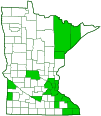
Regular occurring but in small numbers |
||
Taxonomy
Class
Subclass
Theria
Infraclass
Placentalia (Placental Mammals)
Magnorder
Boreoeutheria
Superorder
Laurasiatheria (Ungulates, Carnivorans, and Allies)
Order
Chiroptera (Bats)
Suborder
Yangochiroptera
Superfamily
Vespertilionoidea
Family
Vespertilionidae (Evening Bats)
Subfamily
Vespertilioninae (Vesper Bats)
Tribe
incertae sedis (uncertain placement)
Genus
Perimyotis
Genus
This species was previously classified as Pipistrellus subflavus. A morphological review (Menu, 1984) contended that it was more similar to the genus Myotis, and proposed transferring it to a new genus Perimyotis. The proposal was not widely accepted. A recent molecular phylogenetics study of the family Vespertilionidae (Hoofer, 2003) showed that it does not belong in the genus Pipistrellus, and confirmed its placement in the genus Perimyotis.
Subordinate Taxa
Tricolored Bat (Perimyotis subflavus clarus)
Tricolored Bat (Perimyotis subflavus floridanus)
Tricolored Bat (Perimyotis subflavus subflavus) 
Tricolored Bat (Perimyotis subflavus veraecrucis)
Synonyms
Pipistrellus subflavus
Common Names
Eastern Pipistrelle
Tricolored Bat
Perimyotis subflavus was previously known by the common name Eastern Pipistrelle. It was incorrectly believed to be closely related to the European genus Pipistrellus.
Glossary
Interfemoral membrane
In some mammals, the part of the patagium that extends between the legs and the tail; uropatagium.
Patagium
In some mammals, the membrane between the forelimb and the abdomen that assists in flying or gliding. In Lepidoptera, one of a pair of hair-covered, sausage-shaped, scale-like plates on the thorax that cover the wing bases. Plural: patagia.
Pelage
The coat of a mammal, consisting of fur, wool, or hair, and including a soft undercoat and stiff guard hairs.
Tragus
The fleshy projection on the inner side of the outer ear partially covering the ear canal.