Eastern Tiger Swallowtail - Species Profile
Conservation • Description • Habitat • Ecology • Distribution • Taxonomy

Conservation Status
IUCN Red List
not listed
NatureServe
N5 - Secure
S5 - Secure
Minnesota
not listed
Description
Eastern tiger swallowtail is a large, familiar, swallowtail butterfly. It has a wingspan of 3½″ to 5½″.
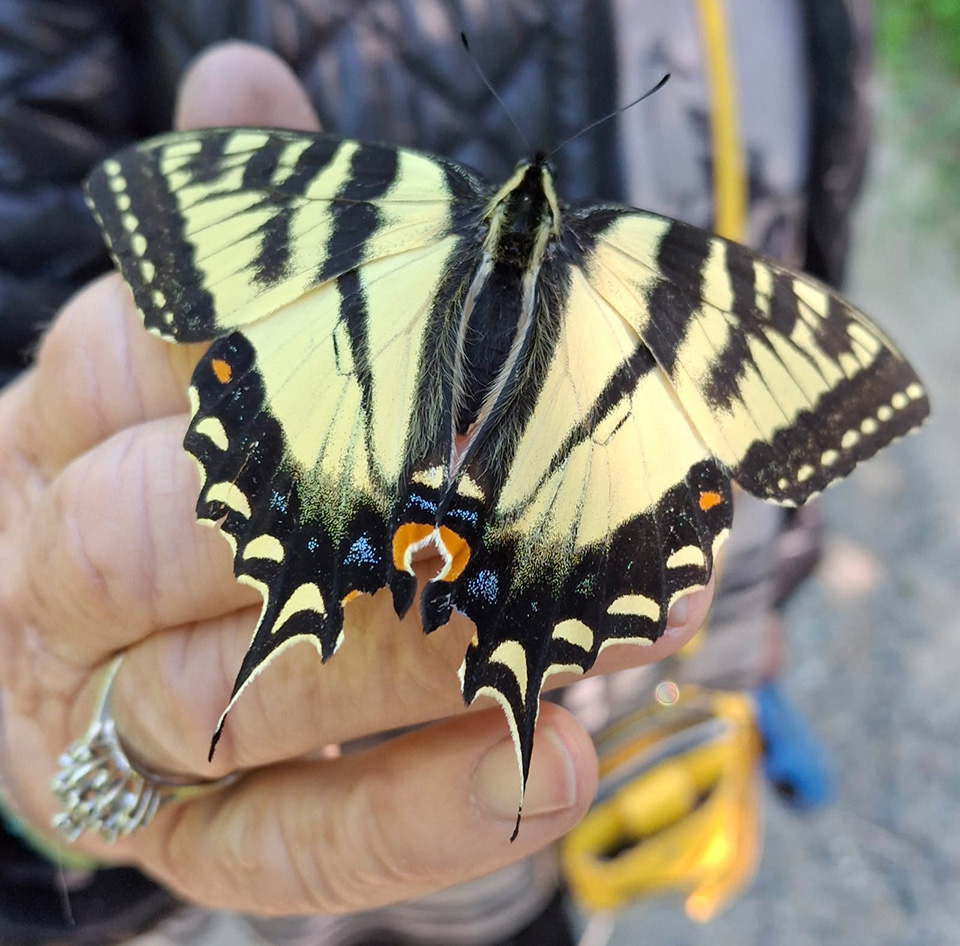
The upperside of the forewing is yellow with four black “tiger” stripes and a wide black border with small yellow spots.
The upperside hindwing is yellow with one black stripe that appears as a continuation of the innermost forewing stripe and a thin black border along the inner margin, next to the body. A wide black border on the outer margin is broken by a marginal band of 5 yellow, crescent-shaped spots and a submarginal band of 2 to 5 iridescent blue, crescent-shaped spots. The amount of blue in the submarginal band is variable. There is a bright orange spot on the inner margin at the rear of the hindwing, and a smaller bright orange spot at the beginning and end of the marginal band of yellow spots. The yellow band, just inside the wide black border of both wings, is continuous, not broken up by conspicuous black veins. The hindwings have “tails”.
The underside of the forewing is paler yellow with black stripes. There is a wide black border with a marginal band of disconnected yellow spots. The underside of the hindwing is yellow with a central black stripe. There is a wide black border with an marginal row of yellow-and-orange spots and an submarginal row of blue spots.
Females have two forms. The yellow form female is similar to the male but with much more blue scaling in the black border. The hindwings have more blue scaling.
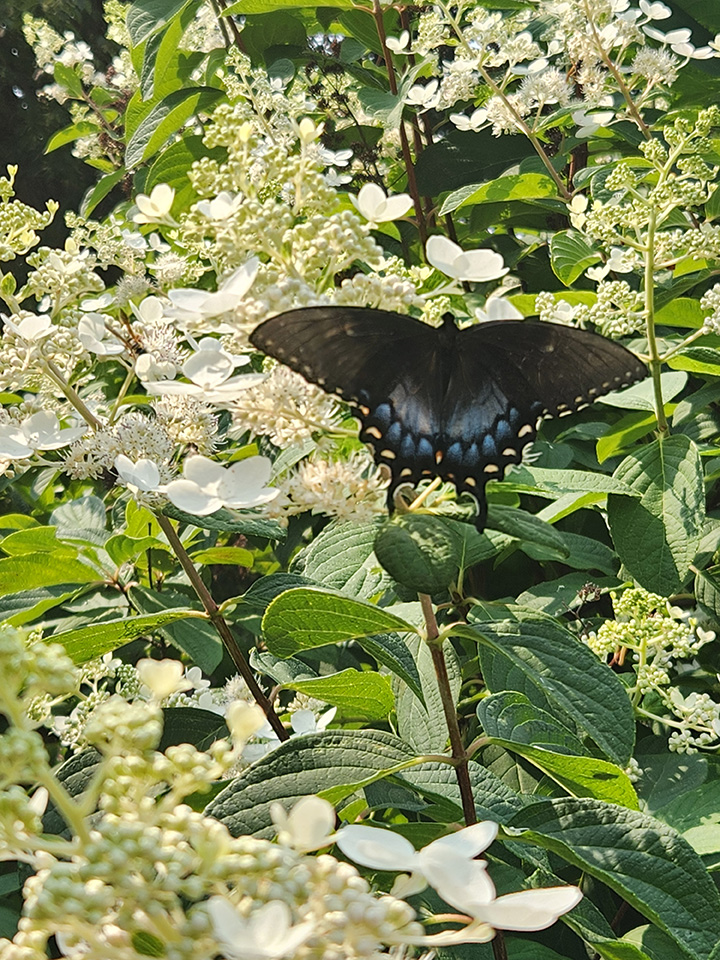
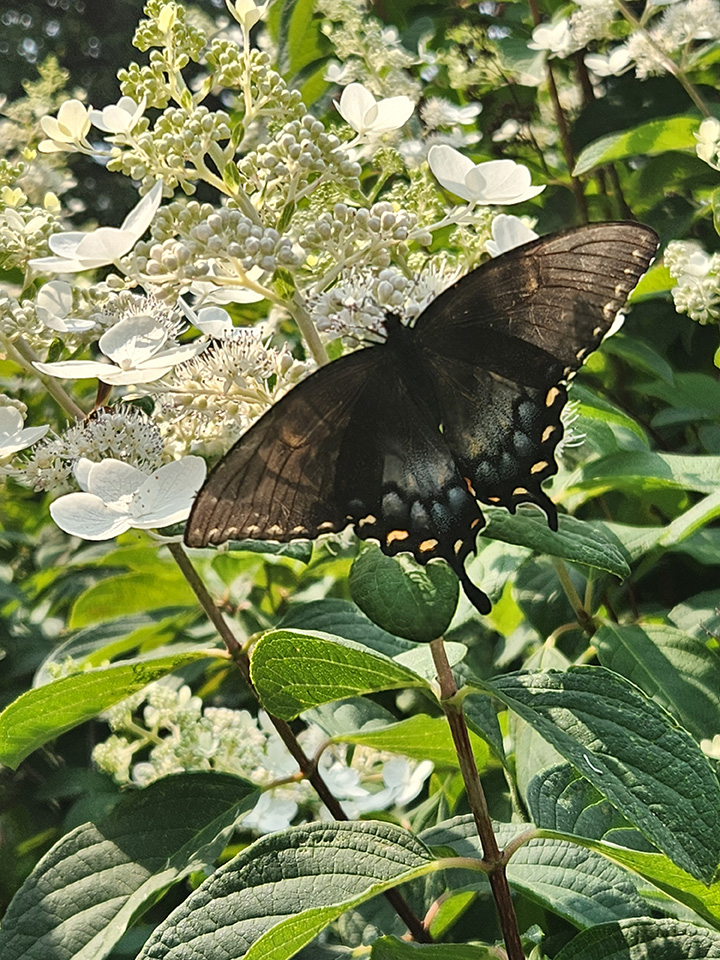
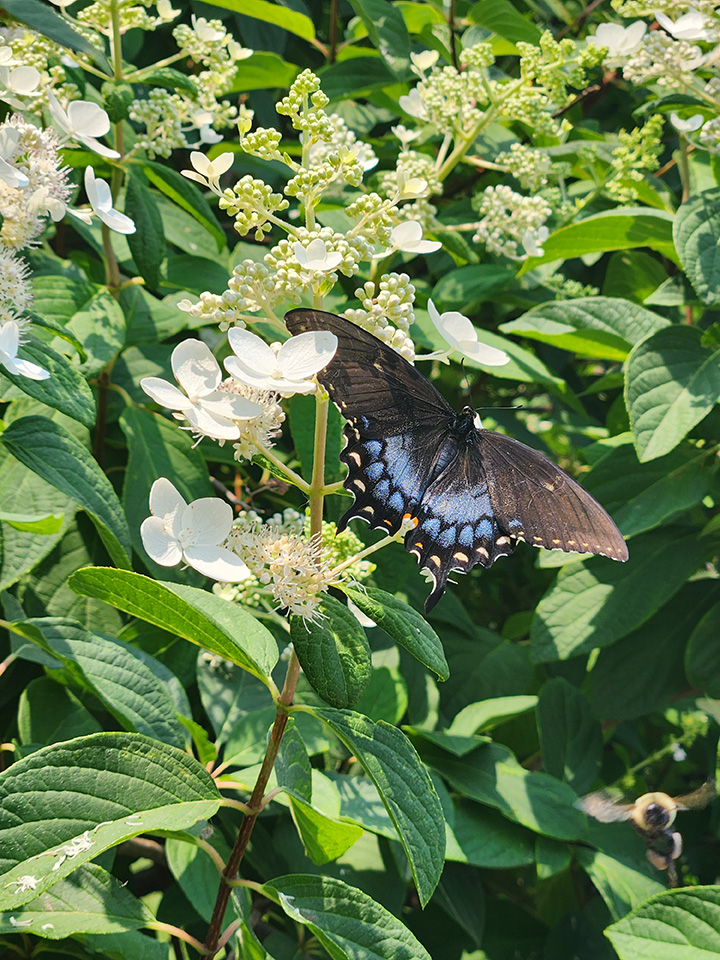
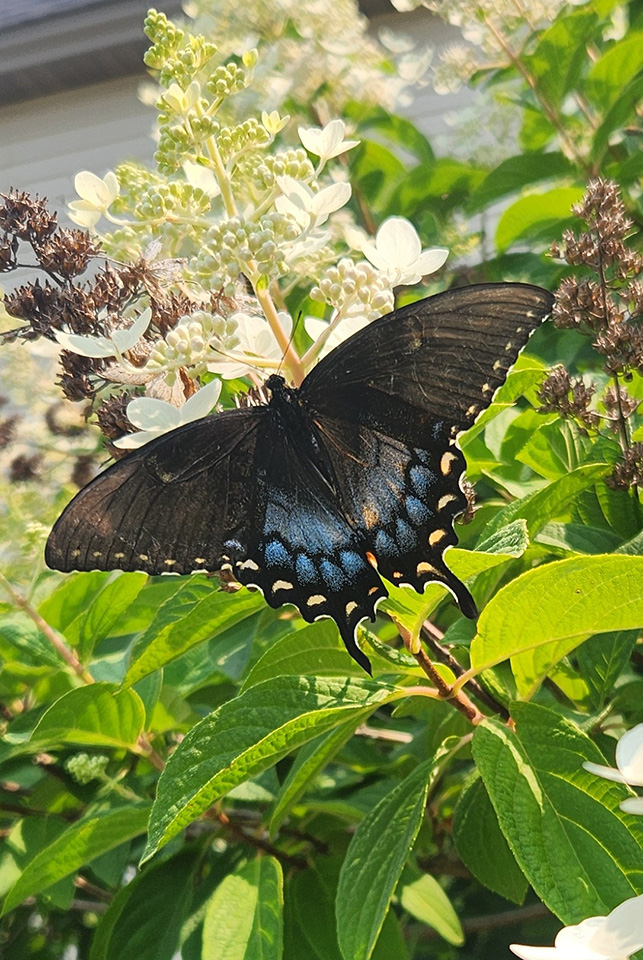
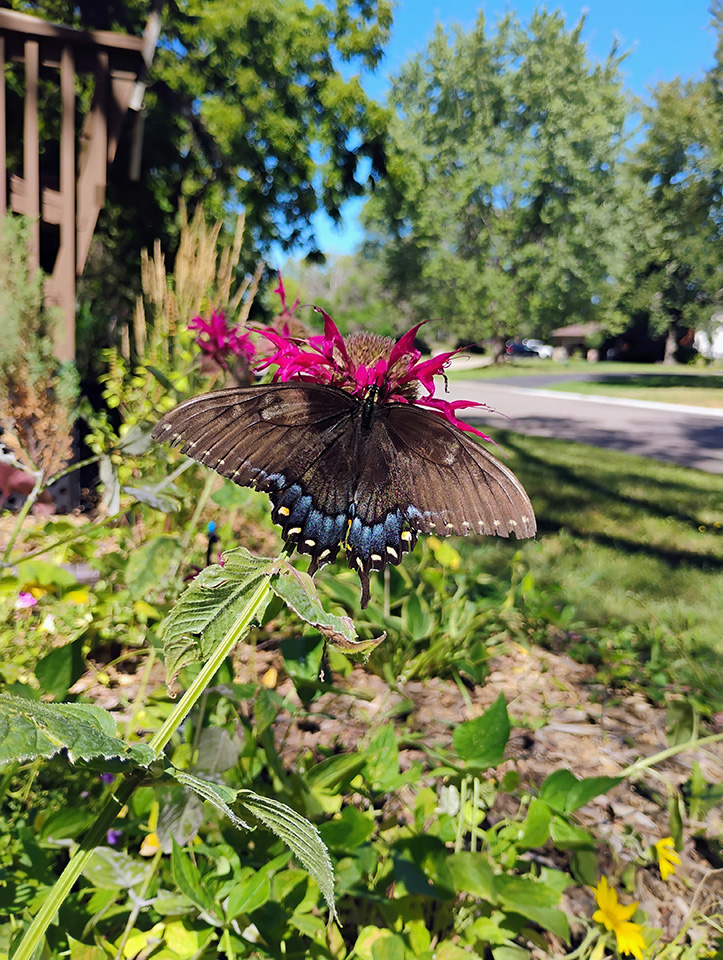
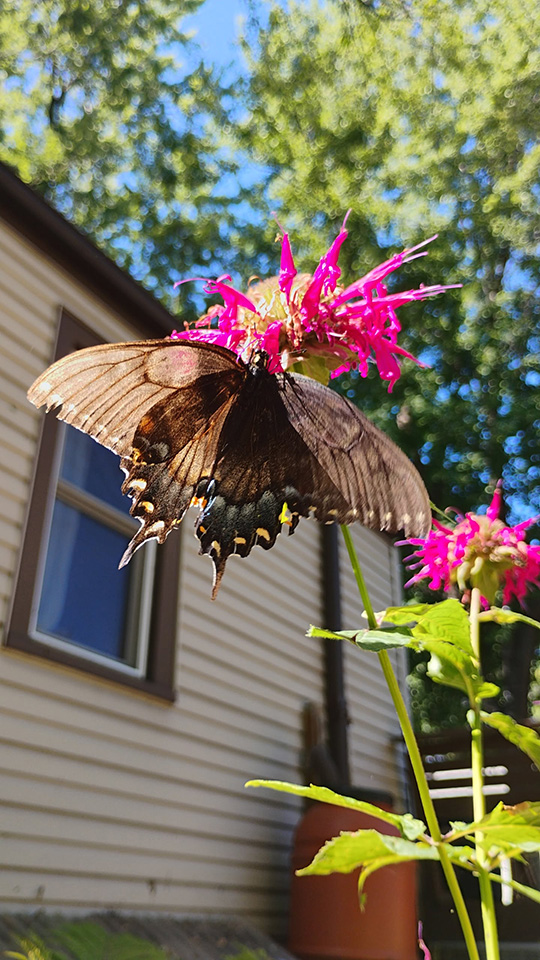
The black form female Eastern Tiger Swallowtail is often misidentified as a Spicebush Swallowtail. It has black forewings and blue-tinged black hindwings. The tiger striping is sometimes faintly visible at some angles. There is a marginal row of small yellowish spots on the forewing and a marginal row of large yellowish spots on the hindwing. On some individuals the spots are white. On the hindwing there is a submarginal row of up to five very large blue spots, and a blue cloud in the postmedial area. The blue spots are separated from the cloud by a distinct scalloped black line. The black form females are common in the south, less common in Minnesota.
The caterpillar is green and smooth, with no spines or hairs. There are small eye-like spots on the third thoracic segment with a black and white pupil.
Size
Wingspan: 3½″ to 5½″
Similar Species
Black swallowtail (Papilio polyxenes) looks similar to the black form female Eastern Tiger Swallowtail, but it has 2 rows of yellow spots across both wings and a yellow subapical spot on the forewing.
Canadian Tiger Swallowtail (Papilio canadensis) is smaller and less yellow above. The black border along the inner margin of the wing is much wider. The marginal band of yellow spots on the underside of the forewing is continuous, not broken into spots. It is found in the northern half of the state.
Habitat
Deciduous woods, woodland edges, river valleys, swamps, parks, suburbs.
Ecology
Season
Two broods: late April to early July, and July through September.
Behavior
Life Cycle
Males emerge in the spring shortly before the females. The congregate, often in large groups, at mud puddles where they replenish moisture and minerals lost during metamorphosis.
Individuals overwinter as a chrysalis.
Larva Food/Hosts
Woody plants, including black cherry, chokecherry, American basswood), birch, ash, poplar, plains cottonwood, mountain ash, and willow.
Adult Food
Nectar of large, high-yield flowers, including black cherry, blazing star, ironweed, joe-pye weed, lilac, milkweed, orange hawkweed, phlox, red clover, thistle, and wild bergamot.
Distribution

Sources
7, 21, 24, 27, 30, 75, 82, 83.
Biodiversity occurrence data published by: Minnesota Biodiversity Atlas (accessed through the Minnesota Biodiversity Atlas Portal, bellatlas.umn.edu. Accessed 4/21/2026).
Papilio glaucus Linnaeus, 1758 in GBIF Secretariat (2023). GBIF Backbone Taxonomy. Checklist dataset https://doi.org/10.15468/39omei accessed via GBIF.org. Accessed 4/21/2026.
Quinn, Edward. M., and Ron Danielson. April 27, 2009. A Survey of Lepidoptera in Three Priority Areas of the Minnesota State Parks System. https://files.dnr.state.mn.us/eco/nongame/projects/consgrant_reports/2009
/2009_quinn_danielson.pdf.
Occurrence
Common
Taxonomy
Order
Lepidoptera (Butterflies and Moths)
Superfamily
Papilionoidea (Butterflies)
Family
Papilionidae (Swallowtails and Parnassians)
Subfamily
Papilioninae (Swallowtails)
Tribe
Papilionini (Fluted Swallowtails)
Genus
Papilio (Common Swallowtails)
Subgenus
Pterourus (Tiger Swallowtails and Allies)
Genus
Some sources have raised the subgenus Pterourus to full species rank. For those sources, which includes Butterflies of America, Moth Photographers Group, and NatureServe, this and other tiger swallowtails and allies are in the genus Pterourus.
Subordinate Taxa
Eastern Tiger Swallowtail (Papilio glaucus glaucus) 
Florida tiger swallowtail (Papilio glaucus maynardi)
Synonyms
Papilio alcidamus
Papilio alexiares
Papilio antilochus
Papilio australis
Papilio delunaris
Papilio dietzi
Papilio ehrmanni
Papilio gerhardi
Papilio imperfecta
Papilio lauri
Papilio maynardi
Papilio niger
Papilio nigra
Papilio paupercula
Papilio perfulva
Papilio perfulva
Papilio turnus
Papilio wheeleri
Pterourus glaucus
Common Names
Eastern Tiger Swallowtail