ladder-marked longhorn beetle - Species Profile
Conservation • Description • Habitat • Ecology • Distribution • Taxonomy
Conservation Status
IUCN Red List
not listed
NatureServe
NNR - Unranked
Minnesota
not listed
Description
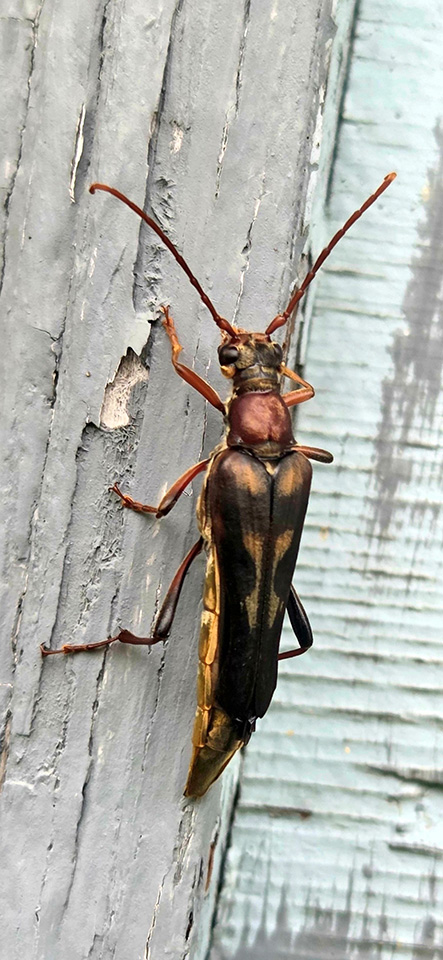
Ladder-marked longhorn beetle is a large, distinctive, flower longhorn beetle. It occurs in the United States and southern Canada east of the Great Plains.
Adults are found from May through July on various flowers. The larvae are found in decayed wood of both deciduous and coniferous trees.
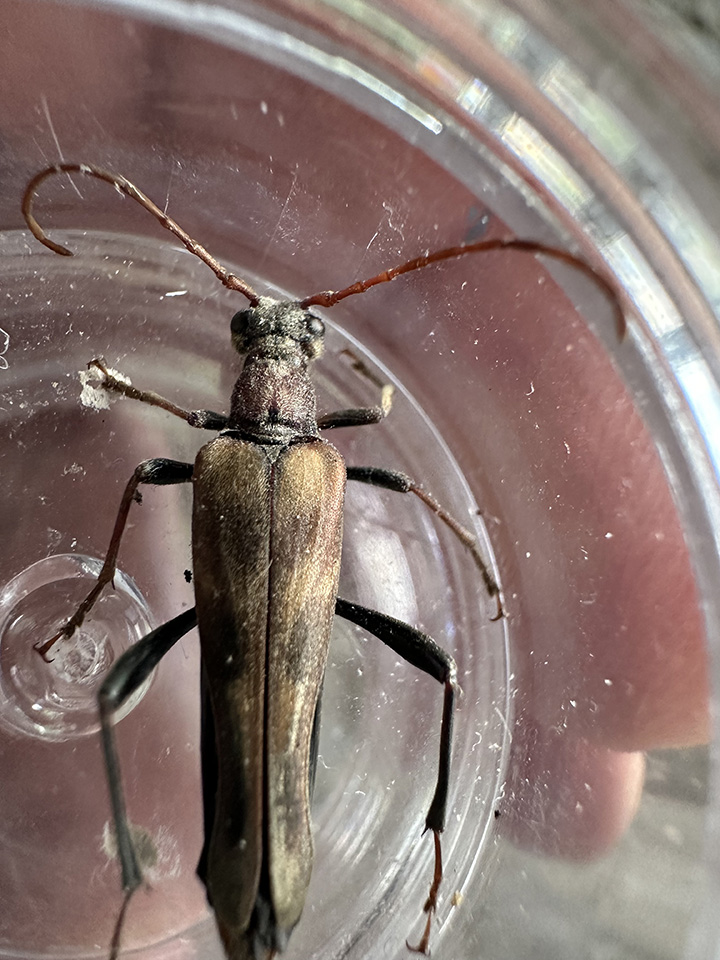
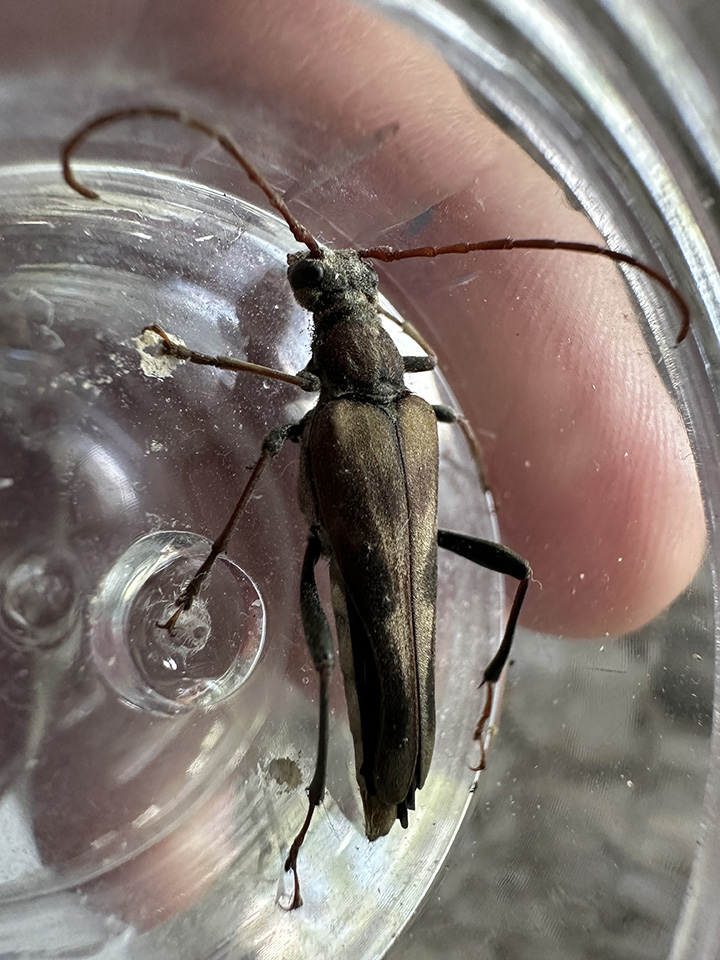
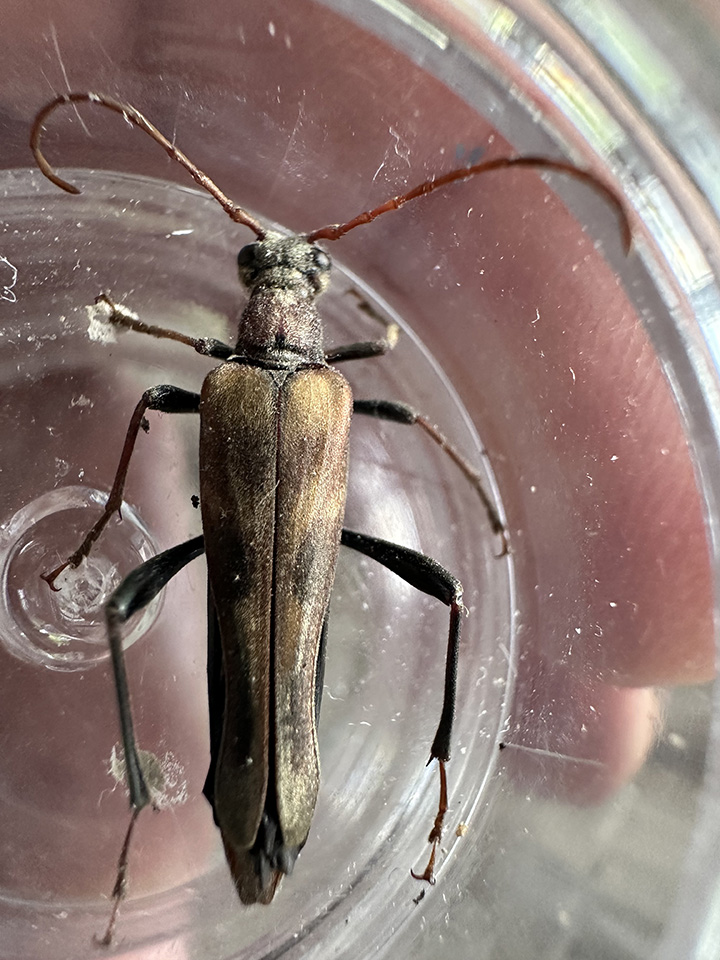
Adults are ⅝″ to 1″ (17 to 26 mm) in length. The body is slender, strongly tapered, and reddish brown.
The head is short and broad. It is angled forward in front and is abruptly constricted in back forming a pronounced neck that is visible when viewed from above. The eyes are notched. The antennae are slender and long, at least half as long as the body. The base of each antenna is inserted in the notch in the eye.
The pronotum (upper thoracic shield) is about as long as wide. There is a deep impression behind the head and another at the base. The angles at the rear corners of the pronotum are sharply pointed outward.
The elytra (hardened wing covers) are long, narrow, and bottle shaped. They are convexly arched on the basal third, then slightly concavely arched to near the tip, making the body appear broad-shouldered. They are dark reddish brown with a variable amount of pale markings. On each elytron, there is a large patch near the base, an oblique patch at the basal quarter, and a narrowly triangular patch on the inner margin at the midpoint. The pattern of the markings is consistent, but the amount and intensity are highly variable. They may be clearly separated or merge together, sharply distinct or diffuse, and boldly contrasting to completely absent. On the male, the tip of the abdomen is expanded.
The legs are slender. The color is variable, from mostly light reddish brown with some dark brown on the hind legs to entirely dark brown. The last part of each leg (tarsus), corresponding to the foot, has five segments but the fourth segment is minute and is concealed within the lobes of the heart-shaped third segment, making it appear that there are only four segments. On the hind leg, the tarsi are slender. The first segment is as long as all of the remaining segments together.
Size
Total length: ⅝″ to 1″ (17 to 26 mm)
Similar Species
Habitat
Ecology
Season
May through August
Behavior
Adults are active during the day. They are attracted to ultraviolet lights.
Life Cycle
Larva Food/Hosts
Adult Food
Distribution

Sources
Biodiversity occurrence data published by: Minnesota Biodiversity Atlas (accessed through the Minnesota Biodiversity Atlas Portal, bellatlas.umn.edu. Accessed 7/8/2026).
Bellamira scalaris (Say, 1827) in Bánki, O., Roskov, Y., Döring, M., Ower, G., Hernández Robles, D. R., Plata Corredor, C. A., Stjernegaard Jeppesen, T., Örn, A., Pape, T., Hobern, D., Garnett, S., Little, H., DeWalt, R. E., Miller, J., Orrell, T., Aalbu, R., Abbott, J., Abreu, C., Acero P, A., et al. (2026). Catalogue of Life (2026-05-15 XR). Catalogue of Life Foundation, Amsterdam, Netherlands. https://doi.org/10.48580/dgxsq
Occurrence
Common
Taxonomy
Order
Coleoptera (Beetles)
Suborder
Polyphaga (Water, Rove, Scarab, Long-horned, Leaf, and Snout Beetles)
Infraorder
Cucujiformia
Superfamily
Cerambycoidea (Longhorn Beetles and Allies)
Family
Cerambycidae (Longhorn Beetles)
Subfamily
Lepturinae (Flower Longhorn Beetles)
Tribe
Lepturini
Genus
Bellamira
Subordinate Taxa
Bellamira coarctatus
Bellemira scalaris
Leptura coarctata
Leptura scalaris
Strangalia coarctata
Strangalia scalaris
Toxotus coarctatus
Common Names
ladder-marked longhorn beetle