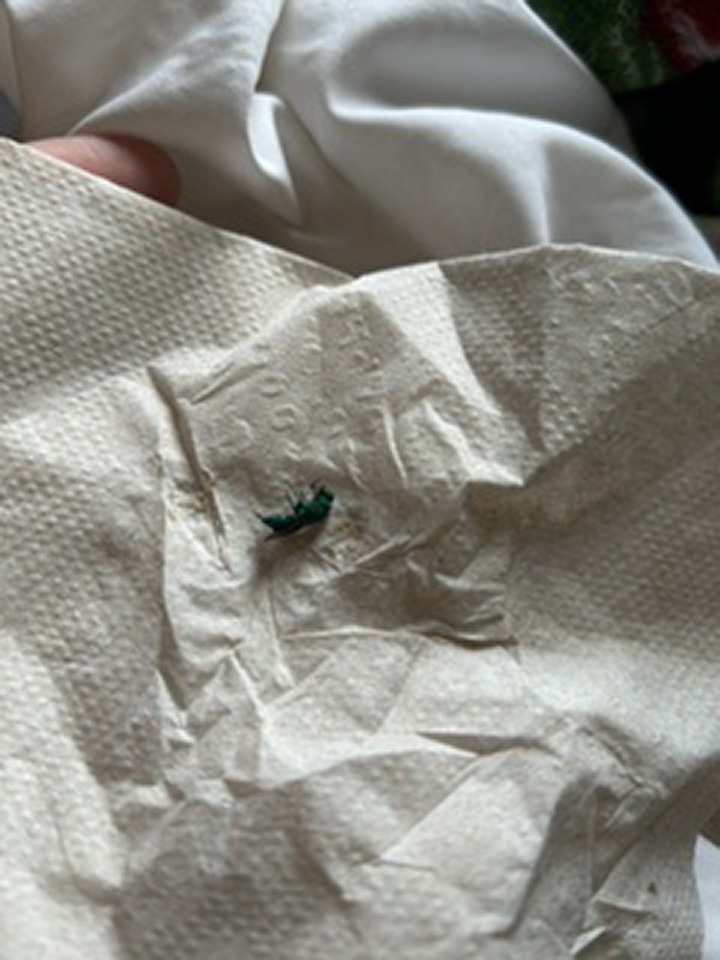
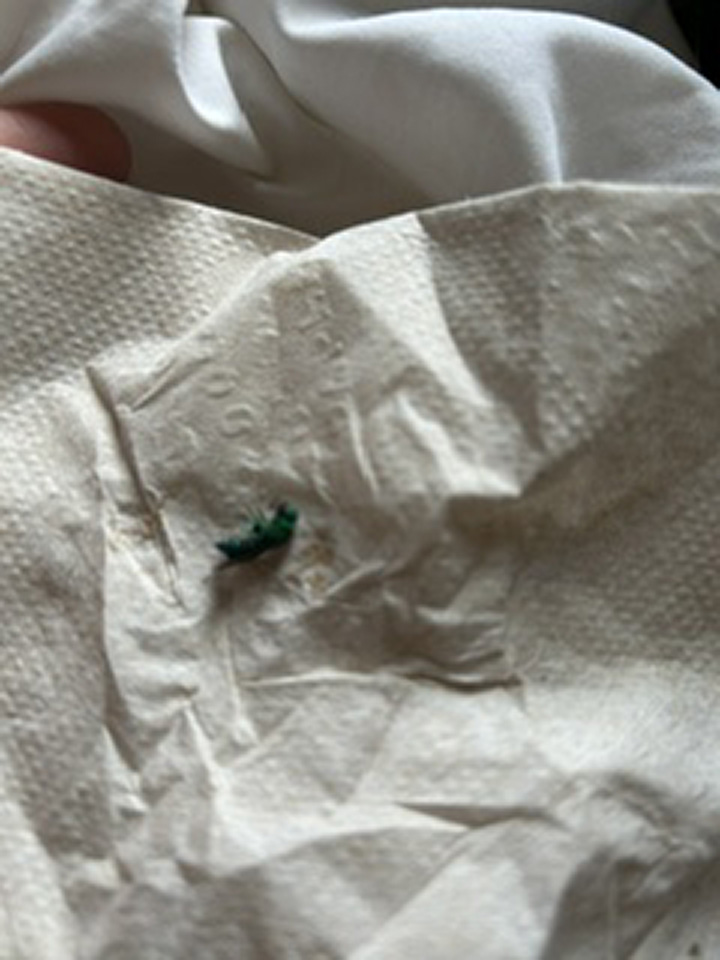
metallic bluish-green cuckoo wasp - Species Profile
Conservation • Description • Habitat • Ecology • Distribution • Taxonomy

Conservation Status
IUCN Red List
not listed
NatureServe
not listed
Minnesota
not listed
Description
Metallic bluish-green cuckoo wasp is an invasive, parasitic cuckoo wasp. It is native to Africa, Europe, Asia, and Australia. It was introduced into North America, probably during World War II, probably on ships with nests of mud daubers on their wooden beams. It is now widespread across the continent, but especially around the coasts.
The head, thorax, and abdomen are bright bluish-green with metallic reflections and coarse sculpturing.
The abdomen has of the male has four segments, that of the female has three segments. The exoskeletal plates on the bottom (ventral) side of the abdomen are flattened or concave. On the male, the rim on the last segment of the abdomen has three notches, four teeth, and a row of ten small pits along the edge. On the female the ovipositor is very long and stinger-like, and protrudes from the tip (apex) of the abdomen.
There are two large compound eyes, one on each side of the head; and three small simple eyes (ocelli) in a triangular pattern at the top of the head between the compound eyes. The antennae are black, short, and thread-like. They have 13 segments.
The wings have reduced venation. The forewing has 5 or fewer closed cells. The hindwing has a distinct lobe at the base and no closed cells.
Size
Total length: ¼″ to 7 ⁄16″
Similar Species
Habitat
Ecology
Season
Behavior
It curls up into a tight ball when threatened. Despite the long, stinger-like ovipositor, the female does not sting.
Life Cycle
The female lays eggs in the nest of a host while it is being provisioned but before it is sealed.
Larva Food/Hosts
Larvae of black and yellow mud dauber (Sceliphron caementarium)
Adult Food
Distribution

Sources
Chrysis angolensis Radoszkowski, 1881 in Bánki, O., Roskov, Y., Döring, M., Ower, G., Hernández Robles, D. R., Plata Corredor, C. A., Stjernegaard Jeppesen, T., Örn, A., Pape, T., Hobern, D., Garnett, S., Little, H., DeWalt, R. E., Miller, J., Orrell, T., Aalbu, R., Abbott, J., Abreu, C., Acero P, A., et al. (2026). Catalogue of Life (2026-05-15 XR). Catalogue of Life Foundation, Amsterdam, Netherlands. https://doi.org/10.48580/dgxsq
Occurrence
Widespread
Taxonomy
Order
Hymenoptera (Ants, Bees, Wasps, and Sawflies)
Suborder
Apocrita (Narrow-waisted Wasps, Ants, and Bees)
Infraorder
Aculeata (Ants, Bees, and Stinging Wasps)
Superfamily
Chrysidoidea (Cuckoo Wasps and Allies)
Family
Chrysididae (Cuckoo Wasps)
Subfamily
Tribe
Chrysidini
Genus
Chrysis
Reinstatement of Chrysis fuscipennis
This species has undergone a complex series of name changes due to homonymy rules and a recent re-evaluation of type specimens:
-
The Original Conflict (Junior Homonymy): For a long time, this widespread cuckoo wasp was known as Chrysis fuscipennis Brullé, 1846. However, taxonomists noted that it was a primary junior homonym of an earlier, obscurely described species: Chrysis fuscipennis Dahlbom, 1829. Under strict ICZN rules, two species in the same genus cannot share the exact same name, meaning Brullé's name had to be rejected.
-
The Temporary Shift (Chrysis angolensis): To fix the homonymy, the species took on the name of its next oldest available synonym, which was thought to be Chrysis angolensis Radoszkowski, 1881. BugGuide, iNaturalist, and many other databases updated their listings to C. angolensis during this period.
-
The 2024 Resolution (Rosa, 2024): After evaluating the historical type materials, researcher Paolo Rosa overturned this arrangement using two specific ICZN mechanisms:
-
Chrysis angolensis is a nomen dubium: Rosa determined that C. angolensis is a name of unknown or doubtful application, meaning it cannot reliably be assigned to this specific species group.
-
Reinstating C. fuscipennis Brullé: Because Dahlbom’s older 1829 name had not been used as a valid name after 1899, Rosa designated it a nomen oblitum (a forgotten name). This allowed him to formally declare Chrysis fuscipennis Brullé, 1846 a nomen protectum (a protected name) to preserve historical stability.
-
Summary: Chrysis angolensis is dropped as a nomen dubium. Chrysis fuscipennis Brullé, 1846 is officially resurrected (status revivisco) and reinstated as the valid name for this species.
Subordinate Taxa
Synonyms
Chrysis angolensis
Chrysis erratica
Chrysis janthinus
Tetrachrysis fuscipennis
Common Names
metallic bluish-green cuckoo wasp