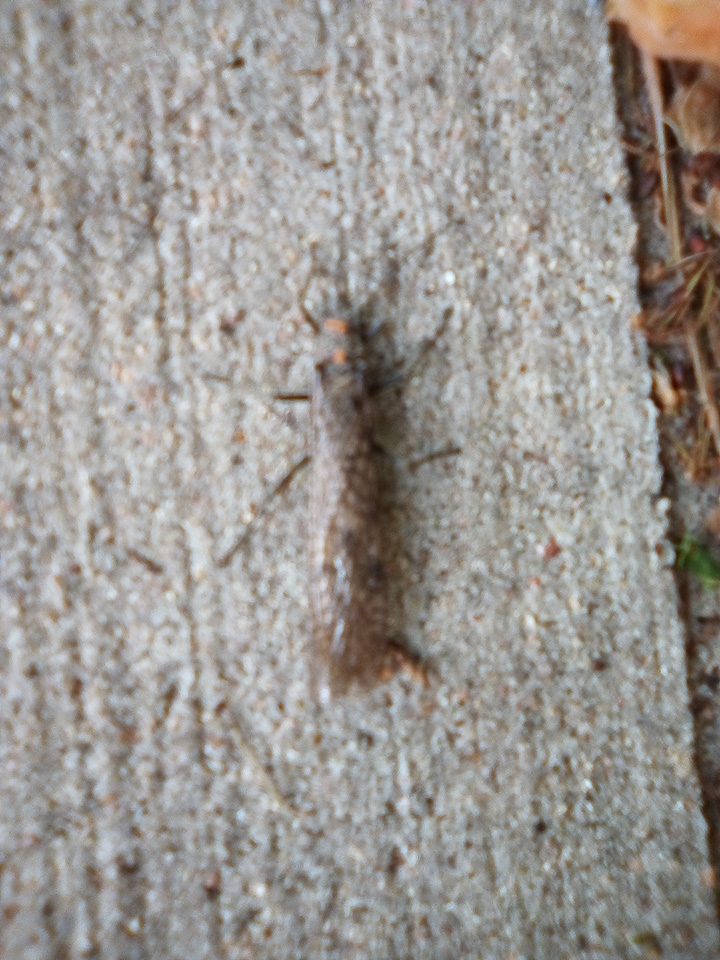
Midwestern salmonfly - Species Profile
Conservation • Description • Habitat • Ecology • Distribution • Taxonomy

Conservation Status
IUCN Red List
not listed
NatureServe
N5 - Secure
SNR - Unranked
Minnesota
not listed
Description
Midwestern salmonfly is a large, dark brown, giant stonefly. It is common in the Midwest from Minnesota and Wisconsin south to Kansas and Indiana.
Adults are 1½″ to 2½″ (38 to 64 mm) long. The body is soft, elongated, and flattened. Females are larger than males.
The head is rounded in front, narrows slightly in the rear, and has a thin, bright orange, rear margin. There are two large compound eyes at the side of the head and three simple eyes (ocelli) in a triangle on top of the head in the middle. The antennae are long and thread-like, and have many segments. The mouthparts are vestigial.
The exoskeletal plate covering the thorax (pronotum) is highly sculptured. It is dark brown with a thin, bright orange, longitudinal stripe in the middle. There are also three bright orange spots at the base.
There is a pair of sensory appendages (cerci) at the end of the abdomen. On males, on the sternite on the ninth segment (S9) is split at the into two lobes, and the tips bordering the notch are curved downward. On females, the rear margin of S8 has a small rectangular notch in the middle.
There are two pairs of membranous wings. The hindwings fold flat over the body fan-like and cover most of the abdomen. It has many prominent veins and a large anal lobe. The forewings are narrower and longer than the hindwings. It also has many prominent veins, including a series of cross veins between the media vein (M) and the cubitus vein (Cu) and between the first cubitus vein first branch (Cu1) and second branch (Cu2). The are also two rows of two rows of cross veins in the anal area and a row of cross veins between the costa (C), the vein at the leading edge of the wing, and the subcosta (Sc).
The third segment (femur) and fourth segment (tibia) of each leg is robust. There is a pair of claws at the end of each leg.
Size
Total length: 1½″ to 2½″ (38 to 64 mm)
Similar Species
American salmonfly (Pteronarcys dorsata) adults are distinguished from Midwestern salmonfly by the shape of the plate (sternite) on the underside of an abdominal segment. On males, the tips bordering the notch on S9 are straightish, not curved downward. On females, the rear margin of S8 is not notched, and sometimes there are two small projections (bumps) extending rearward.The ranges of the two species overlap completely in the east, but in Minnesota, Pteronarcys dorsata is mostly restricted to five northeastern. However, disjunct populations have been recorded extending down clean cold-water river corridors, including in Wabasha County.
Habitat
Cool, small to medium-sized streams
Ecology
Season
April to June
Behavior
Nymphs move very slowly. When disturbed they will pretend to be dead. Adults are poor fliers and when disturbed they will run rather than fly away. They are sometimes found far from water. They are active at night (nocturnal) and are attracted to lights.
Life Cycle
Nymphs live in well aerated water and take 2 to 3 years to develop. Adults emerge from April to June and live for only 2 to 3 weeks.
Larva Food/Hosts
Particulate plant matter
Adult Food
Adults do not feed
Distribution

Sources
Biodiversity occurrence data published by: Minnesota Biodiversity Atlas (accessed through the Minnesota Biodiversity Atlas Portal, bellatlas.umn.edu. Accessed 5/27/2026).
Pteronarcys pictetii Hagen, 1873 in GBIF Secretariat (2023). GBIF Backbone Taxonomy. Checklist dataset https://doi.org/10.15468/39omei accessed via GBIF.org. Accessed 5/27/2026.
Kondratieff, Boris C. and Richard W. Baumann (coordinators). 2000. Stoneflies of the United States. Jamestown, ND: Northern Prairie Wildlife Research Center Online. http://www.npwrc.usgs.gov/resource/distr/insects/sfly/index.htm (Version 12DEC2003). (archived)
Harden PH, Mickel CE. 1952. The stoneflies of MInnesota (Plecoptera). Technical Bulletin of the Minnesota Agricultural Experimental Station 201. 84 pp.
Dark Green Counties: The counties in dark green on the map containing records where specimens were verified to the species level.
Light Green Counties: The counties in light green contain monitoring records from the Minnesota Pollution Control Agency (MPCA). Historically, MPCA stream surveys identified giant stoneflies exclusively to the genus level (Pteronarcys sp.). Given that P. dorsata is biologically restricted to cold, high-gradient streams in the far northeastern arrowhead counties (and isolated cold-water driftless refugia like Wabasha County), these widespread light-green county records across central, western, and southern Minnesota can be confidently inferred as P. pictetii via geographical and ecological exclusion.
Occurrence
Common
Taxonomy
Order
Plecoptera (Stoneflies)
Suborder
Arctoperlaria
Infraorder
Systellognatha
Superfamily
Pteronarcyoidea
Family
Pteronarcyidae (Giant Stoneflies)
Genus
Subordinate Taxa
Synonyms
Common Names
Midwestern salmonfly