eastern purple coneflower - Species Profile
Conservation • Description • Habitat • Ecology • Use • Distribution • Taxonomy
Conservation Status
IUCN Red List
not listed
NatureServe
N4 - Apparently Secure
Minnesota
not listed
Description
Eastern purple coneflower, widely known in the nursery trade as purple coneflower, is an exotic, erect, 20″ to 48″ tall, perennial forb that rises on one to a few stems from a short, vertical rootstock and fibrous roots.
The stems are erect or ascending, usually brownish-green, round, finely ridged, and branched or unbranched. The are sometimes hairless but are usually sparsely to moderately covered with stiff, appressed to ascending, 1 ⁄32″ to 1 ⁄16″ long hairs.
Basal leaves are long stalked, the leaf stalks up to 6¾″ in length. The blades are narrowly to broadly egg-shaped, usually rounded or heart-shaped at the base, and long tapered to a sharp point at the tip. They are up to 11¾″ long and up to 4¾″ wide, about 1½ to 5 times as long as wide. They have usually 5, sometimes 3, prominent main veins. The upper and lower surfaces are rough to the touch and moderately to densely covered with stiff, appressed to loosely appressed hairs. The margins are usually irregularly toothed, rarely untoothed, and usually have a fringe of ascending hairs.
Stem leaves are alternate. They are short tapered to more or less rounded at the base but otherwise similar to basal leaves.
The inflorescence is a solitary flower head on a long stalk at the end of the stem. The flower stalk is leafless, 3″ to 10″ long, and covered with scattered hairs.
At the base of the flower head a whorl of 15 to 30 bracts in three or four overlapping series forming a ½″ to 1½″ in diameter, cup-shaped involucre. The bracts of the involucre (phyllaries) are green, linear to lance-shaped, 5 ⁄16″ to ⅝″ long, sparsely to moderately hairy, and fringed with hairs. The outermost phyllaries are bent backward above the middle.
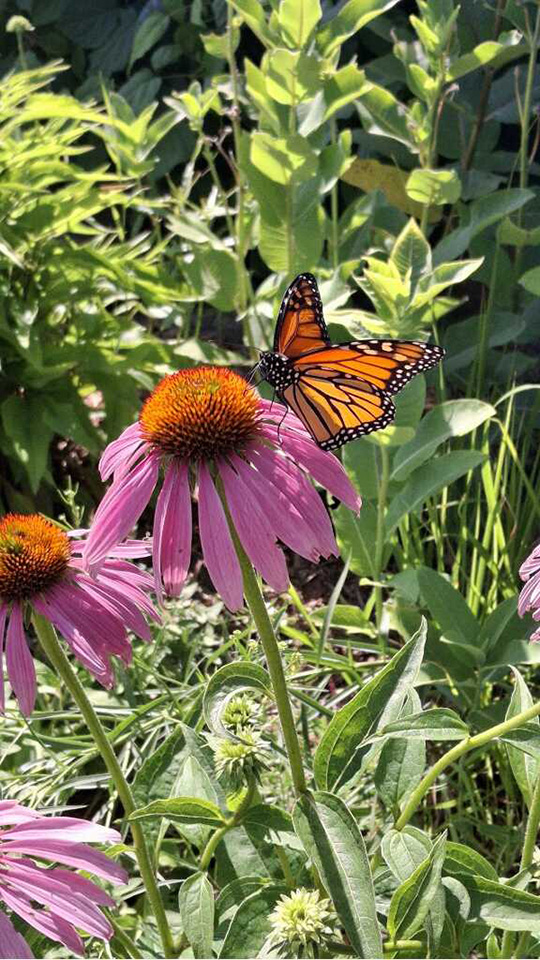
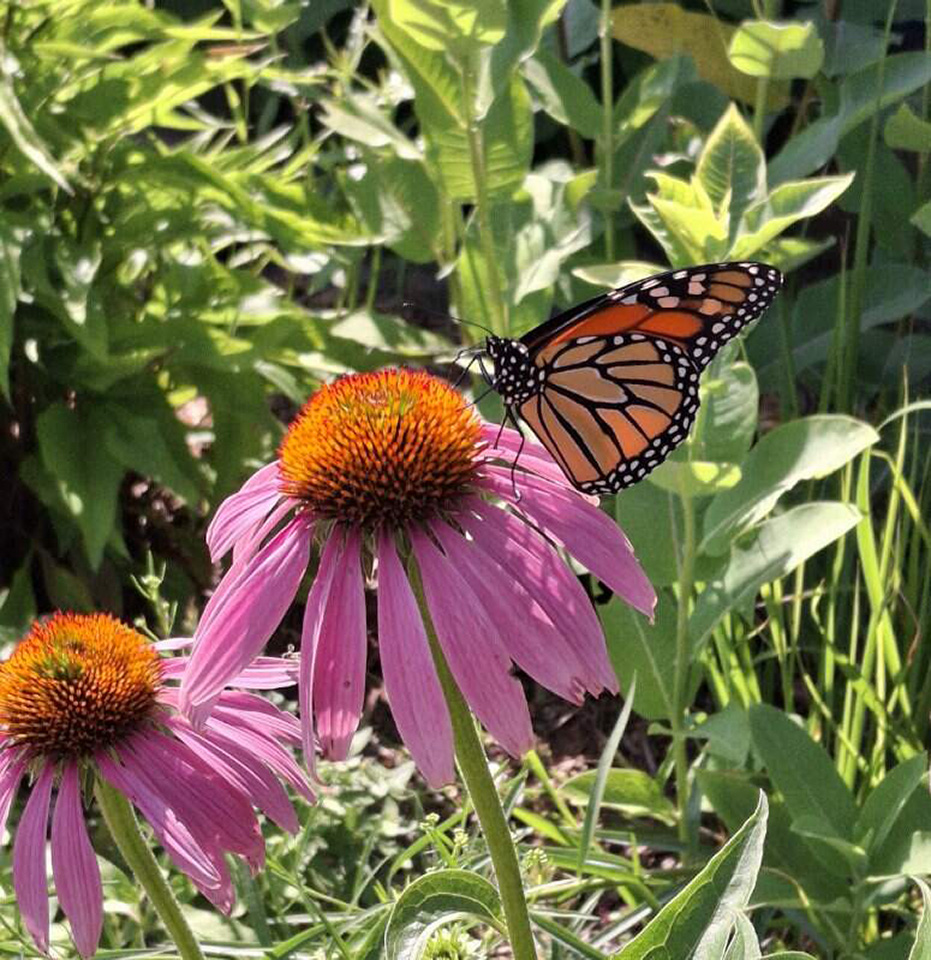
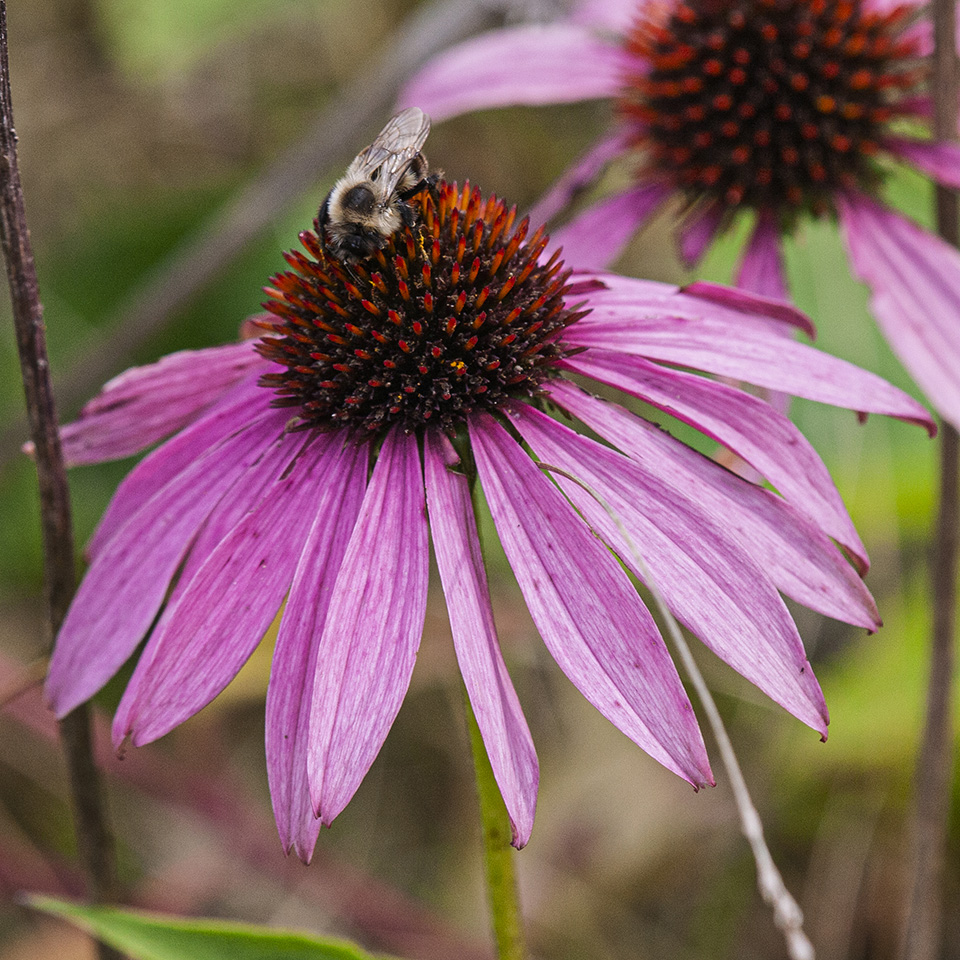
The flower heads are 2½″ to 4″ in diameter. There are 8 to 21 ray florets and 200 to 300 or more disk florets. The disk is flattened when young, becoming cone-shaped as it ages. It is 9 ⁄16″ to 1¾″ tall and ¾″ to 9 ⁄16″ in diameter. The ray florets are pink to purplish or rarely white, 1¼″ to 3⅛″ long, ¼″ to ¾″ wide, and spreading to somewhat drooping at flowering time. The disk florets have five petals fused at the base into a yellow to green tube then separated at the tip into five dark purple lobes. Each disk floret is subtended by a thin, dry, bract. The bracts are ⅜″ to 9 ⁄16″ long, hardened, and sharply pointed with a spine-like tip. They are noticeably longer than the disk corollas. They are usually dark purple at the tip. They remain on the plant at fruiting time.
The fruit is a dry, wedge-shaped, 4-angled in cross section, slightly flattened, ⅛″ to 3 ⁄16″ long seed chamber (cypsela) with a crown of feather-like hairs attached to one end. It is tan toward the base, banded with dark brown toward the tip.
Height
20″ to 48″
Flower Color
Pink to purplish ray florets, purple disk florets
Similar Species
Narrow-leaved purple coneflower (Echinacea angustifolia var. angustifolia) is a shorter plant, no more than 27″ in height. The leaves are egg-shaped, narrower, and 5 to 20 times as long as wide. The leaf margins are untoothed. The hairs on the leaf surfaces are spreading, not appressed. The flower heads are smaller, no more than 2″ in diameter.
Habitat
Dry to moderate moisture. Prairies, woods. Full or partial sun.
Ecology
Flowering
June to October
Pests and Diseases
Use
Distribution

Sources
Biodiversity occurrence data published by: Minnesota Biodiversity Atlas (accessed through the Minnesota Biodiversity Atlas Portal, bellatlas.umn.edu. Accessed 7/24/2026).
Midwest Herbaria Portal. 2026. https://midwestherbaria.org/portal/index.php. Accessed 7/24/2026.
Echinacea purpurea (L.) Moench in Bánki, O., Roskov, Y., Döring, M., Ower, G., Hernández Robles, D. R., Plata Corredor, C. A., Stjernegaard Jeppesen, T., Örn, A., Pape, T., Hobern, D., Garnett, S., Little, H., DeWalt, R. E., Miller, J., Orrell, T., Aalbu, R., Abbott, J., Abreu, C., Acero P, A., et al. (2026). Catalogue of Life (2026-07-17 XR). Catalogue of Life Foundation, Amsterdam, Netherlands. https://doi.org/10.48580/dgykv
The counties in light green on the map represent observations on iNaturalist and repeated on GBIF. Many or even most of those are plants in residential yards or other tended plantings, and therefore not “outside of cultivation.”
Though not native to Minnesota, eastern purple coneflower seed is often included in prairie restorations in the state. Since these are self-sustaining populations, they are “outside of cultivation,” and are dark green on the map.
Nativity
Native south and east of Minnesota, including Iowa and Wisconsin. Introduced, cultivated. Sometimes escapes cultivation.
Occurrence
Common in recent prairie restorations and plant demonstration areas in city, county, and state parks.
Eastern purple coneflower is not native to Minnesota. It is a cultivated plant sold in nurseries. The seeds are often included in wildflower mixes purchased by city, county, regional, and even state parks. As a result, this plant can often be found in parks in Minnesota, especially in recently restored prairies and in showcase plantings near visitor centers.
Taxonomy
Kingdom
Subkingdom
Pteridobiotina
Phylum
Tracheophyta (Vascular Plants)
Class
Order
Asterales (Sunflowers, Bellflowers, Fanflowers, and Allies)
Family
Asteraceae (Sunflowers, Daisies, Asters, and Allies)
Subfamily
Asteroideae
Tribe
Heliantheae (Sunflowers and Allies)
Genus
Subtribe
Zinniinae
Echinacea (Coneflowers)
Subordinate Taxa
Brauneria purpurea
Echinacea intermedia
Echinacea purpurea f. ligettii
Echinacea purpurea f. purpurea
Echinacea purpurea ssp. serotina
Echinacea purpurea var. arkansana
Echinacea purpurea var. purpurea
Echinacea purpurea var. serotina
Echinacea serotina
Helichroa alba
Helichroa amoena
Helichroa crocea
Helichroa elatior
Helichroa fusca
Helichroa fuscata
Helichroa linnaeana
Helichroa purpurea
Helichroa uniflora
Lepachys purpurea
Rudbeckia aspera
Rudbeckia hispida
Rudbeckia purpurea
Rudbeckia purpurea var. purpurea
Rudbeckia purpurea var. serotina
Rudbeckia serotina
Common Names
eastern purple coneflower
echinacea
hedgehog coneflower
purple coneflower