purple loosestrife - Species Profile
Conservation • Weed • Wetland • Description • Habitat • Ecology • Use • Distribution • Taxonomy

Conservation Status
IUCN Red List
not listed
NatureServe
NNA - Not applicable
SNA - Not applicable
Minnesota
not listed
Weed Status
Prohibited Control Noxious Weed
Wetland Indicator Status
Great Plains
OBL - Obligate wetland
Midwest
OBL - Obligate wetland
Northcentral & Northeast
OBL - Obligate wetland
Description
Purple loosestrife is an erect, stout, perennial forb that rises on 30 to 50 stems from a taproot and shallow, fibrous roots that develop rhizomes. It can be 12″ to 72″ tall, though in Minnesota it is usually less than 48″ in height.
The stems are erect, square, hairy within the inflorescence, variably hairy above the middle, hairless below. Mature plant stems may be 5- or 6-sided and woody near the base in late summer.
The leaves are opposite below the inflorescence, sometimes alternate within the inflorescence. Sometimes they appear in whorls of 3. They are lance-shaped to nearly linear, 1″ to 4″ long, and 3 ⁄16″ to ⅝″ wide, becoming gradually smaller as they ascend the stem. They taper to a point at the tip and are rounded at the base. The larger leaves are somewhat heart-shaped at the base and slightly clasp the stem. The upper and lower surfaces are more or less softly hairy, especially those near the top of the stem. The margins are untoothed.
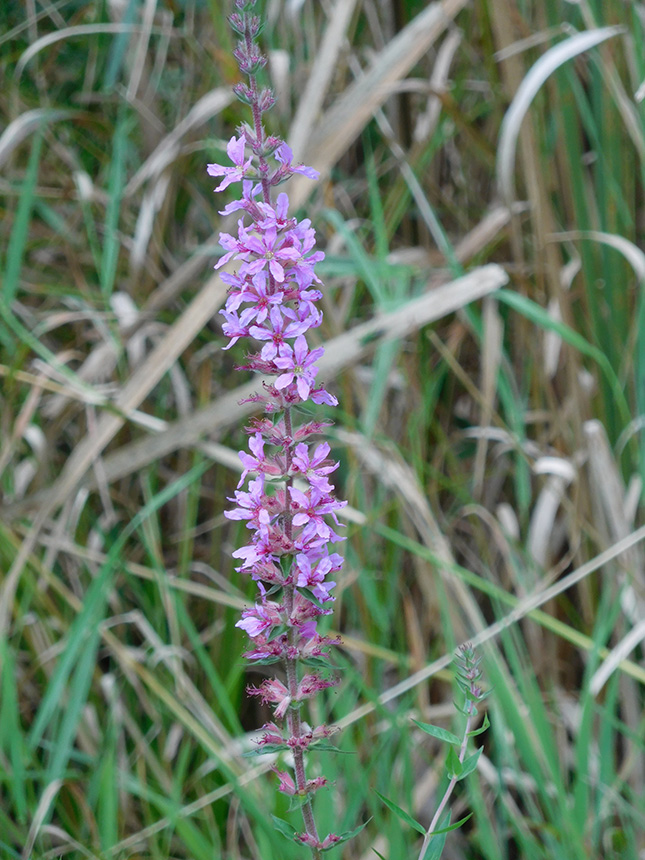
The inflorescence is a dense, 6″ to 14″ long, spike-like cluster of numerous flowers at the end of the stem. The flowers are in whorled clusters rising from a pair of hairy, leaf-like bracts. The clusters have 1 or more stalkless flowers and there are 3 to 9 flowers per whorl.
Individual flowers are ½″ to 1″ wide. There are 5 or 6, sometimes 7, pink to purple petals and the same number of green to purple sepals. The petals are about twice as long as the sepals. The petals are fused at their base with the sepals for most of the sepal length into a hairy, 12-nerved, 3 ⁄16″ to 5 ⁄16″ long, 1 ⁄16″ wide tube (hypanthium). There are always at least 10, usually 12, stamens, in 2 whorls of 5 or 6 each. There are three types of flowers, distinguished as those with short, medium, or long styles. Flowers with short styles have a whorl of long stamens and a whorl of medium length stamens. Flowers with medium-length styles have a whorl of long stamens and a whorl of short stamens. Flowers with long styles have medium to short stamens. The longer stamens protrude well beyond the tube.
The fruit is a two-chambered capsule about ⅛″ long and 1 ⁄16″ in diameter containing many dust-like seeds.
Height
12″ to 72″
Flower Color
Pink to purple
Similar Species
Fireweed (Chamerion angustifolium) stem is round. The leaves are alternate. The flower spike is 4″ to 5″ wide at the base.
Swamp loosestrife (Decodon verticillatus) stems are usually arched and rooting at the tip, not erect. The leaves are usually in whorls of 3 or 4 and are on short leaf stalks. The flowers are in dense clusters in the upper leaf axils.
Winged loosestrife (Lythrum alatum var. alatum), a native plant, is usually hairless. The middle and upper leaves are alternate. The flowers are smaller, ½″ across or less, and appear singly in the upper leaf axils. There are always fewer than 10 stamens per flower.
Habitat
Wet. Fens, marshes, meadows, shores, shallows. Full to partial sun.
Ecology
Flowering
July to September
Pests and Diseases
Biological Control
Several insects that are native to the historic range of purple loosestrife have been intentionally introduced into North America to control the spread of this invasive plant species.
black-margined loosestrife beetle (Neogalerucella calmariensis)
flower bud weevil (Nanophyes marmoratus)
Goeze root-boring weevil (Hylobius transversovittatus)
golden loosestrife beetle (Neogalerucella pusilla)
Use
Distribution

Sources
Biodiversity occurrence data published by: Minnesota Biodiversity Atlas (accessed through the Minnesota Biodiversity Atlas Portal, bellatlas.umn.edu. Accessed 3/10/2026).
Midwest Herbaria Portal. 2026. https://midwestherbaria.org/portal/index.php. Accessed 3/10/2026.
Lythrum salicaria L. in GBIF Secretariat (2023). GBIF Backbone Taxonomy. Checklist dataset https://doi.org/10.15468/39omei accessed via GBIF.org. Accessed 3/10/2026.
EDDMapS. 2013. Early Detection & Distribution Mapping System. The University of Georgia - Center for Invasive Species and Ecosystem Health. Available online at www.eddmaps.org/. Accessed 3/10/2026.
Nativity
Native to Europe, Asia, northern Africa, Australia, and the Indian subcontinent. Introduced and naturalized in North America.
Occurrence
Common
Taxonomy
Kingdom
Subkingdom
Pteridobiotina
Phylum
Tracheophyta (Vascular Plants)
Class
Order
Myrtales (Myrtles, Evening Primroses, and Allies)
Family
Lythraceae (Lythrum)
Subfamily
Lythroideae
Genus
Lythrum (Lythrum Loosestrifes)
Subordinate Taxa
Synonyms
Chabraea vulgaris
Lythron salicarium
Lythrum alternifolium
Lythrum anceps
Lythrum argyi
Lythrum cashmerianum
Lythrum cinereum
Lythrum coronense
Lythrum diffusum
Lythrum dubium
Lythrum gracile
Lythrum hexagonum
Lythrum intermedium
Lythrum nummulariifolium
Lythrum palustre
Lythrum propinquum
Lythrum pubescens
Lythrum purshianum
Lythrum quadrifolium
Lythrum salicaria ssp. anceps
Lythrum salicaria ssp. dubium
Lythrum salicaria ssp. tomentosum
Lythrum salicaria var. anceps
Lythrum salicaria var. angustifolium
Lytharia var. bracteolatum
Lythrum salicaria var. bracteosum
Lythrum salicaria var. canescens
Lythrum salicaria var. genuinum
Lythrum salicaria var. glabricaule
Lythrum salicaria var. glabrum
Lythrum salicaria var. gracile
Lythrum salicaria var. gracilior
Lythrum salicaria var. leptostachyum
Lythrum salicaria var. longespicatum
Lythrum salicaria var. longistylum
Lythrum salicaria var. macrostachyum
Lythrum salicaria var. mairei
Lythrum salicaria var. pubescens
Lythrum salicaria var. quadrifolium
Lythrum salicaria var. salicaria
Lythrum salicaria var. stylosa
Lythrum salicaria var. tomentosum
Lythrum salicaria var. verticillatum
Lythrum salicaria var. vulgare
Lythrum salicarium
Lythrum spicatum
Lythrum spicatum var. verticillatum
Lythrum spiciforme
Lythrum tomentosum
Salicaria spicata
Salicaria vulgaris
Common Names
purple loosestrife
purple lythrum
rainbow weed
salicaire
spiked loosestrife