rattlesnake master - Species Profile
Conservation • Wetland • Description • Habitat • Ecology • Use • Distribution • Taxonomy

Conservation Status
IUCN Red List
not listed
NatureServe
N5 - Secure
S3 - Vulnerable
Minnesota
Special Concern
This is a common plant of native tallgrass prairies in the eastern United States. Southeastern Minnesota is the northwest extent of its natural range, but very little tallgrass prairie remains in the state. This habitat loss led the Minnesota DNR to list rattlesnake master as a special concern species in 1984.
Wetland Indicator Status
Great Plains
FACW - Facultative wetland
Midwest
FAC - Facultative
Northcentral & Northeast
FAC - Facultative
Description
Rattlesnake master is a 16″ to 59″ tall, erect, long-lived, perennial forb that rises on a clump of grass-like basal leaves and a single stem from a small, close bundle of tuberous roots.
Most of the leaves are basal. Basal leaves are stalkless, broadly linear, 6″ to 32″ long, and ⅜″to 1¼″ wide. The leaf blades are stiff, parallel-veined, and taper for most of their length to a sharp point at the tip. The upper and lower surfaces are bluish-green, hairless, and strongly covered with a whitish, waxy substance (glaucous). The margins have widely-spaced, spiny or thread-like, forward-pointing teeth. At least a few basal leaves are present at flowering time.
Stem leaves are few. They are wrap around (clasp) the stem at the base but are otherwise similar to basal leaves. They become progressively much smaller as they ascend the stem.
The stem is erect or ascending, ridged, hairless, and strongly glaucous. It is unbranched except just below the inflorescence.
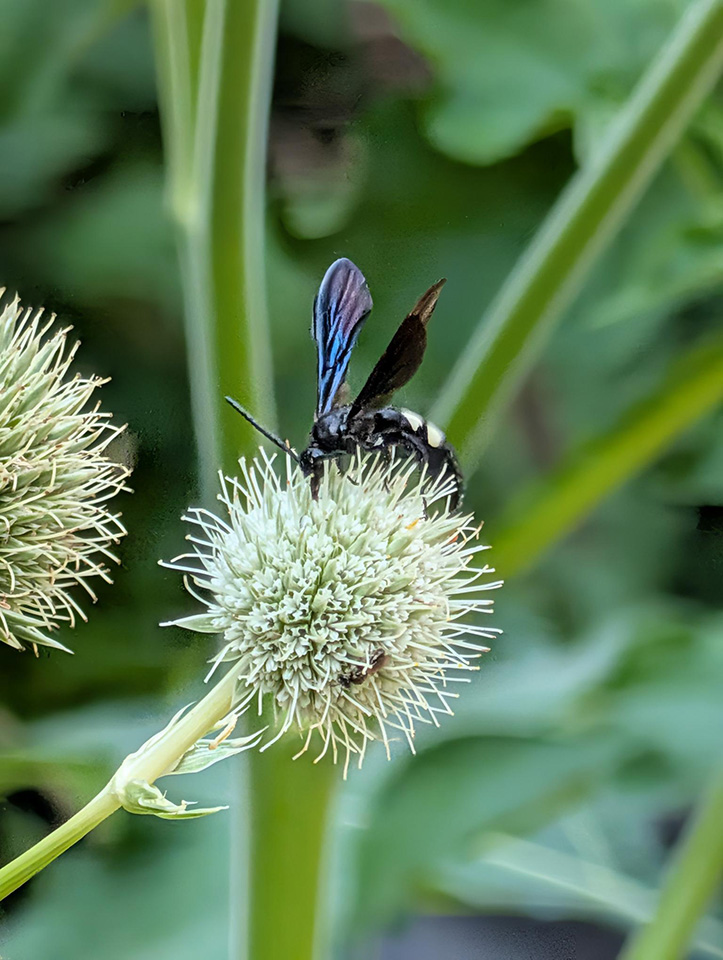
The inflorescence is a spiny head of numerous small, inconspicuous flowers, appearing singly or as branched cluster of several heads, on a long stalk at the end of the stem and each branch. Each branch of the inflorescence is subtended by a single modified leaf (bract). The inflorescence bracts are much smaller than the leaves and have spiny teeth or lobes on the margins. The flower heads are spherical to egg-shaped, ⅜″ to 1″ in diameter, and densely packed with numerous white flowers. They are subtended by a whorl of 6 to 10 bracts. These bracts are narrowly egg-shaped, sharply pointed, 5 ⁄16″ to ⅝″ long, and untoothed or finely toothed.
Each flower is stalkless and subtended by a single grayish-white, ¼″ to ⅜″ long, prickly bractlet. There are 5 sepals, 5 petals, 5 stamens, and 2 styles. The sepals are ⅛″ long, fused at the base for most of their length, and separated at the tip into 5 egg-shaped teeth. The petals are white, oblong, and rounded at the tip. The stamens have long white filaments and light brown anthers. The styles are thread-like and protrude well above the corolla. The flowers have a faint honey-like scent that becomes more intense in strong sunlight. In the fall they turn purplish then brown.
The fruit is a brown, ⅛″ to 5 ⁄16″ long, 2-chambered seedcase (schizocarp). It is oblong in outline, slightly flattened laterally and tapers to a short, prolonged extension (beak) at the tip. It ripens in early September to mid-October and splits into 2 separate seedcases (mericarps), each with a single seed. Each mericarp has 5 angles but is not ribbed, and has ascending, flattened, papery scales attached to the angles.
Height
16″ to 59″
Flower Color
White to purplish
Similar Species
No similar species
Habitat
Moist to slightly dry. Prairies, railroads and abandoned railways. Full sun.
Ecology
Flowering
Early July to mid-August
Pests and Diseases
Use
Rattlesnake master seed is a frequent ingredient in native prairie seed mixes used in southeastern Minnesota, where it is native, and increasingly in other parts of the state, where it is not.
The common name rattlesnake master is derived from its traditional use by Native Americans to treat rattlesnake bite. The plant was also used as a diuretic, a sedative, a pain reliever, a tonic, and for cordage.
Distribution

Sources
Biodiversity occurrence data published by: Minnesota Biodiversity Atlas (accessed through the Minnesota Biodiversity Atlas Portal, bellatlas.umn.edu. Accessed 8/2/2026).
Midwest Herbaria Portal. 2026. https://midwestherbaria.org/portal/index.php. Accessed 8/2/2026.
Eryngium yuccifolium Michx. in Bánki, O., Roskov, Y., Döring, M., Ower, G., Hernández Robles, D. R., Plata Corredor, C. A., Stjernegaard Jeppesen, T., Örn, A., Pape, T., Hobern, D., Garnett, S., Little, H., DeWalt, R. E., Miller, J., Orrell, T., Aalbu, R., Abbott, J., Abreu, C., Acero P, A., et al. (2026). Catalogue of Life (2026-07-17 XR). Catalogue of Life Foundation, Amsterdam, Netherlands. https://doi.org/10.48580/dgykv
Minnesota Department of Natural Resources, Division of Ecological and Water Resources. 2022. Rare Species Guide: an online encyclopedia of Minnesota's rare native plants and animals [web application]. Minnesota Department of Natural Resources, St. Paul. www.dnr.state.mn.us/rsg. Accessed 8/2/2026.
Nativity
Native
Occurrence
Taxonomy
Kingdom
Subkingdom
Pteridobiotina
Phylum
Tracheophyta (Vascular Plants)
Class
Order
Apiales (Carrots, Ivies, and Allies)
Family
Apiaceae (Carrot)
Subfamily
Saniculoideae
Tribe
Saniculeae
Genus
Eryngium (Eryngos)
Subgenus
Monocotyloidea
Species
Eryngium yuccifolium (rattlesnake master)
Subfamily
GRIN places the genera Eryngium and Sanicula in the the subfamily Apioideae. NCBI and the APG IV system place the two genera in the subfamily Saniculoideae, and this is supported by at least two recent molecular DNA studies. No discussion of moving the genera could be found. If the placement in the subfamily Apioideae is an error, that error is repeated by Wikipedia on both Eryngium and Sanicula pages.
Subordinate Taxa
Synonyms
Common Names
button eryngo
button snakeroot
northern rattlesnake master
rattlesnake master