


Western Meadow Vole - Species Profile
Conservation • Description • Habitat • Ecology • Distribution • Taxonomy
Conservation Status
IUCN Red List
LC - Least Concern
NatureServe
N5 - Secure
SNR - Unranked
Minnesota
not listed
Description
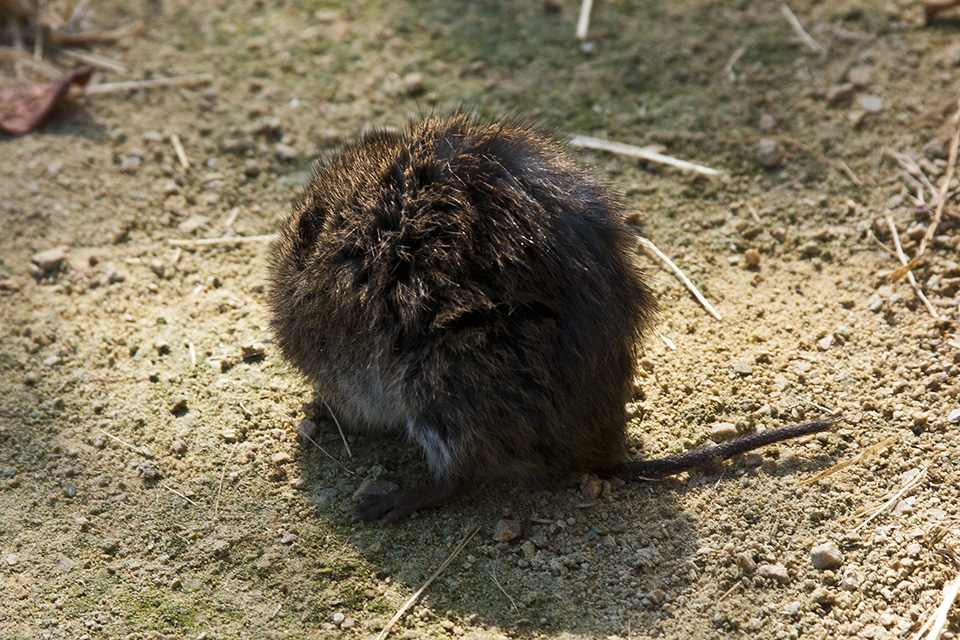
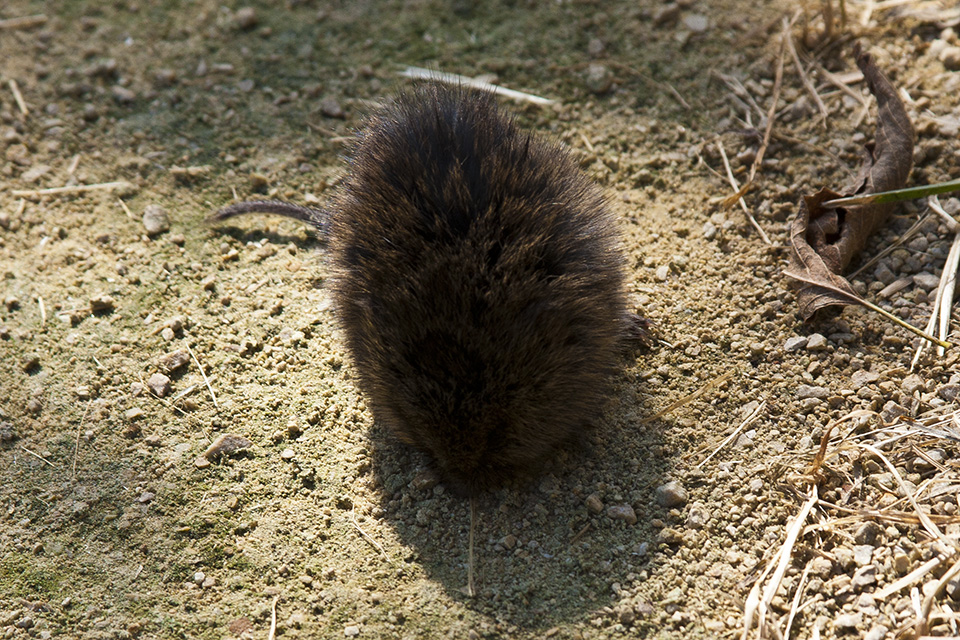
Western Meadow Vole is the largest vole found in Minnesota. It weighs between 1 and 2½ ounces. The length of the head and body together is 3½″ to 5″. The total length, including the tail, is 5″ to 7¾″. The body is 2 to 3 times as long as the tail.
The ears are small, inconspicuous, and hidden by the fur.
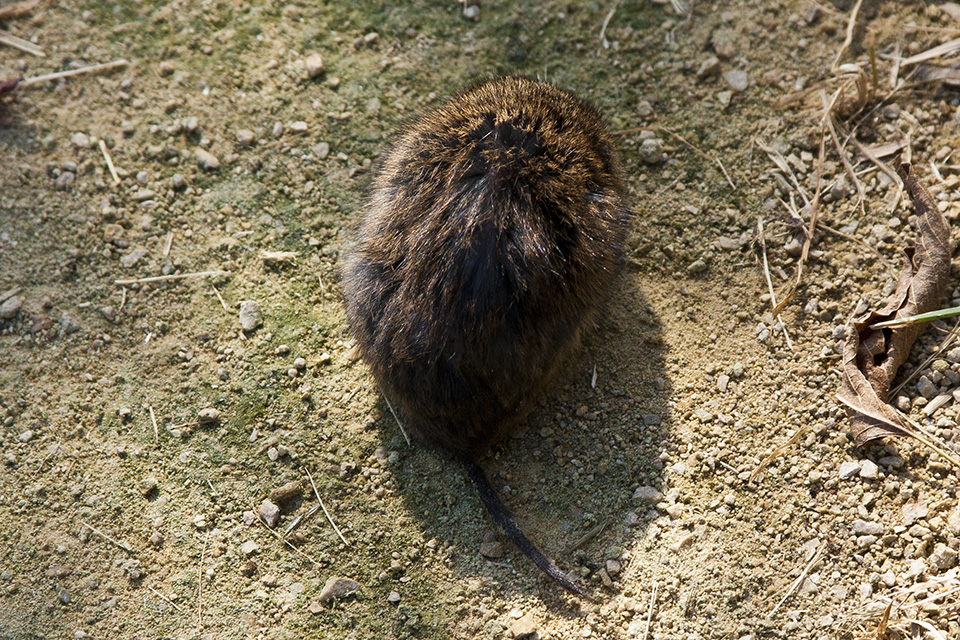
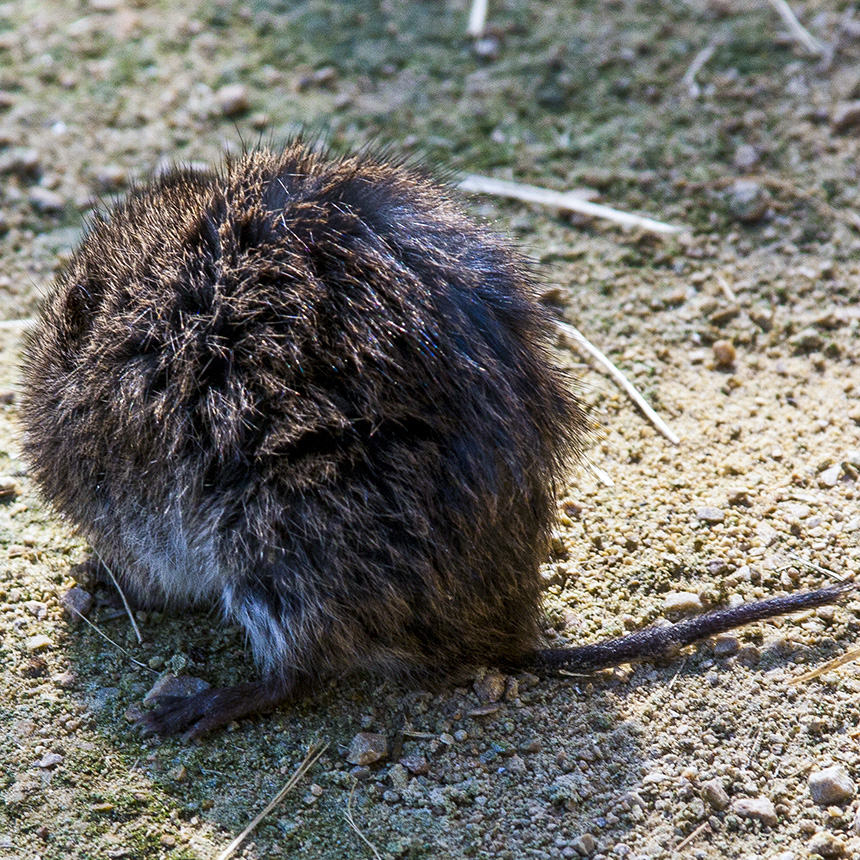
The coat (pelage) is long and soft. It is dark brown on the back, a little lighter on the sides, and silvery on the belly. It is darker on young individuals, lighter on older individuals.
The tail is 15 ⁄16″ to 2½″ long and bicolored. It is 2 to 3 times longer than the hind foot.
Size
Total Length: 5″ to 7¾″
Head and body: 3½″ to 5″
Tail: 15 ⁄16″ to 2½″
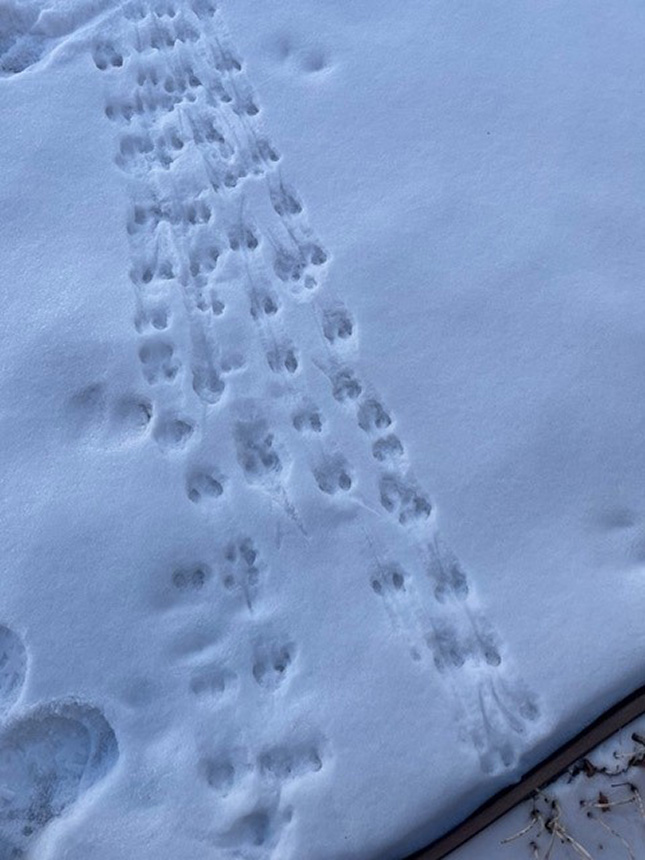
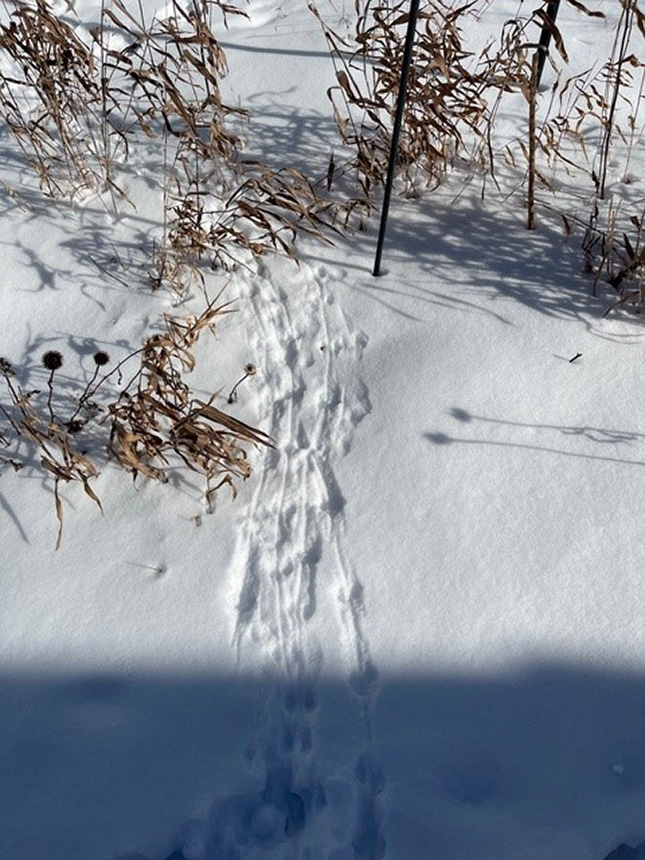
Sign
Similar Species
Prairie Vole (Microtus ochrogaster) pelage has a grizzled appearance. The belly is yellowish. The tail is shorter, 1″ to 1¾″long. Where the ranges overlap Prairie Vole will be in drier areas.
Habitat
Meadows, fields, grassy marshes, grassy woodlands. Moist places.
Ecology
Behavior
Adults are active all times of day.
Lifespan
Less than one year
Life Cycle
Breeding takes place between April and December. Two to four litters are produced each year. There are usually 4 to 6 offspring per litter though there may be as few as 1 or as many as 11. Gestation lasts 20 to 23 days. Due to high nestling and juvenile mortality, an average of only 2.6 offspring are successfully weaned. The offspring reach sexual maturity at 5 to 6 weeks. Adults usually live less than one year but may live up to two years.
Food
Diet consists mostly of grasses, sedges, and herbs, but also includes seeds, grains, and when available, tubers, bulbs, and fruits. In the winter they sometimes eat the bark and roots of woody shrubs and trees.
Distribution |
||
|
Sources Biodiversity occurrence data published by: Minnesota Biodiversity Atlas (accessed through the Minnesota Biodiversity Atlas Portal, bellatlas.umn.edu, 12/15/2025). Timm, R. M. 1975. Distribution, natural history, and parasites of mammals of Cook County, Minnesota. Occasional Papers, Bell Museum of Natural History, University of Minnesota 14:1–56. Hazard, Evan B. 1982. The Mammals of Minnesota. University of Minnesota Press, Minneapolis, Minnesota. 280 pp. |
|
| 12/15/2025 | ||
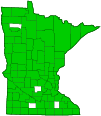
Occurrence |
||
Very common |
||
Taxonomy
Class
Subclass
Theria
Infraclass
Placentalia (Placental Mammals)
Magnorder
Boreoeutheria
Superorder
Euarchontoglires (Primates, Rodents, and Allies)
Order
Rodentia (Rodents)
Suborder
Supramyomorpha
Infraorder
Myomorphi
Superfamily
Muroidea
Family
Cricetidae (Hamsters, Voles, Lemmings, and Allies)
Subfamily
Arvicolinae (Voles, Lemmings, and Muskrats)
Tribe
Arvicolini
Genus
Microtus (Meadow Voles)
Subgenus
Mynomes
Suborder
The American Society of Mammalogists Mammal Diversity Database (MDD) currently places the species within the Suborder Supramyomorpha. This designation reflects the acceptance of recent large-scale molecular phylogenetic studies that reorganized the Rodentia into three major clades. The necessity for the new suborder arose because genetic analysis showed that the classical Suborder Myomorpha, which housed the mouselike rodents, was paraphyletic—it included the common ancestor but excluded certain descendant groups (like beavers and pocket gophers). Supramyomorpha is the larger, monophyletic group that includes the traditional Myomorpha and all of its descendants. The classification system recognizing Suborder Supramyomorpha was adopted in the paper Flynn et al. (2019), with the name formally proposed by D'Elía et al. (2019). We acknowledge that many regional checklists and traditional resources continue to use the more classical and recognizable Suborder Myomorpha.
Tribe
The genus Microtus was formerly included with Arvicola in the broadly defined tribe Arvicolini based on morphological similarity. Recent molecular genetic analysis (Golenishchev and Malikov, 2006) showed that the two genera are not “sister taxa.” In 2006, Microtus was moved to the new tribe Microtini, which now contains seven other genera, all sharing the derived trait of rootless, ever growing molars and crown cement. This site, however, adheres to the current classification of the MDD, which retains Microtus within the tribe Arvicolini.
Species
A recent DNA analysis (Jackson and Cook, 2020) analyzed the mitochondrial DNA of all 28 subspecies of Microtus pennsylvanicus. The authors proposed separating Microtus pennsylvanicus into four distinct species. Under this arrangement, Microtus drummondii is the most widespread species. It subsumes fifteen former subspecies, and it is the only species occurring in Minnesota. It has been given the common name Western Meadow Vole.
Subgenus
The subgenus placement for Microtus drummondii is currently one of the most disputed areas of its classification. Historically, species like the Western Meadow Vole were placed in the subgenus Mynomes, based primarily on cranial characteristics. However, the recent molecular split by Jackson and Cook (2020) placed the resulting species, M. drummondii, into the subgenus Pitymys. The MDD continues to use the subgenus Mynomes for Microtus drummondii, a common practice among major authorities seeking to maintain stability while broader taxonomic revisions for the entire genus Microtus are finalized.
This site adheres to the current classification of the MDD, which places Microtus drummondii in the subgenus Mynomes, retains Microtus within the tribe Arvicolini, and places the infraorder Myomorphi in the Suborder Supramyomorpha.
Subordinate Taxa
While some sources, such as iNaturalist.org, still list numerous historical subspecies for the Western Meadow Vole, the current scientific consensus suggests they are invalid. The extensive historical subspecies list—remnants of the original Microtus pennsylvanicus complex—was based on minor, overlapping morphological differences. The recent molecular analysis by Jackson and Cook (2020), which established Microtus drummondii as a distinct species, found that these historical subspecies do not represent distinct, genetically supported evolutionary units. For this reason, major authoritative taxonomic lists do not recognize any subspecies for Microtus drummondii.
Synonyms
Common Names
Western Meadow Vole
Glossary
Pelage
The coat of a mammal, consisting of fur, wool, or hair, and including a soft undercoat and stiff guard hairs.