Tree-skirt moss
(Pseudanomodon attenuatus)
Information
Conservation • Description • Habitat • Ecology • Use • Distribution • Taxonomy
Conservation Status
IUCN Red List
LC - Least Concern
NatureServe
NNR - Unranked
SNR - Unranked
Minnesota
not listed
Description
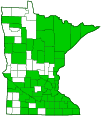
Tree-skirt Moss is a common, large, feather moss. It occurs in Europe, eastern Asia, North America, and Central America. It occurs in the United States and southern Canada east of the Great Plains, with a few scattered populations in the west. It is common in Minnesota. It is found in forests, brushy meadows (meadow/carrs), swamps, bogs, peatlands, and river shores. It most often grows as a large, dense, rough mat on the base of hardwood trees, but smaller populations are found on wet cliffs, bedrock outcrops, rocky shores, and mineral-rich soil. In rocky areas it is found on or associated with limestone, sandstone, or dolomite.
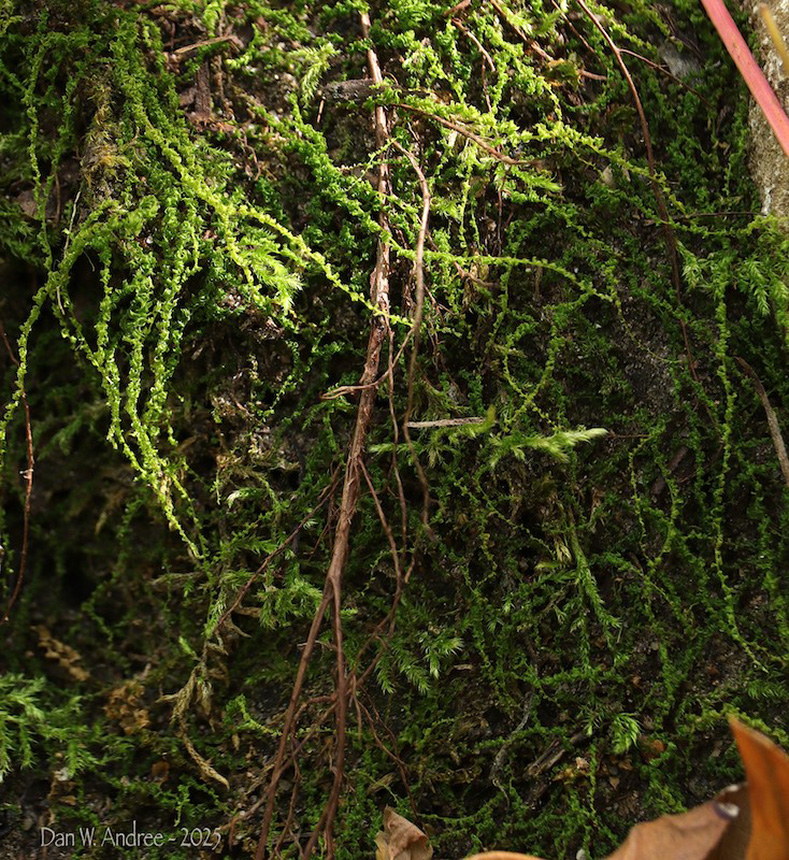
The stems are light green to light yellowish brown, leafy, ⅝″ to 1¼″ (15 to 30 mm) long, and 1⁄32″ (0.8 to 1.0 mm) thick. Older primary stems usually lay flat on the ground or against the substrate. When on a tree trunk or other vertical surface, younger stems grow out from the base and droop slightly. When on the ground they are sprawling to ascending. Primary stems are blunt at the tip. Young stems are often attenuate, and this is the feature that gives the plant its species epithet “attenuatus.” Attenuate branches are tapered gradually to a very slender, thread-like or needle-like tip. The leaves are much smaller and thinner, and they are tightly wrapped around the stem. This makes the branch look like a thin green string. Some attenuate branches eventually fill out with normal-sized leaves. Some can become significantly longer and whip-like, essentially “runners,” that can start a new colony where they touch the ground.
The branch leaves are closely spaced, spirally arranged, and overlapping. When wet, the top and bottom leaves are twisted sharply at the base to point out toward the sides, and the lateral leaves stay spreading outward. They end up lying on the same horizontal plane, making the branch appear flattened. When dry, the leaves curl inward and become tightly appressed to the stem, making the branch appear cylindrical, like a string or a rat tail.
Branch leaves are 3⁄64″ to 3⁄32″ (1.2 to 2.2 mm) in length. The blade is slightly narrowed in the middle. The leaf base is broadly attached and runs down the stem (decurrent). The tip is usually narrowly angled (acute), sometimes broadly angled (obtuse). The margins are flat and usually entire (untoothed), but there are very small teeth near the tip. The midrib (costa) is strong. It extends beyond the midpoint and in most interior leaves it ends near the tip.
The sporophyte (the spore-producing generation) is rarely produced. When present, it consists of a smooth, cylindrical capsule elevated on a long stalk (seta). The seta is slender and ⅜″ to ⅝″ (10 to 15 mm) long. The capsule is 1⁄16″ to ⅛″ (1.6 to 2.8 mm) long. At the end of the capsule there is an obliquely angled opening. When immature, the capsule opening (mouth) is covered with a membranous hood (operculum) and a large, cap (calyptra). The operculum has a short extension (beak) at the tip. At maturity, the calyptra splits and falls away revealing a double ring of minute teeth, which regulates the release of spores. The teeth on the outer ring (exostome) are irregular and 1⁄64″ (0.3 mm) long. The basal membrane on the inner ring (endostome) is 3 or 4 cells high.
Growth Form
Pleurocarp
Height
Similar Species
Habitat
Forests, brushy meadows (meadow/carrs), swamps, bogs, peatlands, and river shores
Ecology
Phenology
Capsules mature in early to mid-fall.
Use
Distribution
Sources
Biodiversity occurrence data published by: Minnesota Biodiversity Atlas (accessed through the Minnesota Biodiversity Atlas Portal, bellatlas.umn.edu. Accessed 1/2/2026).
Janssens, Joannes A., and The Minnesota County Biological Survey, Minnesota Department of Natural Resources, State of Minnesota. County Atlas of Minnesota Mosses. May, 2000. www.dnr.state.mn.us/plants/flm/mossatlas/index.html.
Nativity
Native
Occurrence
Common
Taxonomy
Kingdom
Subkingdom
Bryobiotina (Non-vascular Plants)
Phylum
Class
Bryopsida (Joint-toothed Mosses)
Subclass
Bryidae
Order
Hypnales (Feather Mosses)
Family
Neckeraceae
Genus
Pseudanomodon
Genus and Family
This species was formerly known as Anomodon attenuatus in the family Anomodontaceae. A recent molecular phylogenetic analysis (Ignatov, Fedorova, et al. 2019) found the genus Anomodon is polyphyletic, composed of members from different evolutionary origin that did not share a unique common ancestor. The authors proposed moving A. attenuatus to the newly established genus Pseudanomodon and placing it within the family Neckeraceae. The move has had mixed reception.
Subordinate Taxa
Synonyms
Anomodon attenuatus
Anomodon attenuatus var. cavernarum
Anomodon attenuatus var. immersus
Anomodon attenuatus var. robustu
Anomodon wrightii
Hypnum attenuatum
Hypnum attenuatum var. fulvum
Hypnum fulvum
Hypnum stoloniferum
Leskea attenuata
Leskea attenuata var. minor
Neckera attenuata
Common Names
anomodon moss
common tree-apron moss
common tree-skirt moss
poodle moss
slender tail-moss
tree-skirt moss
Photos
Visitor Photos
Share your photo of this plant.
This button not working for you?
Simply email us at info@MinnesotaSeasons.com.
Attach one or more photos and, if you like, a caption.
Dan W. Andree
Some kind of Moss or Lichen...
I think it may be some kind of moss, but not sure …
Tree-skirt Moss...
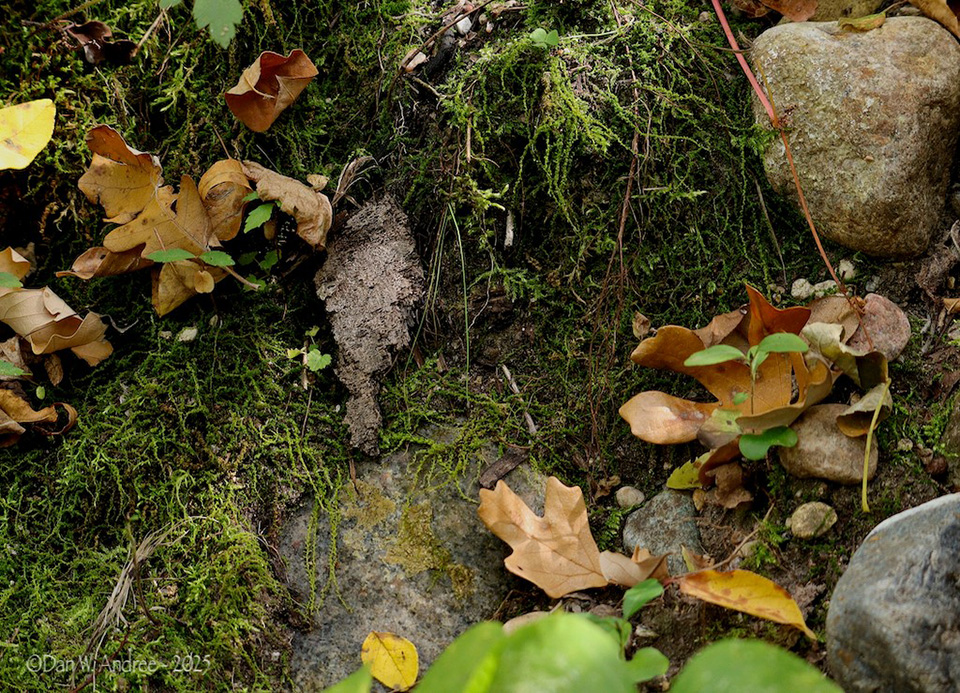
I didn’t pay too much attention if it was near a tree, but it was in the woods with a lot of different sized trees and brush. I just noticed how it grew kind of cascading downward. Cool moss.
Minnesota Seasons Photos
Slideshows
Slideshows
Videos
Visitor Videos
Share your video of this plant.
This button not working for you?
Simply email us at info@MinnesotaSeasons.com.
Attach a video, a YouTube link, or a cloud storage link.
Other Videos
Sightings
Visitor Sightings
Report a sighting of this plant.
This button not working for you?
Simply email us at info@MinnesotaSeasons.com.
Be sure to include a location.
Dan W. Andree
9/14/2025

Location: Norman Co. Mn.
I think it may be some kind of moss, but not sure …
Minnesota Seasons Sightings