Chicken of the Woods - Species Profile
Conservation • Description • Habitat • Ecology • Distribution • Taxonomy

Conservation Status
IUCN Red List
not listed
NatureServe
not listed
Minnesota
not listed
Description
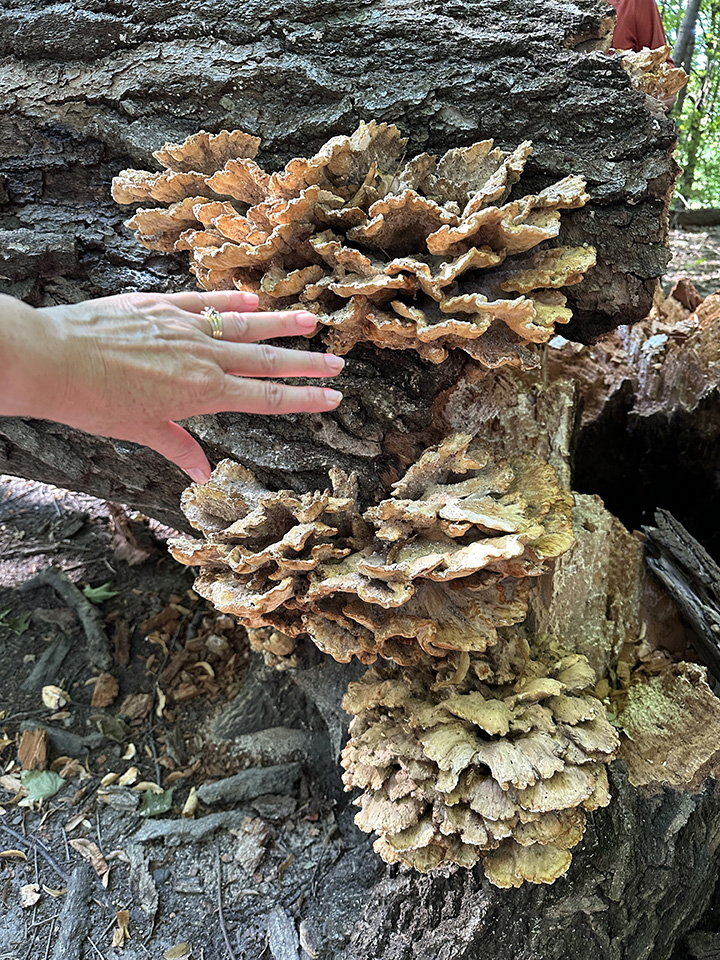
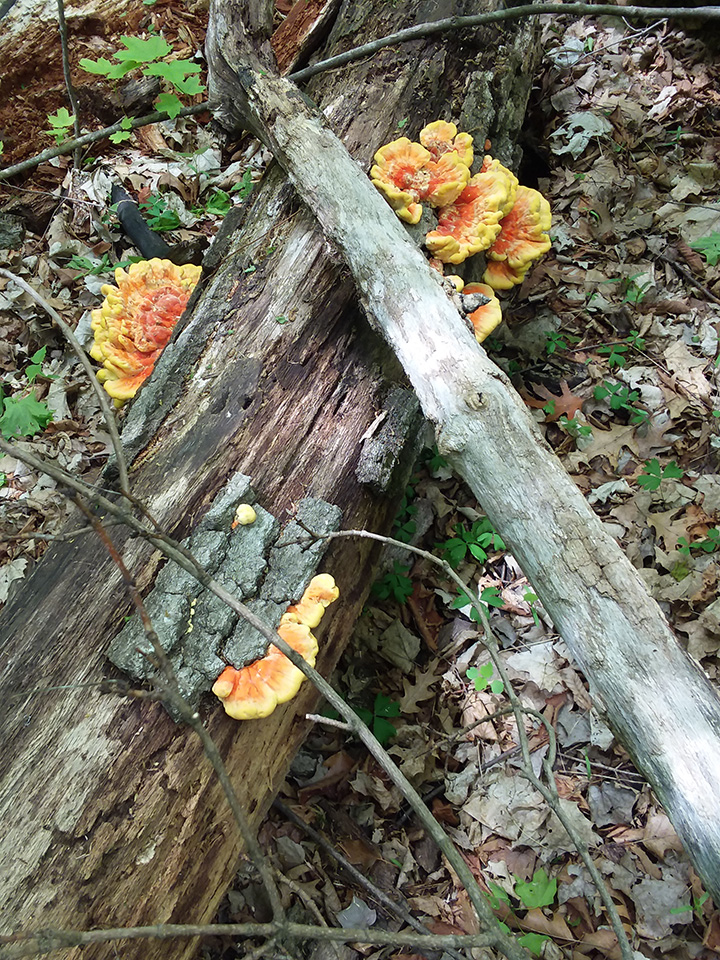
Chicken of the Woods is a large, common, widespread, fleshy, bracket (shelf-like) fungus. It is one of the “Foolproof Four”, the four most easily identified mushrooms. It is usually saprobic, on decaying stumps and logs, but is sometimes parasitic, on the sides of injured trees. It enters the tree through a wound and infects the heartwood causing brown rot.
It is usually found well above the ground on living or dead, standing oaks, or on fallen oaks, sometimes on other hardwoods. It is usually found in overlapping clusters, sometimes singly, sometimes a rosette on the top side of a downed log. The thin, white mycelium can sometimes be seen in cracks of the wood.
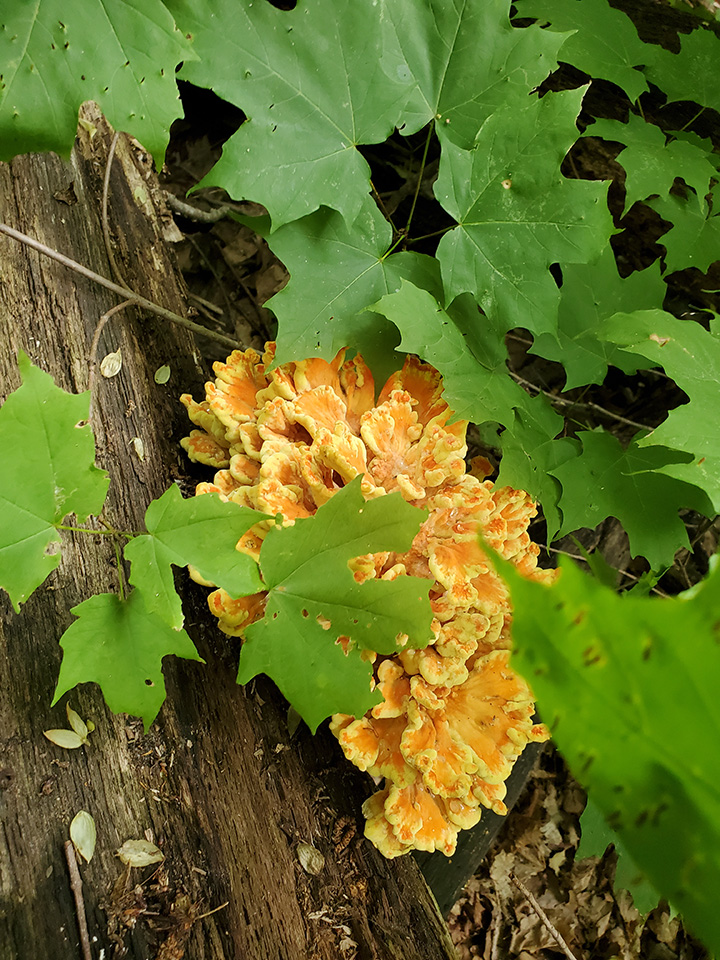
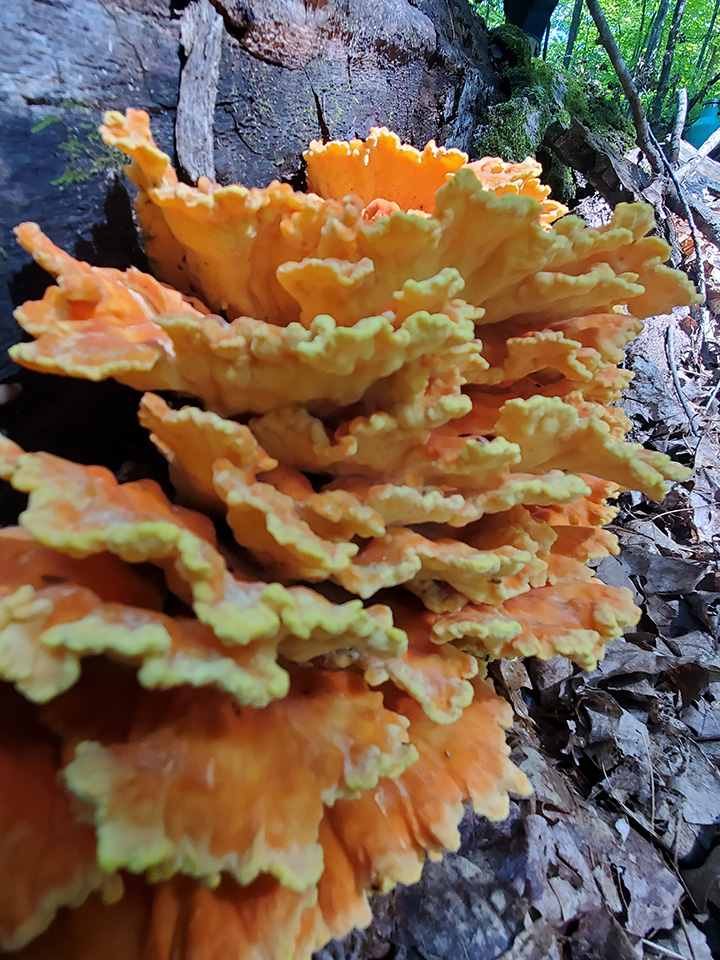
The fruiting body is annual. There is no stem. When it first appears in late summer or fall it is knob-like, but it soon becomes shelf-like. It consists of an overlapping cluster or rosette of several to many brackets and can be up to 23½″ wide.
Each bracket is fan-shaped to semicircular in outline, more or less flat but lumpy and uneven on top, convex on the bottom, usually 2″ to 20″ wide, and up to 1½″ thick. Larger brackets can be up to 27½″ wide. The surface is smooth to suede-like and often finely wrinkled. On younger brackets the upper side is bright reddish-orange to bright orange, yellowish-orange, or salmon. As it ages it fades to yellowish or buff. Older brackets are whitish. The margin on younger brackets is thick, blunt, and usually yellow.
The flesh of young brackets is thick, soft, watery, white to pale yellow, sometimes tinged with salmon. As it ages the flesh becomes tough then crumbly.
The pore tubes on the underside of the bracket are yellow and up to 3 ⁄16″ deep. There are 2 to 4 pores per millimeter. The spores are yellow.
Young, fresh brackets grown on oak are edible when cooked. On older brackets, only the outer, still growing edge is edible.
Similar Species
White-Pored Chicken of the Woods (Laetiporus cincinnatus) grows on the ground at or near the base of oak trees, not on stumps, logs, or the sides of living trees. The pore surface is white or cream-colored.
Habitat and Hosts
Hardwood forests on oak and other hardwoods
Ecology
Season
Late summer and fall
Distribution

Sources
Biodiversity occurrence data published by: Minnesota Biodiversity Atlas (accessed through the Minnesota Biodiversity Atlas Portal, bellatlas.umn.edu. Accessed 4/23/2026).
Laetiporus sulphureus (Bull.) Murrill in GBIF Secretariat (2023). GBIF Backbone Taxonomy. Checklist dataset https://doi.org/10.15468/39omei accessed via GBIF.org. Accessed 4/23/2026.
Mycology Collections Portal (MyCoPortal) https://www.mycoportal.org/portal/collections/index.php). Accessed 4/23/2026.
Occurrence
Common
Taxonomy
Kingdom
Fungi (Fungi)
Subkingdom
Dikarya
Phylum
Basidiomycota (Basidiomycete Fungi)
Subphylum
Agaricomycotina (Higher Basidiomycetes)
Class
Agaricomycetes (Mushrooms, Bracket Fungi, Puffballs, and Allies)
Subclass
Incertae sedis
Order
Polyporales (Shelf Fungi)
Family
Laetiporaceae
Genus
Laetiporus
Family
The genus Laetiporus was formerly placed in the family Polyporaceae. Several DNA studies of fungi in the order Polyporales since 2005 have resulted in the reordering of the families within the order. There is no current consensus. The genus Laetiporus is variously placed in the families Polyporaceae, Laetiporaceae, and Fomitopsidaceae. Most agree that it should be separated from the order Polyporaceae.
Species
In 1998, a study (Banik, Mark T., Harold H. Burdsall, Jr. and Thomas J. Volk. 1998) showed Laetiporus sulphureus to be a species complex and split it into five species. According to the authors, the new Laetiporus sulphureus, the “true” Chicken of the Woods, is the species that has yellow pores; grows on the butt of a standing tree or on downed logs; is usually overlapping shelves but may be a rosette on the top side of a downed log; occurs east of the Great Plains; and is always on hardwoods, usually on oak.
Subordinate Taxa
Synonyms
Boletus sulphureus
Laetiporus sulfureus
Polyporus sulphureus
Common Names
Chicken of the Woods
Sulphur Shelf