goldenrod soldier beetle - Species Profile
Conservation • Description • Habitat • Ecology • Distribution • Taxonomy

Conservation Status
IUCN Red List
not listed
NatureServe
not listed
Minnesota
not listed
Description
Goldenrod soldier beetle is the most common soldier beetle in the Midwest. It is considered beneficial because its larvae feed on the striped cucumber beetle and other pests.
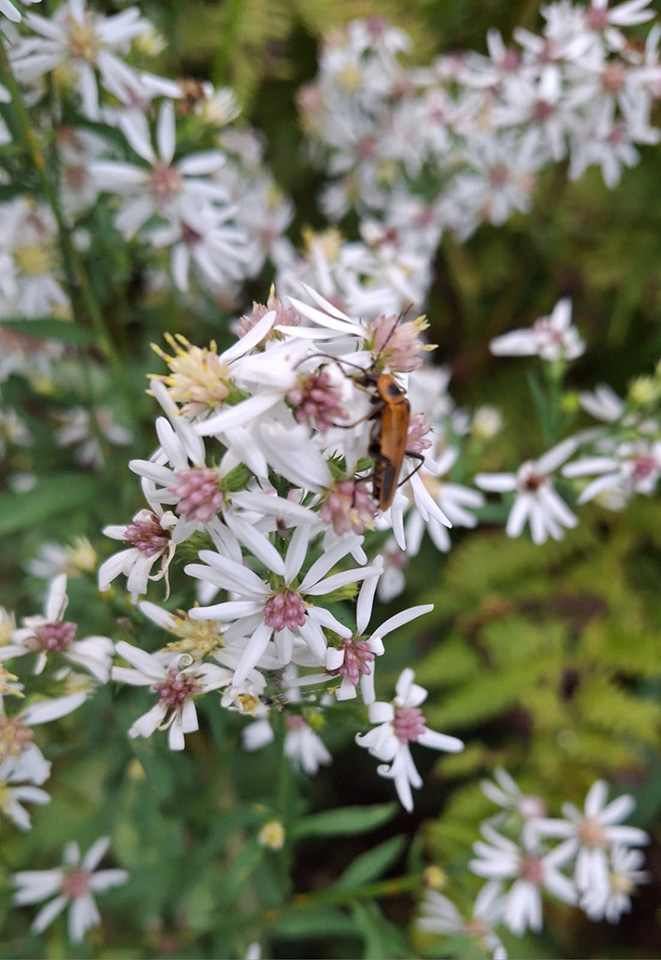
Adults are ⅜″ to 9 ⁄16″ long and colorful. The body is elongated, soft, and somewhat flattened. The sides are nearly parallel. The underside is black.
The thoracic shield (pronotum) is wider than long and brownish-yellow or orangish-yellow. A black spot covers most of the back (posterior) three quarters of the pronotum. The spot is widest at the front (anterior) and does not extend to the anterior margin of the pronotum.
The abdominal segments are mostly black with a narrow brownish-yellow or orangish-yellow posterior margin. The forewings (elytra) are brownish-yellow or orangish-yellow and loose. They are leathery and flexible, not hardened like on most beetles. They are long but do not extend beyond the abdomen. Each elytron has a black, elongated, longitudinal mark. The black mark is usually confined to the posterior half but sometimes extends the entire length of the elytron. The inner (sutural) and outer (lateral) margins are always brownish-yellow or orangish-yellow.
The head is black, large, and prominent. It is visible from above, not concealed beneath the pronotum. The antennae are slender, thread-like, black, and more than half as long as the body.
The legs are long, and slender, and mostly black. The third and most robust segment of each leg (femur) is entirely black. The fourth segment (tibia) of the front leg is brownish-yellow or orangish-yellow. The end segment of each leg (tarsus) has 5 sections. The fourth tarsal segment is lobed.
Size
Total length: ⅜″ to 9 ⁄16″
Similar Species
Margined leatherwing (Chauliognathus marginatus) is darker orange. The pronotum is longer than wide and has a thick black mark extending its entire length longitudinally. Adults are active in May and June. It has been recorded Wisconsin and Iowa, but not in Minnesota.
Habitat
Prairies, meadows, abandoned fields, gardens, parks, and roadsides.
Ecology
Season
Early June to early October
Behavior
Life Cycle
The female deposits clusters of eggs in the soil or in leaf litter. Larvae feed in the soil. They pupate in cells in the soil in the spring of the following year.
Larva Food
Grasshopper eggs, small caterpillars, beetle larvae, and soft-bodied insects.
Adult Food
Nectar and pollen of flowers, especially goldenrod; aphids and other small insects.
Distribution

Occurrence
Common, widespread, and abundant
Taxonomy
Order
Coleoptera (Beetles)
Suborder
Polyphaga (Water, Rove, Scarab, Long-horned, Leaf, and Snout Beetles)
Infraorder
Elateriformia
Superfamily
Elateroidea (Click, Firefly and Soldier Beetles)
Family
Cantharidae (Soldier Beetles)
Subfamily
Chauliognathinae
Tribe
Chauliognathini
Genus
Chauliognathus
Subordinate Taxa
Synonyms
Chauliognathis pennsylvanica
Chlaeniellus pennsylvanicus
Telephorus pensylvanicus
Common Names
goldenrod soldier beetle
Pennsylvania leather-wing
Pennsylvania leatherwing
soldier beetle