Cope’s Gray Treefrog - Species Profile
Conservation • Description • Habitat • Ecology • Distribution • Taxonomy
Conservation Status
IUCN Red List
LC - Least Concern
NatureServe
N5 - Secure
S5 - Secure
Minnesota
not listed
Description
Dryophytes is a genus of small treefrogs. Only two species occur in Minnesota, Gray Treefrog and Cope’s Gray Treefrog. The two species are almost identical in appearance, and are difficult to tell apart in the field, even by experts. The most reliable ways to distinguish between them is by listening to their calls or examining their chromosomes under a microscope. However, the chromosomes are normally invisible under a light microscope. They become visible only when the cell duplicates.
Cope’s Gray Treefrog is a small, solitary, nocturnal frog. It is 1¼″ to 2⅜″ long at maturity. Females are larger than males.
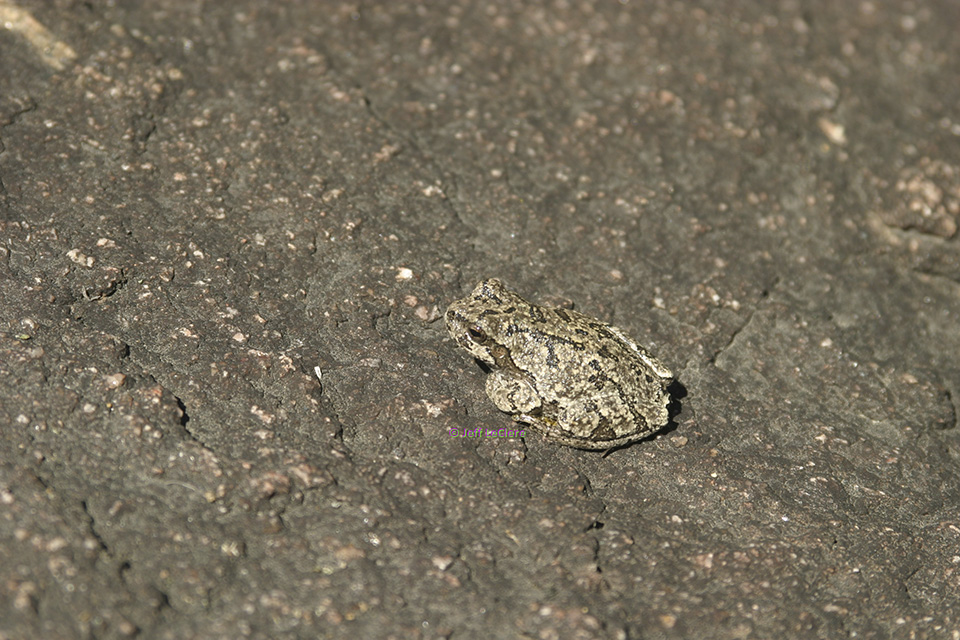
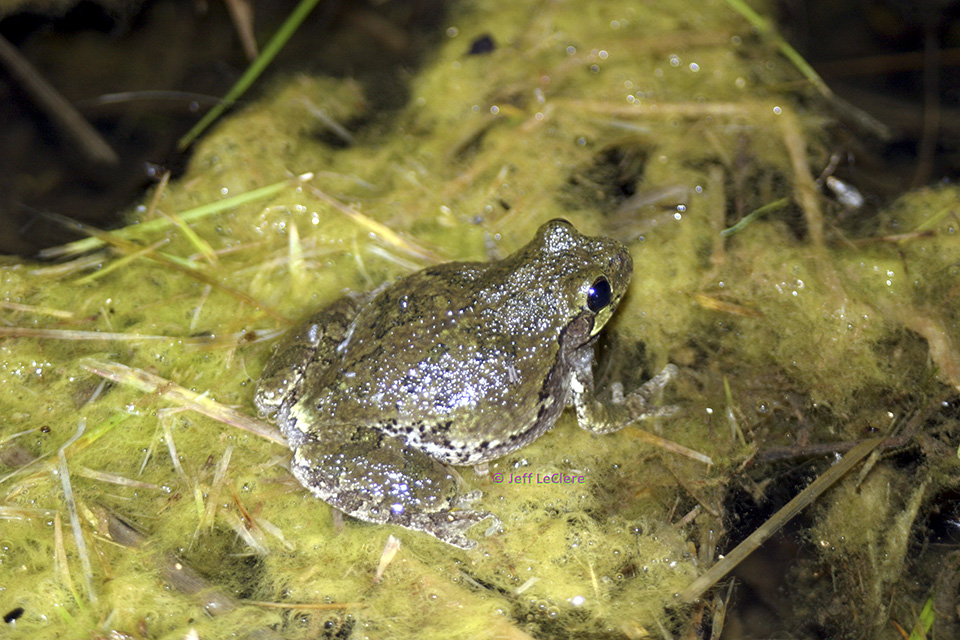
The upper (dorsal) surface is warty. It may have blotches but often does not. If there are blotches then the blotches are usually not outlined in black. The background color can change in seconds from green, light grayish-green, gray, brown, or dark brown. The color is determined by the color of the background, the season, and the humidity. It is most often some shade of gray. There is usually a large, irregular, dark blotch on the back. Beneath each eye there is a small spot. The spot is white or another light color, and it may be prominent or obscure.
The belly is white. On females the chin is pale olive-gray. On males the chin is darker gray.
The toes end in large adhesive pads. On males, the lower (ventral) side of the hind legs is bright yellow or yellowish-orange.
Size
Total length: 1¼″ to 2⅜″
Voice
Amphibian Research and Monitoring Initiative (ARMI), Midwest Region
Frog and Toad Calls
A fast trill lasting 1 to 3 seconds, not varying in pitch
Similar Species
Gray Treefrog (Dryophytes versicolor) is almost indistinguishable morphologically. The dorsal surface is rougher and usually blotched. The blotches are outlined in black. The call of Gray Treefrog is a slower trill with about half as many notes. They prefer more wooded habitats.
Habitat
Forest edges, prairies, oak savannas, areas near permanent or temporary waters. Near street lamps and lighted buildings at night.
Ecology
Behavior
Adults are usually found high in trees, on mossy or lichen-covered fences, or sometimes in abandoned bird houses. They are rarely found on the ground except in breeding season.
During breeding season the adult’s background color is usually green.
Lifespan
Unknown. Probably 5 to 7 years.
Life Cycle
Breeding occurs from April to July, peaking in May to June. After breeding, the female will deposit 450 to 600 packets of 30 to 40 eggs each on emergent vegetation at the surface of a shallow pond or a permanent or temporary pool. The eggs hatch in about three weeks and metamorphosis occurs about four weeks later. The tadpole is about 2″ long preceding metamorphosis.
Adults overwinter under the shelter of a log, rock, bark, or leaf litter. They are freeze tolerant and can survive multiple freeze-thaw cycles. Glycerine is produced preventing the formation of ice crystals in vital organs. They live 5 to 7 years.
Tadpole Food
Algae, material from dead and decaying plants and animals (detritus).
Adult Food
Insects, insect larvae, mites, spiders, plant lice, harvestmen, snails, and smaller frogs.
Distribution
Sources
Biodiversity occurrence data published by: Minnesota Biodiversity Atlas (accessed through the Minnesota Biodiversity Atlas Portal, bellatlas.umn.edu. Accessed 1/1/2026).
USGS National Amphibian Atlas. https://armi.usgs.gov/atlas/. Accessed 1/1/2026).
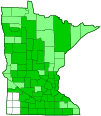
The counties in light green represent distribution data from the USGS ARMI National Amphibian Atlas that does not occur in any of the other sources. It reflects a modeled or generalized range map based on the 2005 Lannoo status assessment. It is a tool for understanding the broad distribution of a species across the U.S. landscape, but it should not be treated as a list of confirmed county-level observation records, especially where it contradicts more rigorous state-level herpetological databases.
Occurrence
Common and widespread
Taxonomy
Class
Amphibia (Amphibians)
Order
Anura (Frogs and Toads)
Family
Hylidae (Treefrogs and Allies)
Genus
Genus
The genus Dryophytes was originally described in 1843. In 1882 all Dryophytes species were transferred to the genus Hyla, which then contained all treefrog species in the Northern Hemisphere. In 2014 North American species were placed in the new subgenus Dryophytes. In 2016 the subgenus was raised to genus level, resurrecting the original genus. Today, the genus Hyla now contains only Old World species. All North American treefrog species, and three species in temperate eastern Asia, now belong to the genus Dryophytes. The common name for the genus is Holarctic Treefrogs.
The last move was not universally accepted. Amphibian Species of the World, The Center for North American Herpetology, Catalogue of Life, GBIF, ITIS, NatureServe, and NCBI use Dryophytes. iNaturalist, AmphiaWeb, MNHerps, Discover Life, and National Amphibian Atlas (USGS) all continue to use the genus Hyla.
Species Separation
Cope’s Gray Treefrog and Gray treefrog were until 1968 considered the same species, Dryophytes versicolor.
Subordinate Taxa
Synonyms
Dryophytes versicolor chrysoscelis
Dryophytes versicolor sandersi
Hyla chrysoscelis
Hyla femoralis chrysoscelis
Hyla versicolor chrysoscelis
Hyla versicolor sandersi
Common Names
Cope’s Gray Treefrog
Southern Gray Treefrog