Great Plains Toad - Species Profile
Conservation • Description • Habitat • Ecology • Distribution • Taxonomy
Conservation Status
IUCN Red List
LC - Least Concern
NatureServe
N5 - Secure
S3 - Vulnerable
Minnesota
Special Concern
Species in Greatest Conservation Need
Description
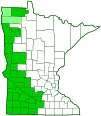
Great Plains Toad is a large true toad resident in North American grasslands. In the United States it occurs from western Minnesota to eastern Texas, west to Montana and southwestern California, and there is a disjunct population in south-central Colorado. It also occurs in Canada from southwestern Manitoba to southeast Alberta, and in northern and central Mexico. In Minnesota its range is roughly coextensive with the Prairie Parkland and Tallgrass Aspen Parklands Provinces, extending from Kittson and Roseau Counties in the north to Rock and Blue Earth Counties in the south. It is found in the low damp areas of prairies, grasslands, and agricultural fields, near temporary or permanent bodies of water, including reservoirs, ponds, rain pools, streams, and roadside ditches.
Adult females are 2″ to 4½″ (49 to 115 mm) in length. Males are a little smaller, 1⅞″ to 4″ (47 to 103 mm) in length. The body is broad and stocky.
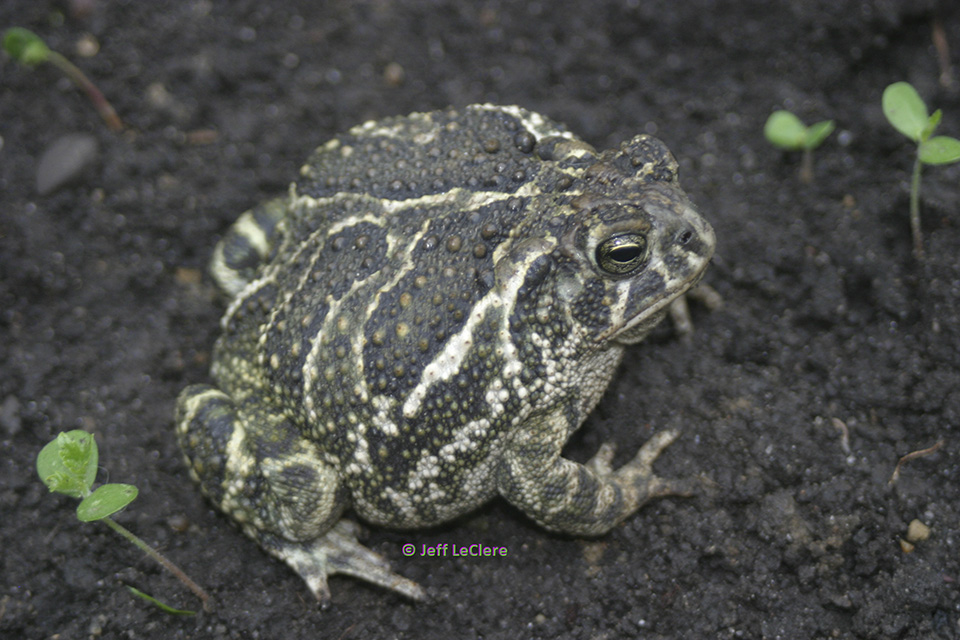
The skin is bumpy. The background color may be brown, gray, or olive. On the upper side there are several elongated dark patches with cream-colored borders. The patches are paired, but one may be a slightly different size and shape than its opposite. Each patch has many small warts, usually four or more. There are similar but smaller spots on the sides of the body and on the legs.
The belly is white or cream-colored and usually unmarked. On some individuals there is a dark breast spot. On males there is a black vocal sac, but this is covered when not in use by a white throat sac.
The snout is short. Behind each eye there is a large oval swelling. These are the paratoid glands, which secrete a toxin to discourage predators. There are 2 cranial ridges between the eyes that meet in the front near the snout, forming a V shape, and connect with a paratoid gland at the rear.
The hind legs are short.
Size
Female: 2″ to 4½″ (49 to 115 mm)
Male: 1⅞″ to 4″ (47 to 103 mm)
Voice
The call of the male is a loud, pulsating, metallic trill lasting 20 to 40 seconds.
Similar Species
Habitat
Prairies and grasslands near temporary or permanent bodies of water, including reservoirs, ponds, rain pools, streams, and roadside ditches
Ecology
Behavior
Great Plains Toads are active from May to September, but individual adults are dormant from two-thirds to three-quarters of the year. They spend most of their time underground, emerging at night to feed. During breeding season, they are also active during the day. They spend short periods of inactivity in burrows no more than 2″ (5 cm) deep. In dry periods they burrow deeper to avoid desiccation and may enter into a period of reduced metabolic activity (aestivate).
In wet years they appear aboveground after heavy rains for breeding from early May to mid-July. After breeding, adults disperse up to three quarters of a mile from the breeding site. They emerge about an hour before dusk to feed if the weather is favorable. If it is dry, they remain underground. In dry years they may remain underground year-round, skipping the breeding season.
Lifespan
5 to 8 years in the wild
Life Cycle
Eggs are deposited in clear shallow water.
In August and September adults move into overwintering burrows 29″ to 41″ (74 to 104 cm) deep.
Tadpole Food
Adult Food
Moth larvae (cutworms), flies, beetles, ants, and other insects.
Distribution
Sources
Biodiversity occurrence data published by: Minnesota Biodiversity Atlas (accessed through the Minnesota Biodiversity Atlas Portal, bellatlas.umn.edu. Accessed 1/5/2026).
HerpMapper. 2026. HerpMapper - A Global Herp Atlas and Data Hub. Iowa, U.S.A. Available http://www.herpmapper.org. (Accessed: 1/5/2026).
USGS National Amphibian Atlas. https://armi.usgs.gov/atlas/. Accessed 1/5/2026).
Occurrence
Taxonomy
Class
Amphibia (Amphibians)
Order
Anura (Frogs and Toads)
Family
Bufonidae (True Toads)
Genus
Anaxyrus (North American Toads)
Genus
This species was formerly classified Bufo cognatus. In 2006 all North American true toads (family Bufonidae) were transferred out of the genus Bufo by Frost et al., and several new genera were created.
Subordinate Taxa
Synonyms
Bufo cognatus
Bufo cognatus cognatus
Bufo dipternus
Bufo lentiginosus cognatus
Chilophryne cognata
Incilius cognatus
Common Names
Great Plains Toad