Blue-spotted Salamander - Species Profile
Conservation • Description • Habitat • Ecology • Distribution • Taxonomy
Conservation Status
IUCN Red List
LC - Least Concern
NatureServe
N5 - Secure
S5 - Secure
Minnesota
not listed
Description
Blue-Spotted Salamander is a medium-sized, very cold-tolerant, mole salamander. It occurs in the northern United States and southern Canada from Quebec and New Jersey in the east to Iowa and eastern Manitoba in the west. In Minnesota it is common in the northeast and there are scattered populations in remnant forests in the south. It is found in flat forested areas with permanent ponds. It is often discovered under logs.
Adults are 3″ to 5″ (7.6 cm to 12.9 cm) long. Females are slightly larger than males.
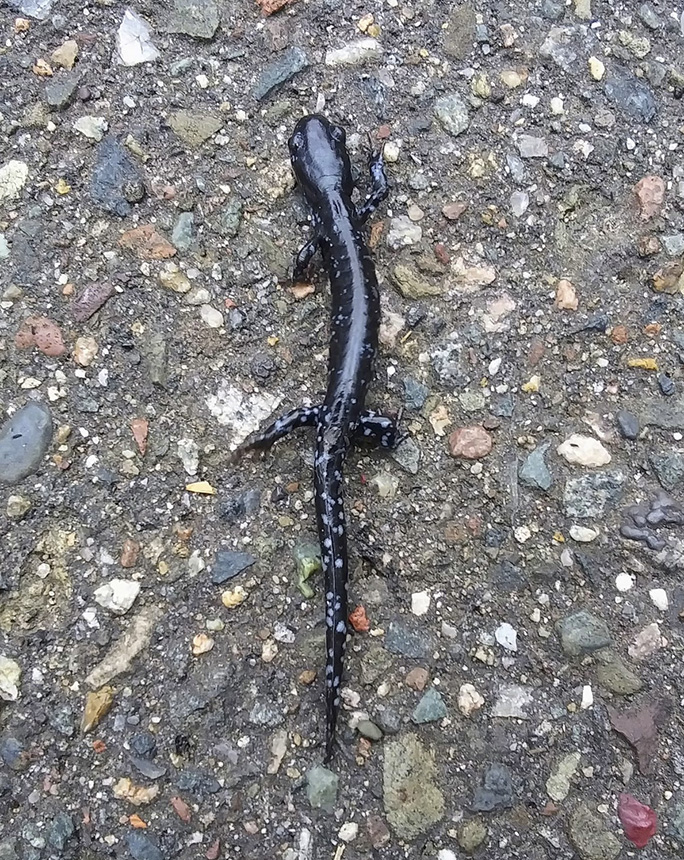
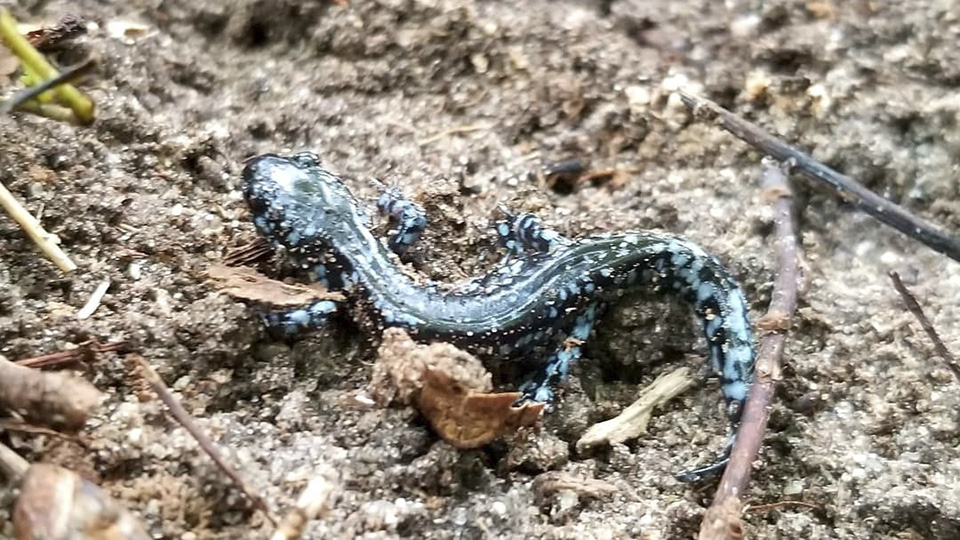
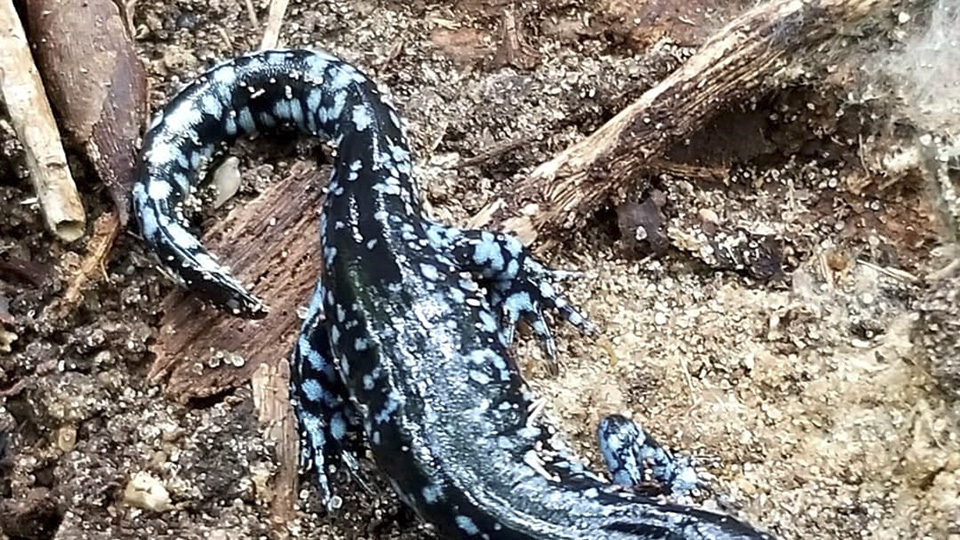
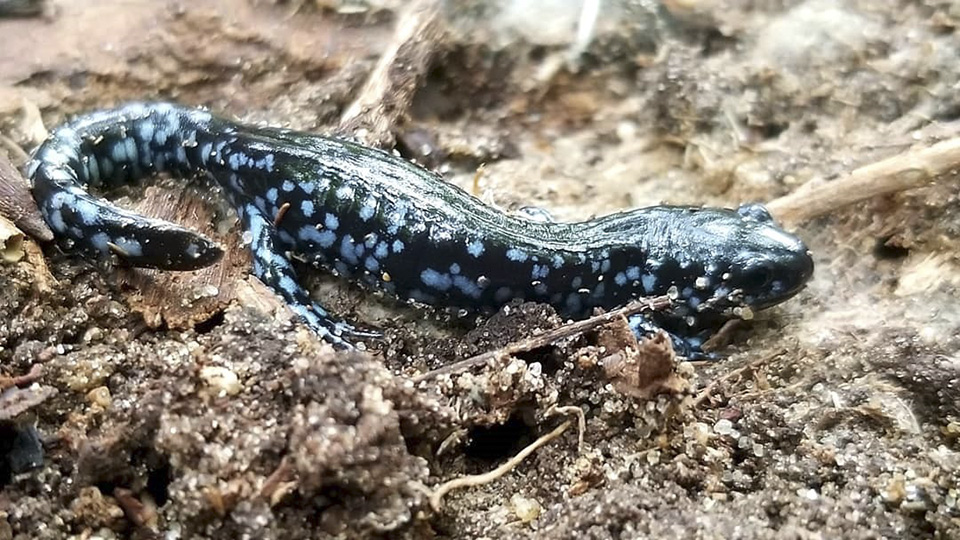
The body is stout with four well-developed limbs that project sidewards. The trunk is cylindrical. The tail is broad and oval at the base, becoming cylindrical as it approaches the tip. It is long, comprising about 40% of the salamander’s total length. The skin is soft, moist, and dark brown, black, or bluish-black. There are numerous pale blue or bluish-white spots and flecks on the lower sides of the trunk and tail, fewer or absent on the upper (dorsal) surface. There are usually 12 or 13, sometimes 14, prominent vertical depressions (costal grooves) on each side between the forelimbs and the ventral area. The belly is usually lighter and flecked. The vent is black.
The head is moderately large, distinctly wider than the neck.
The legs are relatively short but the toes are relatively long (compared to other salamanders).
Juveniles are dark brown. They have yellowish blotches on the back and a yellow stripe on each side.
Size
3″ to 5″ (7.6 cm to 12.9 cm)
Similar Species
Habitat
Forests and wetlands
Ecology
Behavior
The adult spends most of the year under a log or other cover. When threatened it holds its tail up and curved over the body. Small, granular glands, concentrated mostly on the tail, exude a milky, unpleasant tasting liquid in response to a predator.
Lifespan
Unknown
Life Cycle
Breeding occurs in April in small woodland ponds and ditches. The female lays eggs individually or in groups of 2 to 4, attaching them to leaves or other debris at the bottom of the pond. The eggs hatch in about a month.
Adults are not freeze tolerant. It is thought that they burrow below the frost line to overwinter.
Larva Food
Insects, mosquito and other insect larvae, water fleas, copepods, and other small aquatic invertebrates.
Adult Food
Earthworms, beetles, spiders, centipedes, snails, slugs, and other invertebrates.
Distribution

Sources
Biodiversity occurrence data published by: Minnesota Biodiversity Atlas (accessed through the Minnesota Biodiversity Atlas Portal, bellatlas.umn.edu. Accessed 1/1/2026).
USGS National Amphibian Atlas. https://armi.usgs.gov/atlas/. Accessed 1/1/2026).
Occurrence
Taxonomy
Class
Amphibia (Amphibians)
Order
Caudata (Salamanders)
Family
Ambystomatidae (Mole Salamanders)
Genus
Ambystoma (Mole Salamanders)
Subordinate Taxa
Synonyms
Amblystoma jeffersonianum laterale
Amblystoma laterale
Ambystoma nothagenes
Ambystoma platineum
Common Names
Blue-spotted Salamander