Eastern Red-backed Salamander - Species Profile
Conservation • Description • Habitat • Ecology • Distribution • Taxonomy
Conservation Status
IUCN Red List
LC - Least Concern
NatureServe
N5 - Secure
S4 - Apparently Secure
Minnesota
not listed
Species in Greatest Conservation Need
Description
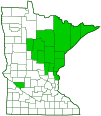
Eastern red-backed salamander is a small lungless salamander. It occurs in the United States from Maine to North Carolina, west to Minnesota and Illinois. It is common and locally abundant in northeastern Minnesota, where it reaches the western extent of its range, but is absent in the remainder of the state except for an isolated population in Chippewa County. It is found in deciduous, coniferous, and mixed forests, under logs and rocks and in small burrows.
Adults can be up to 4⅞″ (122 mm) in length but are usually shorter. Females are usually 29⁄16″ to 3½″ (64 to 90 mm) in length. Males are slightly smaller, usually 25⁄16″ to 3½″ (58 to 91 mm) in length.
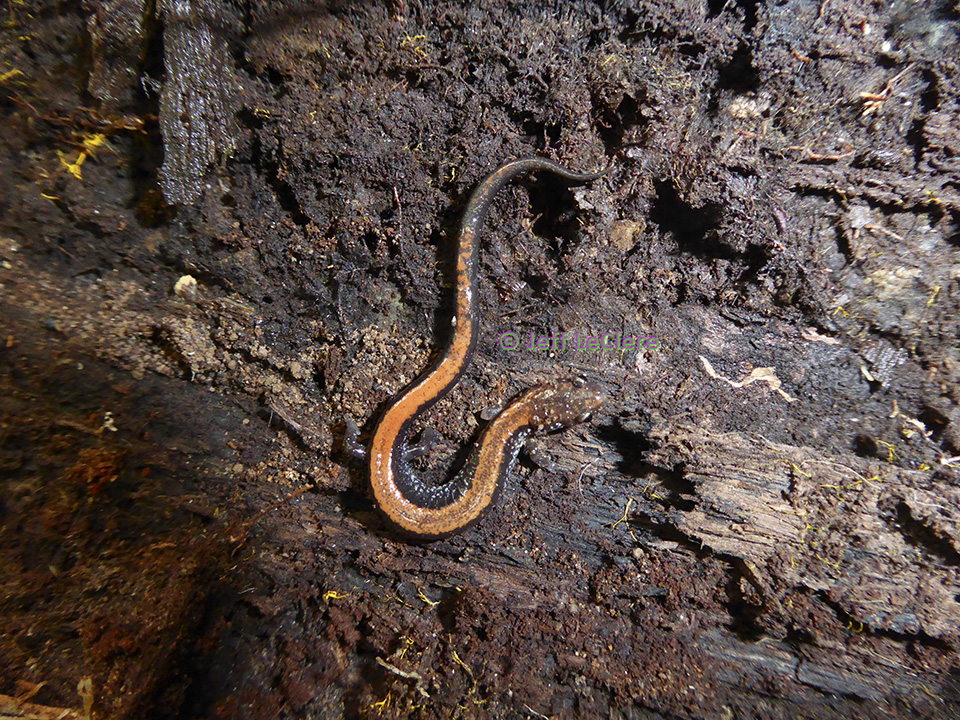
The body is elongated, slender, slightly flattened above, and rounded on the sides. On each side of the body between the forelimbs and the ventral area there are usually 18 or 19, sometimes 17 or 20, prominent vertical depressions (costal grooves). There are two main color phases. Both phases are dark gray or black with small white flecks on the sides, becoming lighter toward the bottom. The belly is strongly mottled with contrasting white and gray, making a salt-and-pepper pattern. The “red-backed” phase has a stripe above, from the head down the back and onto the tail, that may be red, pink, orange, yellow, or white. The stripe often has small black flecks. The “lead-backed” phase does not have a stripe above. It is the same color above and on the sides.
The tail is nearly circular in cross section from the base to the tip. There is no circular constriction at the base of the tail.
The eyes are large and bulging.
The front feet have four toes, and the hind feet have five toes.
Size
Male: 25⁄16″ to 3½″ (58 to 91 mm)
Female: 29⁄16″ to 3½″ (64 to 90 mm)
Similar Species
Habitat
Deciduous, coniferous, and mixed forests
Ecology
Behavior
Lifespan
Unknown
Life Cycle
It overwinters underground, under stones, in rotten logs and stumps, and in ant mounds.
Larva Food
Adult Food
Ants, termites, mites, and other invertebrate insects.
Distribution
Sources
Biodiversity occurrence data published by: Minnesota Biodiversity Atlas (accessed through the Minnesota Biodiversity Atlas Portal, bellatlas.umn.edu. Accessed 1/8/2026).
HerpMapper. 2026. HerpMapper - A Global Herp Atlas and Data Hub. Iowa, U.S.A. Available http://www.herpmapper.org. (Accessed: 1/8/2026).
USGS National Amphibian Atlas. https://armi.usgs.gov/atlas/. Accessed 1/8/2026).
Occurrence
Common
Taxonomy
Class
Amphibia (Amphibians)
Order
Caudata (Salamanders)
Family
Plethodontidae (Lungless Salamanders)
Subfamily
Plethodontinae
Genus
Plethodon (Woodland Salamanders)
Subordinate Taxa
Synonyms
Ambystoma erythronotum
Plethodon cinereus cinereus
Plethodon cinereus erythronotus
Plethodon erythronota
Plethodon erythronotum
Plethodon erythronotus cinereus
Plethodon huldae
Salamandra agilis
Salamandra cinerea
Salamandra erithronota
Salamandra erythronota
Salamandra puncticulata
Saurophis erythronotus
Spelerpes erythronota
Common Names
Eastern Red-backed Salamander
Northern Red-backed Salamander
Red-backed Salamander
Redback Salamander