Four-toed salamander - Species Profile
Conservation • Description • Habitat • Ecology • Distribution • Taxonomy
Conservation Status
IUCN Red List
LC - Least Concern
NatureServe
N5 - Secure
S3 - Vulnerable
Minnesota
Special Concern
Species in Greatest Conservation Need
Description
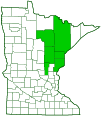
Four-toed Salamander is a small lungless salamander. It occurs in the United States from Maine to northern Florida, west to eastern Minnesota and Louisiana. In Canada it occurs in Nova Scotia, southern Quebec, and southern Ontario. It is rare in Minnesota. It is found in mature upland deciduous or mixed forests with moss and near vernal pools, ponds, sphagnum bogs, shallow marshes, or other water bodies with no fish.
Four-toed Salamander is the smallest salamander in Minnesota. Adults are 2″ to 4″ (5 to 10 cm) in length, rarely longer.
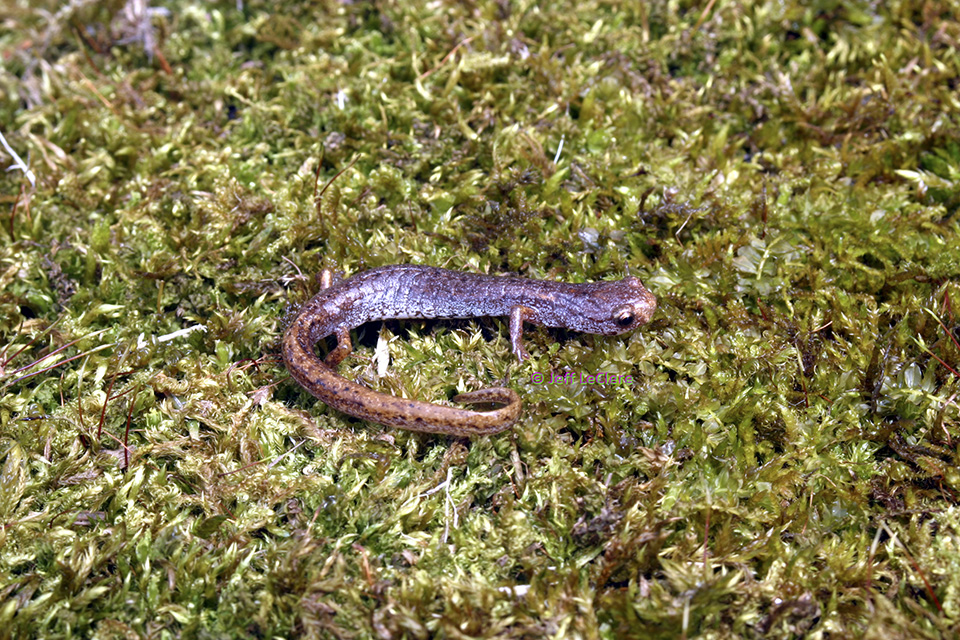
The body is elongated. The upperside is reddish-brown above with a dense speckling of small silver or bluish spots or flecks on the sides, sometimes becoming almost entirely grayish or bluish toward the belly. The underside is bright white with black spots scattered along the sides of the belly and on the chin. On each side of the body between the forelimbs and the ventral area there are 13 or 14 prominent vertical depressions (costal grooves). The grooves meet on the back in a forward-pointing V shape.
The tail is a little longer than the body on the adult, shorter than the body on the juvenile. There is a constricted ring at the base of the tail. The rear of the tail is usually brighter than the body.
The snout is rounded and short on the female, long and squared off on the male. Between the nostril and the upper lip there is a slit (nasolabial groove) that assists drainage of water and debris from the nose. The salamander has no lungs and cannot clear the nostrils by expelling air (blowing its nose).
All of the feet have four toes.
Size
Total length: 2″ to 4″ (5 to 10 cm)
Similar Species
Habitat
Forests with moss and near water bodies with no fish
Ecology
Behavior
Lifespan
Captive: up to 9 years
Wild: unknown
Life Cycle
It overwinters on land under rocks, logs or leaves, or in burrows
Larva Food
Small aquatic crustaceans
Adult Food
Insects, spiders, ticks, worms, and springtails
Distribution
Sources
Biodiversity occurrence data published by: Minnesota Biodiversity Atlas (accessed through the Minnesota Biodiversity Atlas Portal, bellatlas.umn.edu. Accessed 1/10/2026).
HerpMapper. 2026. HerpMapper - A Global Herp Atlas and Data Hub. Iowa, U.S.A. Available http://www.herpmapper.org. (Accessed: 1/10/2026).
USGS National Amphibian Atlas. https://armi.usgs.gov/atlas/. Accessed 1/10/2026).
Occurrence
Rare in Minnesota
Taxonomy
Class
Amphibia (Amphibians)
Order
Caudata (Salamanders)
Family
Plethodontidae (Lungless Salamanders)
Subfamily
Hemidactyliinae
Genus
Hemidactylium (Four-toed Salamanders)
Subordinate Taxa
Synonyms
Batrachoseps scutatus
Cotobotes scutatum
Desmodactylus melanostictus
Desmodactylus scutatus
Salamandra melanosticta
Salamandra scutata
Common Names
Four-toed Salamander