Black Witches’ Butter - Species Profile
Conservation • Description • Habitat • Ecology • Distribution • Taxonomy
Conservation Status
IUCN Red List
not listed
NatureServe
NNR - Unranked
Minnesota
not listed
Description
Black Witches’ Butter is a common gelatinous fungus. It occurs worldwide on all continents except Antarctica. In the United States, it occurs east of the Great Plains and west of the Rocky Mountains.
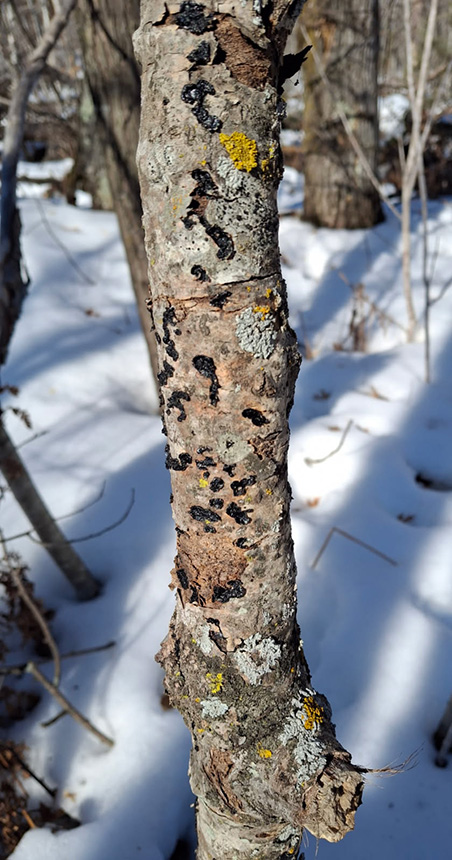
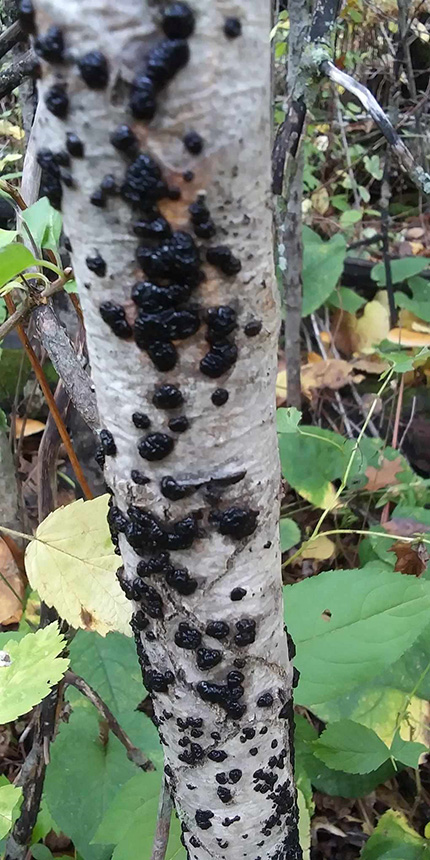
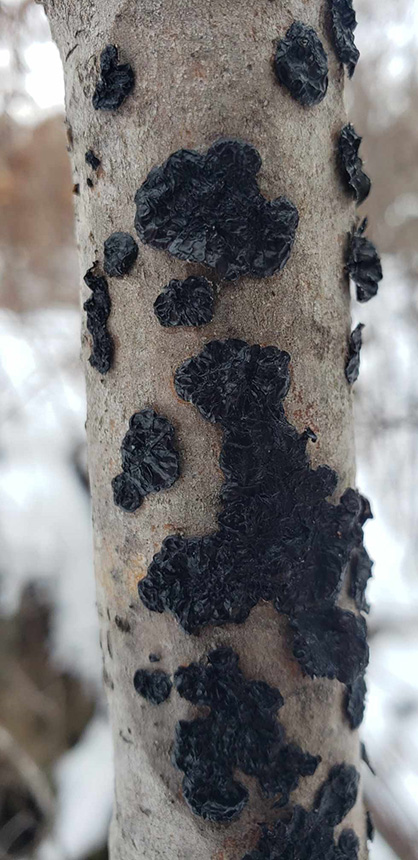
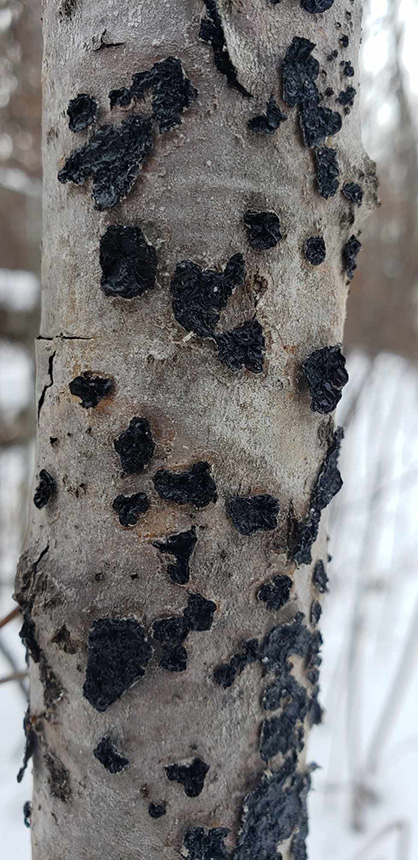
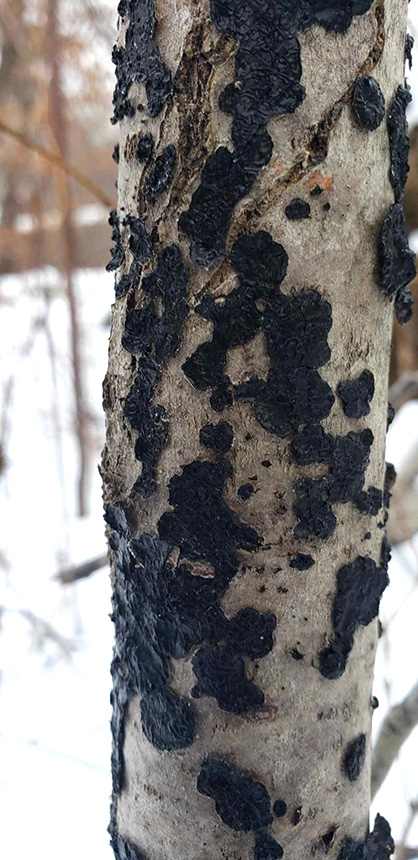
Black Witches’ Butter fruits only in cool temperatures. It appears in the spring and in the fall. It also appears in unseasonably warm spells in the winter and cold spells in the summer. It grows on dead wood, including recently dead wood, of hardwoods, especially oaks. It is usually found on dead or dying, fallen or attached branches. It is also found on standing, dead or dying tree trunks, as shown by photos on this page. It obtains its nutrients from dead wood (saprobic).
When it first appears, the fruiting body appears like a translucent blister. As it ages, it darkens and spreads out. The mature fruiting body is black, shiny, ⅜″ to ¾″ (1 to 2 cm) in diameter, blister-like or cushion-like, and depressed in the middle, “like an inverted cone” (Wikipedia). It is attached directly to the substrate, without a stalk. The upper surface, which is the fertile surface, may be smooth or rough, dotted with warts. The warts are minute, and it may require a hand lens to see them. Fruiting bodies may appear singly or in small clusters, but they do not fuse into large or long sheets. When older specimens dry out, they form a flat, black crust.
The flesh is gelatinous and insignificant. The edibility is unknown and is likely to remain so.
The spore print is white.
Similar Species
Warlock’s Butter (Exidia nigricans)
Habitat and Hosts
Hardwoods, especially oaks
Ecology
Season
Spring and fall
Distribution
Sources
Biodiversity occurrence data published by: Minnesota Biodiversity Atlas (accessed through the Minnesota Biodiversity Atlas Portal, bellatlas.umn.edu. Accessed 2/21/2026).
Exidia glandulosa (Bull.) Fr. in GBIF Secretariat (2023). GBIF Backbone Taxonomy. Checklist dataset https://doi.org/10.15468/39omei accessed via GBIF.org. Accessed 2/21/2026.
Mycology Collections Portal (MyCoPortal) https://www.mycoportal.org/portal/collections/index.php). Accessed 2/21/2026.
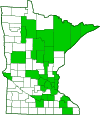
Black Witches’ Butter is very similar to, often confused with, and often lumped together with Warlock’s Butter (Exidia nigricans). For this reason, the exact distribution of each species is uncertain. Both species occur in Minnesota.
Occurrence
Common and widespread
Taxonomy
Kingdom
Fungi (Fungi)
Subkingdom
Dikarya
Phylum
Basidiomycota (Basidiomycete Fungi)
Subphylum
Agaricomycotina (Higher Basidiomycetes)
Class
Agaricomycetes (Mushrooms, Bracket Fungi, Puffballs, and Allies)
Subclass
Auriculariomycetidae
Order
Auriculariales
Family
Genus
Exidia
Nomenclatural dispute
This species was originally described as Tremella glandulosa in 1789. In 1822, it was moved to the genus Exidia and lumped with a similar species under the name Exidia glandulosa. In 1936, the two species were separated. This species became Exidia truncata and the other species retained the name Exidia glandulosa, but this was an error. In 1966 the error was corrected, and this species regained its original name, Exidia glandulosa. The other species became Exidia plana, but the name was later changed to Exidia nigricans.
Recent molecular research (Weiss, 2001) confirms the separation of the species. However, the two species are still usually lumped together in both print and online sources.
Subordinate Taxa
Two subspecies and four varieties have been described, but these are not generally recognized.
Synonyms
Auricularia glandulosa
Exidia duthieae
Exidia duthiei
Exidia purpureocinerea
Exidia truncata
Peziza glandulosa
Spicularia glandulosa
Tremella arborea
Tremella atra
Tremella glandulosa
Tremella nigricans var. glandulosa
Tremella spiculosa
Common Names
Black Jelly Roll
Black Witches’ Butter
Black Witche’s Butter
Warty Jelly Fungus
Witches’ Butter