


Sheepish Pelt Lichen
(Peltigera extenuata)
Conservation • Description • Ecology • Distribution • Taxonomy
Conservation Status |
|
||||
| IUCN Red List | not listed |
||||
| NatureServe | NNR - Unranked SNR - Unranked |
||||
| Minnesota | not listed |
||||
Description
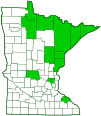
Sheepish Pelt Lichen is a recently recognized lichen. It occurs in Europe and North America. In the United States it occurs from Maine to Connecticut, west to Minnesota, and in the Pacific Northwest. It occurs across southern Canada, north in the west to Alaska. The species is likely more common than the limited number of records indicate because it was only recently recognized as distinct from Peltigera didactyla in 2018.
The ecology of Sheepish Pelt Lichen is still little studied due to its recent recognition as a separate species. Like Peltigera didactyla, it is found in moist and shaded habitats, in or at the margins of forests, and in disturbed habitats. It grows on the ground on soil, among mosses that grow on soil (tericolous), and on plant debris.
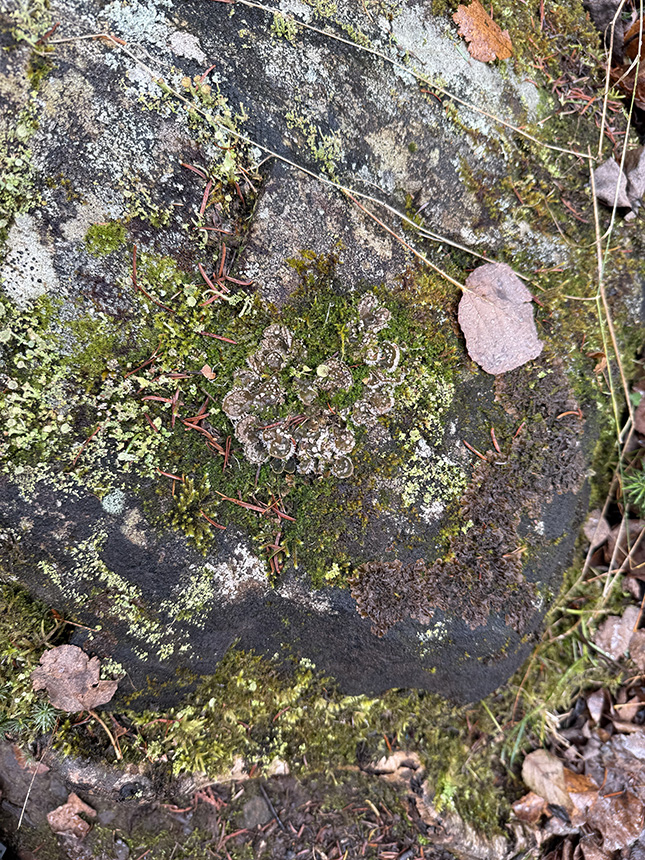
The vegetative body (thallus) is leaf-like (foliose). It forms a rosette that is often up to 2″ (5 cm) in diameter, sometimes up to 3″ (8 cm) in diameter. The lobes are elongate and flat or concave, and the tips are rounded to almost straight across (subtruncate). They are usually 5⁄16″ to ⅜″ (8 to 10 mm) wide, and up to 1¼″ (3 cm) long, sometimes larger, up to ⅝″ (15 mm) wide and up to 2″ (5 cm) long.
The upper surface is gray to pale brown and dull when dry, blackish green when wet. It is densely covered with short, matted, whitish-gray hairs (tomentose), especially toward the margins and on younger parts. The protective outer layer (cortex) is pseudoparenchymatous—it is composed of fungal threads (hyphae) so tightly packed that they resemble the three-dimensional cells of other organisms, though they are not truly cellular.
Granular, asexual, reproductive structures (soredia) are produced in persistent, orb-shaped, up to 1⁄16″ (2 mm) wide structures (soralia). They appear as pale patches on the upper surface of the lobe, clustered in a submarginal band.
The lower surface is white with a network of pale veins, and white, 3⁄16″ (5 mm) long, densely branched, root-like structures (rhizines) that become darker toward the middle. It does not have an outer protective layer (cortex).
Sexual (spore-producing) reproductive structures (apothecia) are rare. When present, they are reddish brown, saddle-shaped, and up to 3⁄16″ (5 mm) wide, and they appear on short, ascending lobes.
Unlike Peltigera didactyla, from which it was separated, Sheepish Pelt Lichen reacts to applied chemicals, though the reaction is faint and it disappears quickly.
Similar Species
Ecology
Substrate
Ground
Growth Form
Foliose
Habitat
Forests and forest edges, in moist and/or shaded areas
Hosts
Distribution |
||
|
Sources Biodiversity occurrence data published by: Minnesota Biodiversity Atlas (accessed through the Minnesota Biodiversity Atlas Portal, bellatlas.umn.edu, 12/11/2025). |
|
| 12/11/2025 | ||
Occurrence |
||
|
||
Taxonomy
Kingdom
Fungi (Fungi)
Subkingdom
Dikarya
Phylum
Ascomycota (Sac Fungi)
Subphylum
Pezizomycotina
Class
Lecanoromycetes (Common Lichens)
Subclass
Lecanoromycetidae (Shield Lichens, Sunburst Lichens, Rosette Lichens, and Allies)
Order
Peltigerales
Suborder
Peltigerineae
Family
Peltigeraceae
Subfamily
Peltigeroideae
Genus
Peltigera (Pelt Lichens)
Section
Peltigera
Mycobiont
Peltigera extenuata
Photobiont
Nostoc
Species
Until recently, this lichen was classified as Peltigera didactyla var. extenuata. In 2018 it was raised to full species level based on the absence of apothecia; lighter veins; white, 5 mm long, densely branched rhizines that become darker toward the middle; and its reaction to applied chemicals.
Subordinate Taxa
Synonyms
Peltigera canina ssp. extenuata
Peltigera canina var. extenuata
Peltigera didactyla var. extenuata
Common Names
Sheepish Pelt Lichen
Glossary
Apothecium
An open, disk-shaped or cup-shaped, reproductive structure, with spore sacs on the upper surface, that produces spores for the fungal partner of a lichen. Plural: apothecia.
Foliose
Leaf-like; referring to lichens with thin, flat, leaf-like growths divided into lobes which are free from the substrate.
Hypha
A thread-like cell of a fungus that is the main mode of vegetative growth: the basic structural unit of a multicellular fungus. Plural: hyphae. Collectively, the hyphae of a fungus is the mycelium.
Rhizine
A root-like structure of a lichen that attaches the lower layer to the substrate.
Soralium
On lichens, an area on the thallus with no cortex, usually on or near the margin or the tip of a lobe, on which soredia are produced. Plural: soralia.
Soredium
An asexual reproductive structure of a lichen in the form of a tiny dull granule on the thallus surface that can be easily brushed off. It consists of a cluster of algal cells (the photobiont) wrapped in fungal filaments (the mycobiont), but without an outer layer of protective tissue (cortex). Plural: soredia.
Thallus
In lichens: The vegetative body of a lichen composed of both the alga and the fungus. In liverworts: a flat, relatively undifferentiated plant body. Plural: thalli.
Tomentose
Densely covered with short, soft, matted or tangled, woolly, usually white or silvery hairs.
Visitor Photos
Share your photo of this lichen.
This button not working for you?
Simply email us at info@MinnesotaSeasons.com.
Attach one or more photos and, if you like, a caption.
Nancy Falkum |
 |
MinnesotaSeasons.com Photos
|

Slideshows
Visitor Videos
Share your video of this lichen.
This button not working for you?
Simply email us at info@MinnesotaSeasons.com.
Attach a video, a YouTube link, or a cloud storage link.
Other Videos

Visitor Sightings
Report a sighting of this lichen.
This button not working for you?
Simply email us at info@MinnesotaSeasons.com.
Be sure to include a location.
Nancy Falkum
10/23/2025

Location: Superior National Forest, Ram Lake Trail
MinnesotaSeasons.com Sightings |
|