


Least Chipmunk - Species Profile
Conservation • Description • Habitat • Ecology • Distribution • Taxonomy
Conservation Status
IUCN Red List
LC - Least Concern
NatureServe
N5 - Secure
SNR - Unranked
Minnesota
not listed
Description
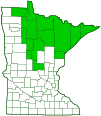
Least Chipmunk is the most widespread and also the smallest of the North American chipmunks. In Canada it occurs from Ontario to Yukon Territory. In the United States it occurs west of the Great Plains and in the upper Great Lakes region. In Minnesota it occurs in the Arrowhead and north-central regions and is absent from the remainder of the state. There are 21 subspecies of Least Chipmunk. Only one, Neotamias minimus neglectus, occurs in Minnesota. It is found at the edges and in the openings, clearcuts, and disturbed areas of coniferous and mixed forests.
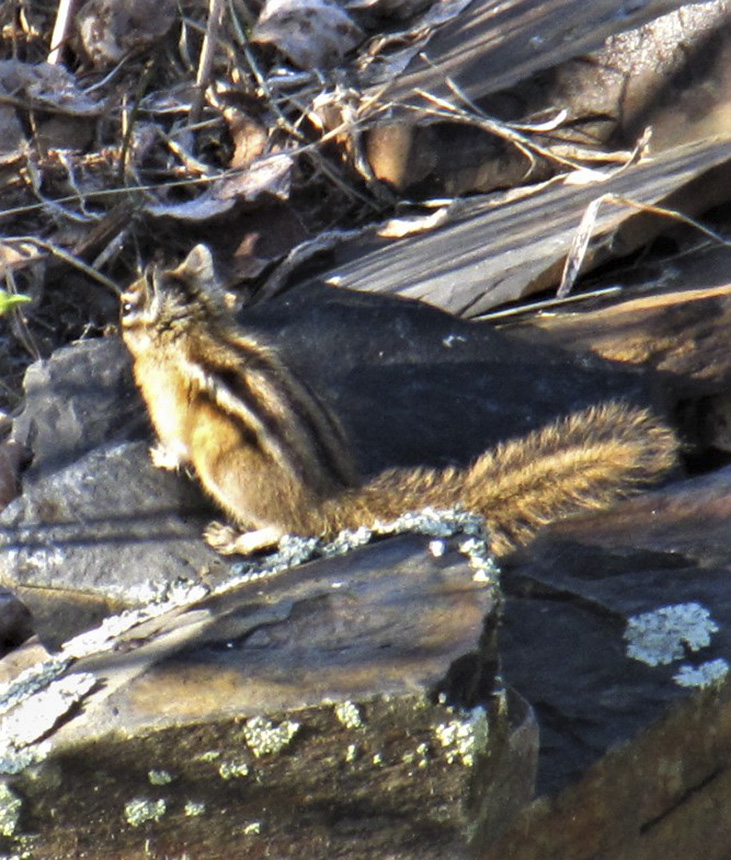
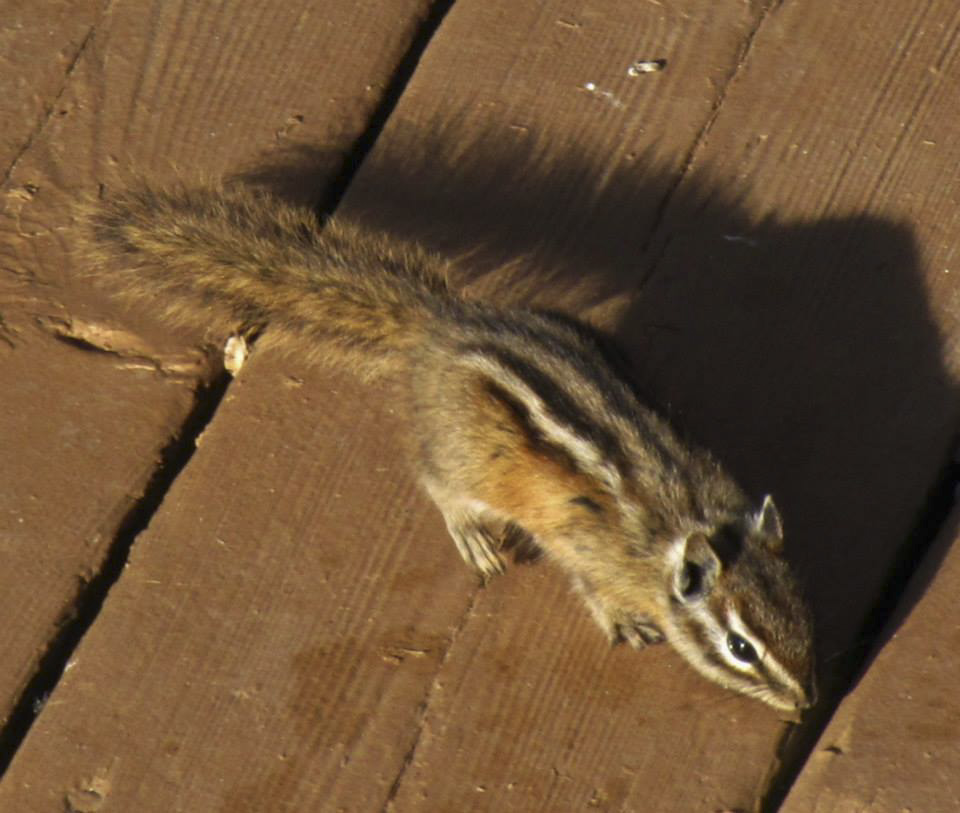
The adult is 7¼″ to 8¾″ (185 to 222 mm) long and weighs 1.48 to 1.87 ounces (42 to 53 grams). It weighs about half as much as an Eastern Chipmunk. The coat (pelage) on the sides is reddish-brown in the front, grayish brown in the rear. The rump is grayish-brown. The belly is grayish-white. There are five dark brown or black stripes on the back separated by white or cream-colored stripes. The middle stripe stretches from the nape of the neck to the base of the tail. On each side of the face there are three dark brown stripes separated by two white or cream-colored stripes. The facial stripes are well defined and highly visible. The tail is 3″ to 4½″ (76 to 114 mm) long, orangish-brown, and bushy.
Size
Total length: 7¼″ to 8¾″ (185 to 222 mm)
Head and body: 3⅝″ to 4½″ (93 to 114 mm)
Tail: 3″ to 4½″ (76 to 114 mm)
Sign
Similar Species
Habitat
Edges, openings, clearcuts, and disturbed areas within coniferous and mixed forests
Ecology
Behavior
When running it holds its tail erect.
Lifespan
10 years
Life Cycle
Least Chipmunk nests under stumps, logs, and rocks. It winters in a burrow it digs that reaches up to one meter underground.
Food
Seeds, nuts, fruits, acorns, snails, insect eggs and larvae, and small birds and mammals
Distribution |
||
|
Sources Biodiversity occurrence data published by: Minnesota Biodiversity Atlas (accessed through the Minnesota Biodiversity Atlas Portal, bellatlas.umn.edu, 12/24/2025). Timm, R. M. 1975. Distribution, natural history, and parasites of mammals of Cook County, Minnesota. Occasional Papers, Bell Museum of Natural History, University of Minnesota 14:1–56. Hazard, Evan B. 1982. The Mammals of Minnesota. University of Minnesota Press, Minneapolis, Minnesota. 280 pp. The counties in light green lack modern records but have historic county or township specimens or records. |
|
| 12/14/2025 | ||
Occurrence |
||
Common |
||
Taxonomy
Class
Subclass
Theria
Infraclass
Placentalia (Placental Mammals)
Magnorder
Boreoeutheria
Superorder
Euarchontoglires (Primates, Rodents, and Allies)
Order
Rodentia (Rodents)
Suborder
Sciuromorpha (Squirrels, Dormice, and Mountain Beavers)
Family
Sciuridae (Squirrels)
Subfamily
Xerinae (Ground and African Tree Squirrels)
Tribe
Tamiini (Chipmunks)
Genus
Neotamias (Western Chipmunks)
Genus
Three subgenera were of the genus Tamias were previously recognized: Neotamias, Tamias, and Eutamias. A recent analysis (DeGruyter, 2015) showed an earlier evolutionary divergence of Neotamias from Tamias and Eutamias. The three subgenera were raised to genus level. Eutamias now contains a single living species, the Siberian Chipmunk (Eutamias sibiricus). Noetamias now contains 23 species, mostly occurring in western North America. Tamias now contains just a single living species, the Eastern Chipmunk (Tamias striatus). Many sources, including ITIS, NCBI, The Taxonomicon, and Mammal Species of the World, continue to place all chipmunks in a subgenus of the genus Tamias.
Subordinate Taxa
Badlands Chipmunk (Neotamias minimus cacodemus)
Bighorn Chipmunk (Neotamias minimus confinis)
Cary’s Chipmunk (Neotamias minimus caryi)
Chuska Mountain Chipmunk (Neotamias minimus chuskaensis)
Common Least Chipmunk (Neotamias minimus minimus)
Flathead Least Chipmunk (Neotamias minimus oreocetes)
Gray-headed Chipmunk (Neotamias minimus caniceps)
Great Basin Chipmunk (Neotamias minimus pictus)
Hudson Bay Chipmunk (Neotamias minimus hudsonius)
Lake Superior Chipmunk (Neotamias minimus jacksoni)
Least Chipmunk (Neotamias minimus grisescens)
Least Chipmunk (Neotamias minimus neglectus) 
Least Chipmunk (Neotamias minimus scrutator)
Least Chipmunk (Neotamias minimus silvaticus)
Lesser Arizona Chipmunk (Neotamias minimus arizonensis)
Lesser Colorado Chipmunk (Neotamias minimus operarius)
Northern Interior d(Neotamias minimus borealis)
Peñasco Least Chipmunk (Neotamias minimus atristriatus)
Plains Chipmunk (Neotamias minimus pallidus)
Selkirk Least Chipmunk (Neotamias minimus selkirki)
Timberline Chipmunk (Neotamias minimus oreocetus)
Wasatch Chipmunk (Neotamias minimus consobrinus)
Synonyms
Eutamias minimus
Tamias minimus
Common Names
Least Chipmunk
Glossary
Pelage
The coat of a mammal, consisting of fur, wool, or hair, and including a soft undercoat and stiff guard hairs.