Common Watersnake
(Nerodia sipedon)
Information
Conservation • Description • Habitat • Ecology • Distribution • Taxonomy
Conservation Status
IUCN Red List
LC - Least Concern
NatureServe
N5 - Secure
S4 - Apparently Secure
Minnesota
not listed
Description
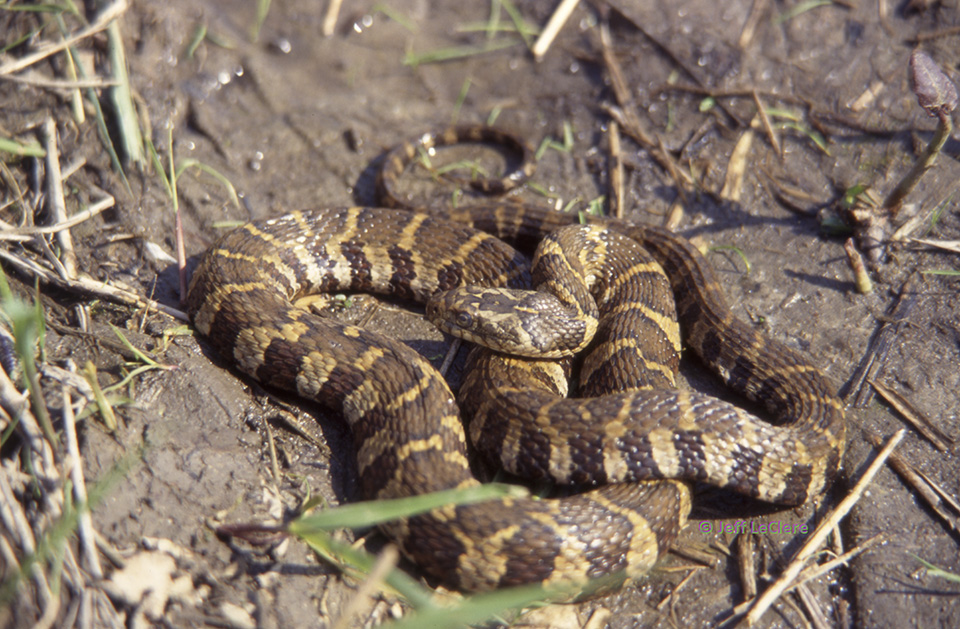
The background color is reddish-brown to tan or gray, but it may appear all brown, especially when dry. There are dark brown to black, squarish blotches on the back and similar spots on the sides. The back spots sometimes alternate with the side spots, sometimes join with them to form bands. The belly is cream colored and is usually irregularly covered with reddish, half-moon shaped marks.
Size
Total length: 24″ to 55″
Similar Species
Massasauga (Sistrurus catenatus) tail ends in a small, dark-colored rattle.
Northern cottonmouth (Agkistrodon piscivorus) is similar but have bands instead of blotches on the back. Their range does not extend to the upper Midwest.
Habitat
Ponds, lakes, marshes, streams, and river backwaters.
Ecology
Behavior
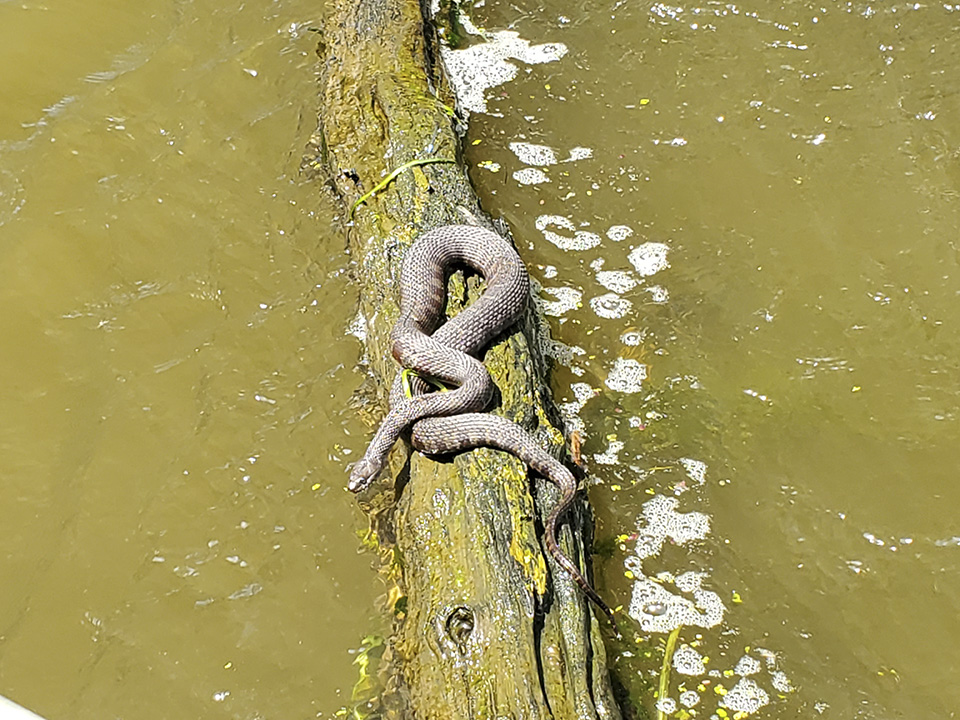
It can often be seen basking on a tree branch or shrub on the shore or bank of a river or stream.
t is not poisonous to humans but it can deliver a painful bite if cornered.
Lifespan
Up to 9.6 years
Life Cycle
Food
Fish, mammals, frogs, toads, salamanders, crayfish, worms, young snakes, young turtles, and insects.
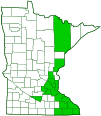
Distribution
Sources
Biodiversity occurrence data published by: Minnesota Biodiversity Atlas (accessed through the Minnesota Biodiversity Atlas Portal, bellatlas.umn.edu. Accessed 2/5/2026).
Nerodia sipedon (Linnaeus, 1758) in GBIF Secretariat (2023). GBIF Backbone Taxonomy. Checklist dataset https://doi.org/10.15468/39omei accessed via GBIF.org. Accessed 2/5/2026.
Occurrence
Taxonomy
Class
Reptilia (Reptiles)
Superorder
Lepidosauria
Order
Squamata (Snakes and Lizards)
Suborder
Serpentes (Snakes)
Family
Colubridae (Colubrid Snakes)
Subfamily
Natricinae
Genus
Nerodia (Watersnakes)
Subordinate Taxa
Carolina Watersnake (Nerodia sipedon williamengelsi)
Lake Erie Watersnake (Nerodia sipedon insularum)
Midland Watersnake (Nerodia sipedon pleuralis)
Northern Watersnake (Nerodia sipedon sipedon) 
Synonyms
Coluber sipedon
Natric sipedon
Natrix sipedon
Natrix sipedon williamengelsi
Nerodia agassizii
Common Names
Common Watersnake
Common Water Snake
Northern Watersnake
Photos
Visitor Photos
Share your photo of this reptile.
This button not working for you?
Simply email us at info@MinnesotaSeasons.com.
Attach one or more photos and, if you like, a caption.
Minnesota Seasons Photos
Slideshows
Slideshows
Videos
Visitor Videos
Share your video of this reptile.
This button not working for you?
Simply email us at info@MinnesotaSeasons.com.
Attach a video, a YouTube link, or a cloud storage link.
Other Videos
Northern watersnake - Nerodia sipedon sipedon - Hamilton County, Ohio, USA - May 27, 2013
William Hull
Venom H.L. Non Venomous, Northern watersnake (Nerodia sipedon sipedon)
VenomHerpLair
Venom H.L. Non Venomous, Northern watersnake (Nerodia sipedon sipedon) In HD
VenomHerpLair
Northern watersnake
nwwmark
60-Second Snakes: The Northern watersnake
MichiganDNR
Sightings
Visitor Sightings
Report a sighting of this reptile.
This button not working for you?
Simply email us at info@MinnesotaSeasons.com.
Be sure to include a location.
Jason Durnen
7/13/2019
Location: Winona
Jonathan H.
9/13/2017
Location: Eagle Creek in Scott County
Adult seen swimming along the bottom of stream until disappearing somewhere in the stream bank.
Jeff LeClere
2006
Location: Houston County
northern watersnake
Minnesota Seasons Sightings