


Dragon Horn
(Cladonia squamosa)
Conservation • Description • Ecology • Distribution • Taxonomy
Conservation Status
IUCN Red List
not listed
NatureServe
NNR - Unranked
SNR - Unranked
Minnesota
not listed
Description
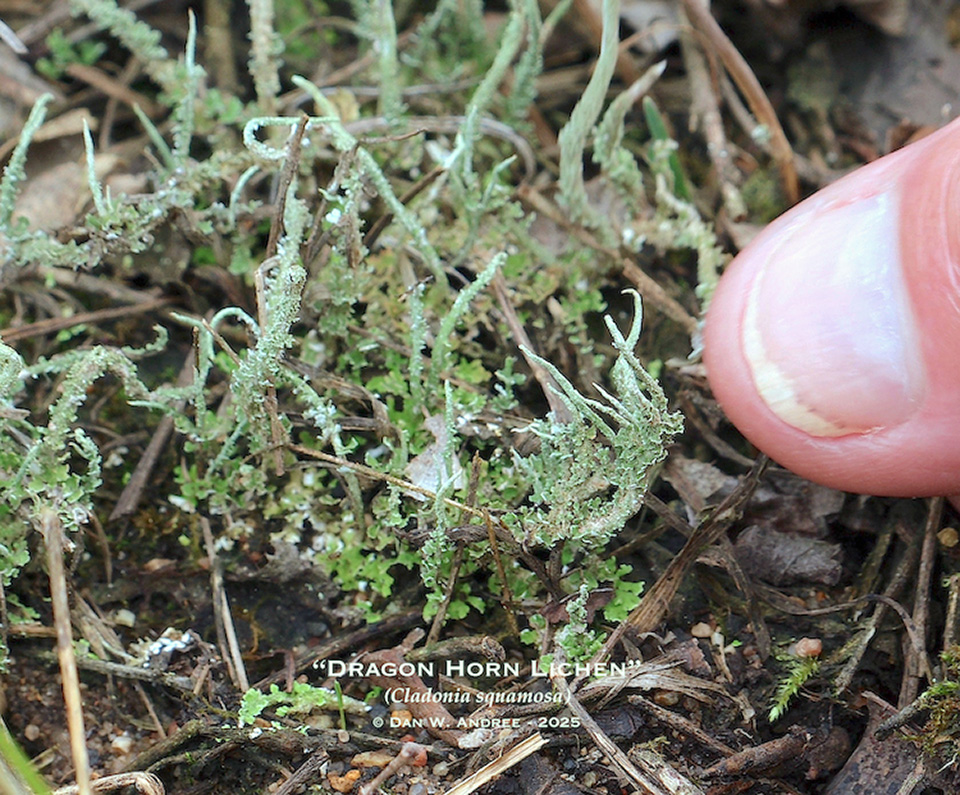
Dragon Horn is a common and highly variable lichen. Its distribution is widespread but scattered. It occurs worldwide on every continent except Antarctica. In the United States it occurs east on the Great Plains and on the West Coast, with a few scattered populations in between. It is found in moist, shaded, sheltered areas in woodlands. It grows on the ground among mosses on soil, rocks, rotting wood, or plant debris, and at the bases of trees.
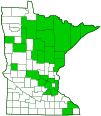
Dragon Horn produces two types of vegetative growth (thallus). The primary thallus is a leaf-like scale (squamule) that lies on the soil. The squamules are numerous but often small and inconspicuous, 1⁄16″ to ¼″ (2 to 6 mm) long, and 1⁄32″ to ⅛″ (1 to 3 mm) wide. The margins are deeply indented (incised) forming narrow, often coral-like lobes. The upper surface is light grayish green and the lower surface is white. The squamules form dense mats and they are persistent, remaining as the secondary thallus matures.
The secondary thallus (podetium) is extremely variable in shape and size. It is a slender, hollow, greenish gray to dark brown stalk that rises from the center of a basal squamule. It can be ¾″to 5½″ (2 to 14 cm) tall and 1⁄64″ to 3⁄16″ (0.5 to 5.0 mm) thick, but it is usually no more than 2¾″ (7 cm) tall and 1⁄16″ (2 mm) thick. It may have 2 to a few branches or be unbranched. The tips are usually pointed and there are openings (perforations) at the tips and the axils. Sometimes the openings are expanded, funnel-like, with apothecia (reproductive structures) clustered around the opening. The protective outer layer (cortex) breaks up above the base, above which the podetia surface is covered with abundant squamules, microsquamules, and granules. The squamules are up to ¼″ (6 mm) long and are deeply lobed, almost finger-like. They are upturned and overlapping, and they often hide the openings. They sometimes appear granulose.
Apothecia are uncommon. When present, they are brown, convex, and 1⁄16″ to ⅛″ (2 to 3 mm) in diameter.
Similar Species
Ecology
Substrate
Ground
Growth Form
Fruticose
Habitat
Moist, shaded areas in woodlands
Hosts
Distribution |
||
|
Sources Biodiversity occurrence data published by: Minnesota Biodiversity Atlas (accessed through the Minnesota Biodiversity Atlas Portal, bellatlas.umn.edu, 12/13/2025). |
|
| 121/13/2025 | ||
Occurrence |
||
Common |
||
Taxonomy
Kingdom
Fungi (Fungi)
Subkingdom
Dikarya
Phylum
Ascomycota (Sac Fungi)
Subphylum
Pezizomycotina
Class
Lecanoromycetes (Common Lichens)
Subclass
Lecanoromycetidae (Shield Lichens, Sunburst Lichens, Rosette Lichens, and Allies)
Order
Lecanorales (Shield Lichens, Rim Lichens, and Allies)
Family
Cladoniaceae (Spindles and Structured Lichens)
Genus
Cladonia (Pixie Cup and Reindeer Lichens)
Mycobiont
Cladonia squamosa
Photobiont
green algae other than Trentepohlia
Subordinate Taxa
Cladonia squamosa is common, widespread, and very variable lichen. Many subspecies, varieties, and forms have been described. Populations in which the thallus is more robust and more densely covered with squamules, and that reacts differently to applied chemistry, have been treated as Cladonia subsquamosa or Cladonia squamosa var. subsquamosa. However, it is considered a chemotype of Cladonia squamosa because the difference in morphology is questionable and the two acids that react differently are very closely related. No subspecies, varieties, or forms are currently recognized, all are treated as synonyms.
Synonyms
Baeomyces pleolepis
Baeomyces sparassus
Baeomyces squamosus
Baeomyces trachynus var. pleolepis
Capitularia sparassa
Cenomyce allotropa var. sparassa
Cenomyce sparassa
Cenomyce squamosa
Cenomyce squamosa var. muricella
Cenomyce squamosa var. squamosissima
Cladonia degenerans var. pleolepidea
Cladonia degenerans var. pleolepis
Cladonia delicata var. subsquamosa
Cladonia denticollis
Cladonia muricella
Cladonia pityrea var. subsquamosa
Cladonia sparassa
Cladonia sparassa var. denticollis
Cladonia squamosa ssp. denticollis
Cladonia squamosa ssp. fascicularis
Cladonia squamosa ssp. frondosa
Cladonia squamosa ssp. mucronata
Cladonia squamosa ssp. multibrachiata
Cladonia squamosa ssp. muricella
Cladonia squamosa ssp. phyllocoma
Cladonia squamosa ssp. phyllopoda
Cladonia squamosa ssp. pityrea
Cladonia squamosa ssp. squamosa
Cladonia squamosa ssp. squamosissima
Cladonia squamosa ssp. subsquamosa
Cladonia squamosa ssp. tenellula
Cladonia squamosa ssp. turfacea
Cladonia squamosa var. allosquamosa
Cladonia squamosa var. denticollis
Cladonia squamosa var. frondosa
Cladonia squamosa var. levicorticata
Cladonia squamosa var. multibrachiata
Cladonia squamosa var. muricella
Cladonia squamosa var. phyllocoma
Cladonia squamosa var. polychonia
Cladonia squamosa var. sparassa
Cladonia squamosa var. squamosa
Cladonia squamosa var. squamosissima
Cladonia squamosa var. subsquamosa
Cladonia squamosa var. turfacea
Cladonia subsquamosa
Coenomyce sparassa
Lichen cornutus var. squamosus
Lichen pleolepis
Lichen sparassus
Lichen squamosus
Patellaria caespitosa
Schasmaria sparassa
Scyphophorus sparassus
Common Names
Dragon Cladonia
Dragon Cup Lichen
Dragon Horn
Dragon Horn Lichen
Glossary
Apothecium
An open, disk-shaped or cup-shaped, reproductive structure, with spore sacs on the upper surface, that produces spores for the fungal partner of a lichen. Plural: apothecia.
Axil
The upper angle where a branch, stem, leaf stalk, or vein diverges.
Fruticose
Shrubby: referring to the growh form of lichens that may be tufted, draped, or stalked.
Podetium
The hollow stalk of the fruiting body of lichens in the genus Cladonia. Plural: podetia.
Squamules
On lichens: small, flat, often overlapping, leaf-like scales without a lower cortex. Adjective: squamulose
Thallus
The vegetative body of a lichen composed of both the alga and the fungus.
Visitor Photos
Share your photo of this lichen.
This button not working for you?
Simply email us at info@MinnesotaSeasons.com.
Attach one or more photos and, if you like, a caption.
Dan W. Andree |
||
|
 |
|
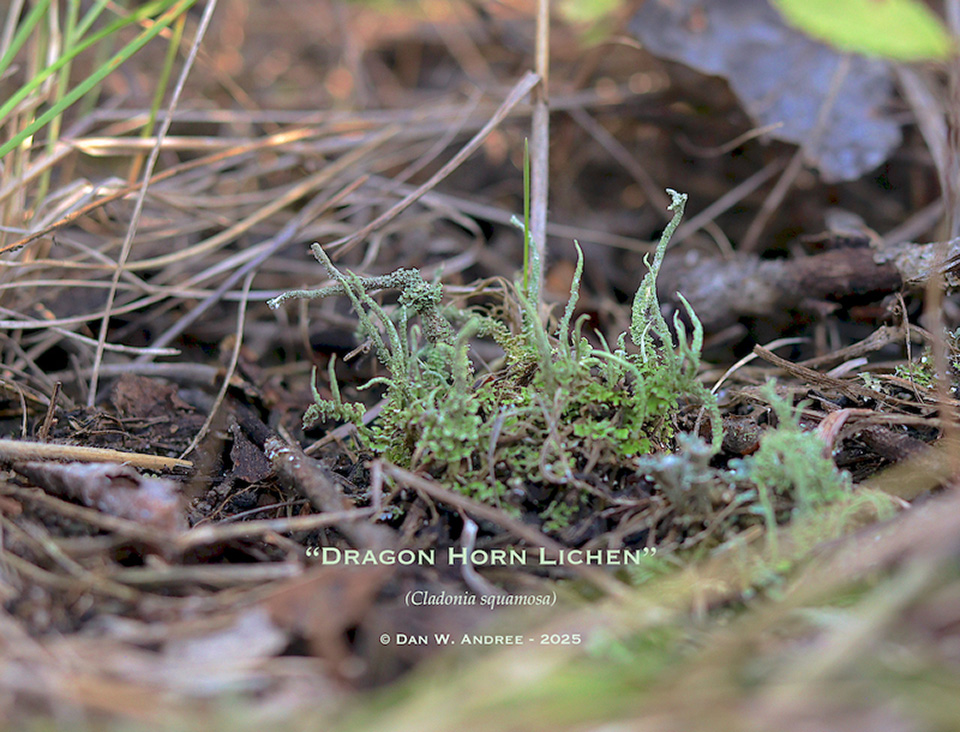
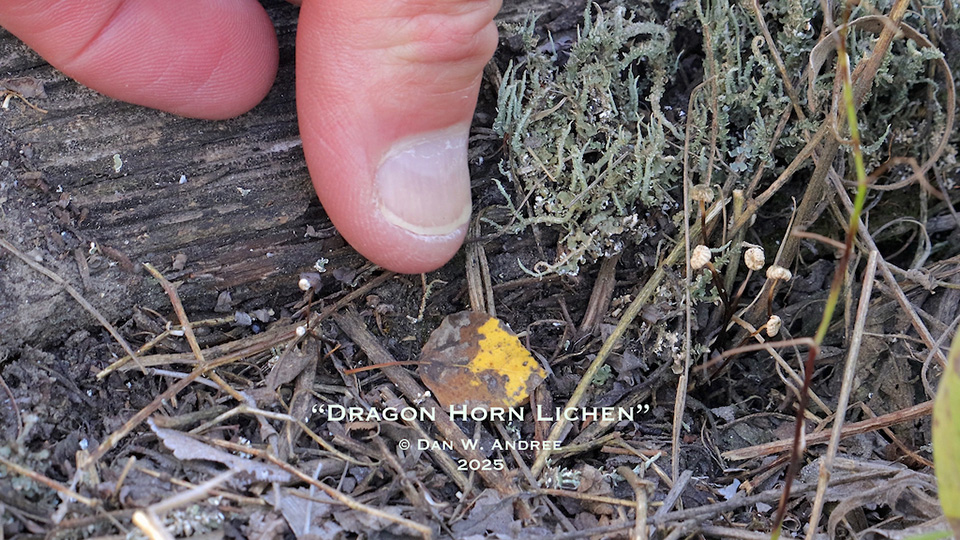
Another Dragon Horn... Here is another dragon horn lichen I came across. I like when there has been adequate moisture they seem to have a bit brighter color than when it has been hot and dry etc. conditions. Real interesting growth formations. This one kind a looks like it has a long necked creature on the right side with a small head and pointed ears etc. If one uses their imagination. 😊 |
||
Dragon Looking Dragon Horn Lichen... I came across this dragon horn lichen that reminded me of some type of friendly little dragon. Observed it on and off over a month or so and noticed depending on weather it sometimes looked greener and if drier conditions more greener gray like. Pretty cute little dragon horn lichen. |
||
 |
||
| Dragon Horn Lichen... |
|
|
MinnesotaSeasons.com Photos
|

Slideshows
The dragon cup lichen Cladonia squamosa
Θεόδωρος Φωτιάδης
Cladonia squamosa Greece by Theo Fotiadis
Θεόδωρος Φωτιάδης
Visitor Videos
Share your video of this lichen.
This button not working for you?
Simply email us at info@MinnesotaSeasons.com.
Attach a video, a YouTube link, or a cloud storage link.
Other Videos

Visitor Sightings
Report a sighting of this lichen.
This button not working for you?
Simply email us at info@MinnesotaSeasons.com.
Be sure to include a location.
Dan W. Andree
11/23/2025

Location: Norman Co. Mn.
Dan W. Andree
11/22/2025

Location: Norman Co. Mn.
Dan W. Andree
9/17/2025

Location: Norman Co. Mn.
MinnesotaSeasons.com Sightings |
|