Lumpy Bracket
(Trametes gibbosa)
Information
Conservation • Description • Habitat • Ecology • Distribution • Taxonomy
Conservation Status
IUCN Red List
not listed
NatureServe
NNR - Unranked
Minnesota
not listed
Description
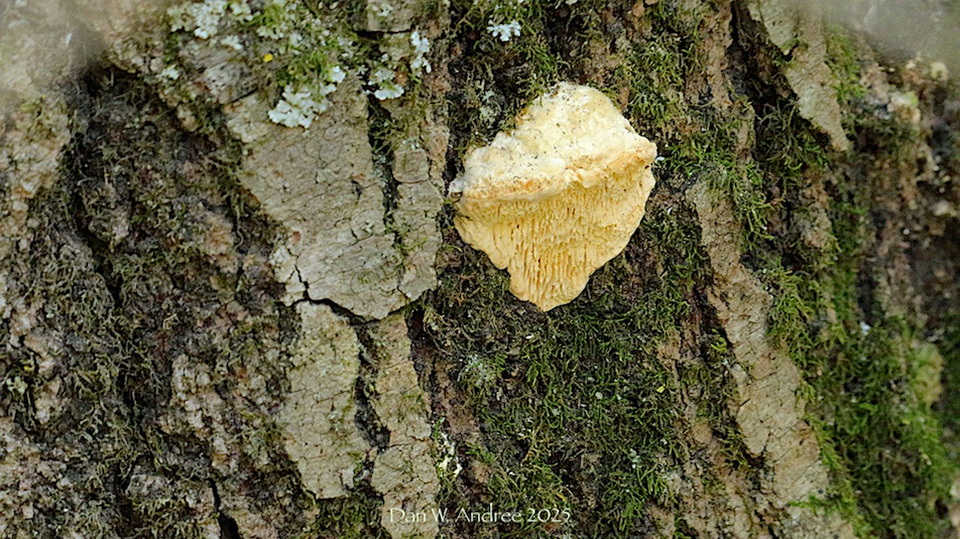
Lumpy Bracket (Trametes gibbosa) is an exotic, medium-sized to large, bracket fungus. It is native to Europe and Asia. It was previously included in Trametes elegans, and printed field guides and most online resources still refer to it by that name. It was first identified in North America in 2007 when cultures from Pennsylvania and Quebec were compared with cultures from the Czech Republic. It is believed to have been introduced accidentally by either imported wood or nursery stock. It now occurs throughout the United States and southern Canada east of the Great Plains and in the Pacific Northwest.
Lumpy Bracket is found from spring through fall, alone or in groups but not clustered (gregarious), on the dead wood of hardwood logs and stumps. It obtains its nutrients from decayed wood (saprobic). It is an annual fungus, only producing spores for one season, but its leathery brackets are extremely durable and often persist on the wood throughout the winter and into the following year.
The cap is 1½″ to 8″ (4 to 20 cm) wide, 1″ to 3½″ (2.5 to 9.0 cm) deep, ⅝″ to 2″ (1.5 to 5.0 cm) thick, semicircular or kidney-shaped, and flat above but convex below (planoconvex). While usually appearing as a shelf-like bracket, it is sometimes effused-reflexed, growing as part shelf and part flat crust. In these instances, especially in younger growth, the pore surface is decurrent, stretching several inches down the bark from the point of attachment while the cap remains relatively small.
When young, the fungus is whitish and the texture is corky. The margin is rounded and often yellowish to brownish. The upper surface is dry with concentric zones of soft, short, woolly, matted hairs (tomentose) alternating with hairless (bald) zones. The zones may be distinct or barely discernible. As the bracket grows outward from the tree, it tends to thicken and swell at the base where it attaches to the wood, creating a distinct “hump.” This is the feature that gives the fungus its species epithet gibbosa, which means “humped” or “gibbous.” As it ages, it becomes grayish or brownish and the margin is sharply angled (acute). The surface often becomes partially covered with green algae, especially in the hairy zones, which can create a striped appearance.
The underside (pore surface) is whitish to brownish with 1 to 2 pores per 1⁄32″ (1 mm). The pores are thick-walled and mostly 1⁄16″ to 5⁄16″ (2 to 8 mm) deep, up to ⅝″ (15 mm) deep in older “humps.” They are usually elongate, radiating outward from the point of attachment, and 1⁄32″ to 3⁄16″ (1 to 5 mm) long, but there are occasionally some longer, maze-like pores. The pore surface may bruise yellow to pinkish or brownish or not bruise at all. On older specimens it is often bug-eaten.
The spore print is white.
Similar Species
Habitat and Hosts
Hardwoods
Ecology
Season
Spring through fall
Distribution
Occurrence
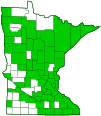
Common
Taxonomy
Kingdom
Fungi (Fungi)
Subkingdom
Dikarya
Phylum
Basidiomycota (Basidiomycete Fungi)
Subphylum
Agaricomycotina (Higher Basidiomycetes)
Class
Agaricomycetes (Mushrooms, Bracket Fungi, Puffballs, and Allies)
Order
Polyporales (Shelf Fungi)
Family
Polyporaceae (Bracket Fungi)
Genus
Trametes (Turkey-tails and Allies)
Species
Recent DNA studies have revealed that what was formerly called Trametes elegans in North America is actually two distinct species: Trametes gibbosa, an introduced species common in the Pacific Northwest and Eastern U.S. (identified by its lumpy cap and slot-like pores), and Trametes aesculi, a native species found primarily from the Southeast up to the Midwest. Current research suggests the true Trametes elegans is a tropical species that does not occur in the United States.
Subordinate Taxa
Synonyms
Agarico-suber scalptum
Agaricus tectulum
Boletus sinuosus
Bulliardia virescens
Daedalea gibbosa
Daedalea gibbosa ssp. gibbosa
Daedalea gibbosa ssp. sinuosa
Daedalea gibbosa ssp. torulosa
Daedalea gibbosa var. sinuosa
Daedalea sinuosa
Daedalea virescens
Lenzites gibbosus
Merulius gibbosus
Microporus kalchbrenneri
Polyporus gibbosus
Polyporus kalchbrenneri
Polystictus kalchbrenneri
Pseudotrametes gibbosa
Pseudotrametes gibbosa ssp. tenuis
Trametes crenulata
Trametes gibbosa ssp. gibbosa
Trametes gibbosa ssp. tenuis
Trametes gibbosa var. tenuipora
Trametes gibbosa var. tenuis
Trametes kalchbrenneri
Trametes nigrescens
Common Names
Lumpy Bracket
Lumpy Bracket Fungus
Photos
Visitor Photos
Share your photo of this fungus.
This button not working for you?
Simply email us at info@MinnesotaSeasons.com.
Attach one or more photos and, if you like, a caption.
Minnesota Seasons Photos
Slideshows
Slideshows
Lumpy Bracket/Trametes Gibbosa
Fantastic Situation
Trametes gibbosa - fungi kingdom
Nineli Lishina
Trametes gibbosa
Mushrooms Fungi
Videos
Visitor Videos
Share your video of this fungus.
This button not working for you?
Simply email us at info@MinnesotaSeasons.com.
Attach a video, a YouTube link, or a cloud storage link.
Other Videos
Lumpy bracket (Trametes gibbosa)
Dlium
Lumpy Bracket (Trametes gibbosa) - 2013-02-09
Westdelta
Trametes gibbosa
Dodskie's Passion
Sightings
Visitor Sightings
Report a sighting of this fungus.
This button not working for you?
Simply email us at info@MinnesotaSeasons.com.
Be sure to include a location.
Dan W. Andree
September 2025

Location: Norman Co. Mn.
Minnesota Seasons Sightings