


Grass spiders
(Agelenopsis spp.)
Overview • Description • Distribution • Taxonomy

Overview
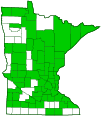
Agelenopsis is a genus of funnel weaver spiiders. They are called grass spiders because their conspicuous webs are often seen in grass. There are fourteen currrently recognized species of grass spiders. All occur in North America north of Mexico. At least three species occur in Minnesota.
Grass spiders are found in woodlands and grassy areas, low in bushes, in stone piles and gardens, and in corners of buildings, both outdoors and indoors.
Like all spiders, grass spiders are venomous, but they are not harmful to humans.
Description
Females are ⅜″ to ⅝″ (10 to 17 mm) in length not including the legs. Males are just a little smaller, ⅜″ to ⅝″ (9 to 15 mm) long.
The top of the front segment (carapace) has 3 pale and 2 dark horizontal stripes. Like other funnel-web spiders, the spinnerets extend well beyond the end of the rear segment (abdomen), and are visible from above.
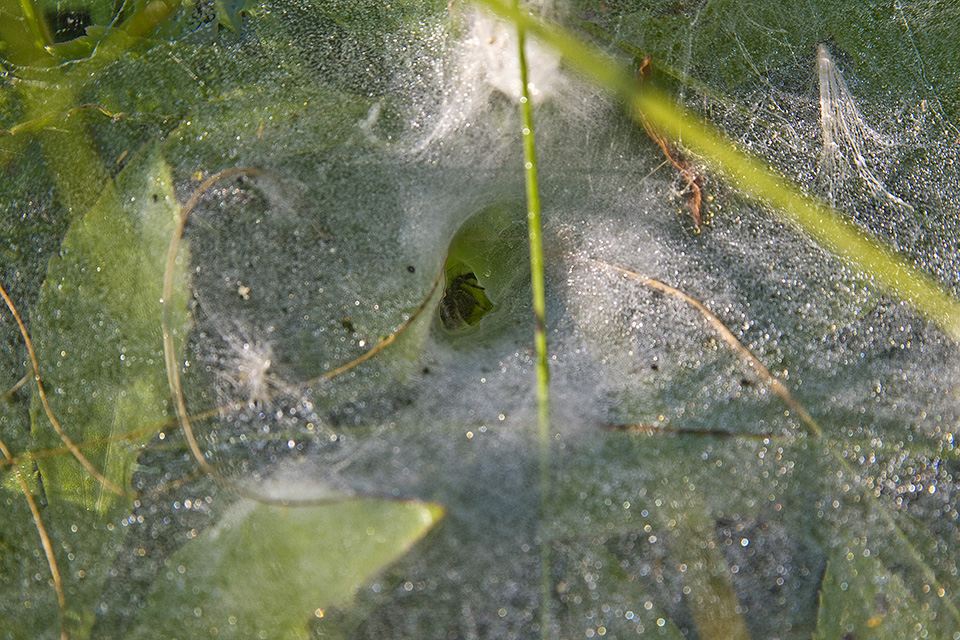
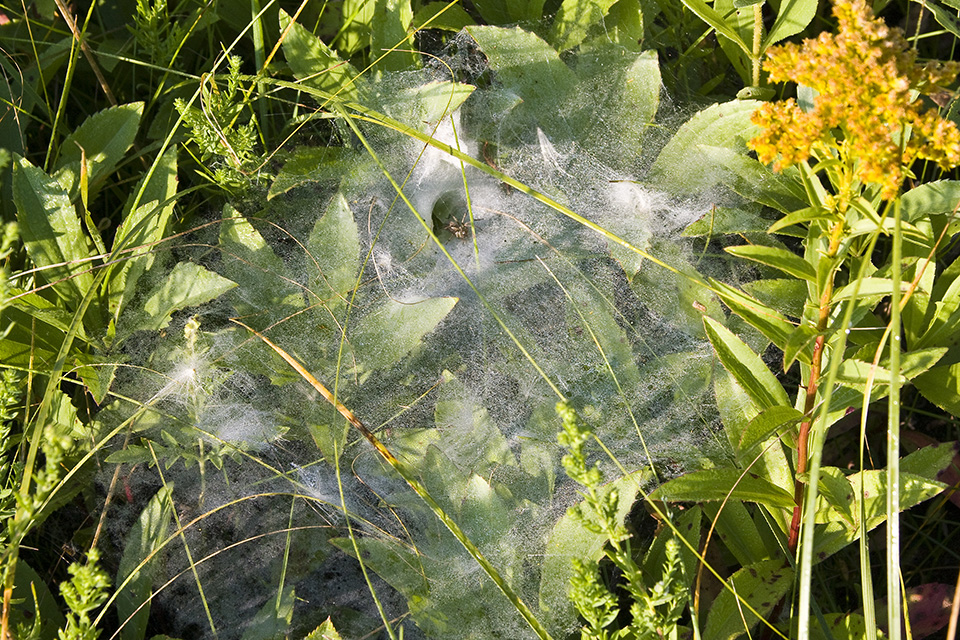
The web is a horizontal, non-sticky sheet with a funnel near one edge or in the middle.
Distribution |
||
|
Sources |
|
| 12/2/2025 | ||
Taxonomy
Class
Order
Suborder
Araneomorphae (Typical Spiders)
Infraorder
Entelegynae
Zoosection
RTA clade (RTA Clade Spiders)
Zoosubsection
Marronoid (Meshweavers and Allies)
Family
Subfamily
Ageleninae (Typical Funnel Weavers)
Subordinate Taxa
eastern funnelweb spider (Agelenopsis naevia)
Emerton’s funnelweb spider (Agelenopsis emertoni)
funnelweb spider (Agelenopsis aleenae)
funnelweb spider (Agelenopsis riechertae)
Kaston’s funnelweb spider (Agelenopsis kastoni)
long stylet funnelweb spider (Agelenopsis longistyla)
Oklahoma funnelweb spider (Agelenopsis oklahoma) 
Oregon funnelweb spider (Agelenopsis oregonensis)
Pennsylvania funnelweb spider (Agelenopsis pennsylvanica)
Potter’s grass spider (Agelenopsis potteri)
spatulate funnelweb spider (Agelenopsis spatula)
truncated grass funnelweaver (Agelenopsis actuosa)
Utah funnelweb spider (Agelenopsis utahana)
western funnelweb spider (Agelenopsis aperta)
Synonyms
Agalenopsis
Common Names
grass spiders
Glossary
Carapace
On spiders, the top of the cephalothorax.
Cephalothorax
The front part of a spider’s body, composed of the head region and the thoracic area. Eyes, legs, and antennae are attached to this part.
Visitor Photos
Share your photo of this arachnid.
This button not working for you?
Simply email us at info@MinnesotaSeasons.com.
Attach one or more photos and, if you like, a caption.
Justin B.
Hello!
My name is Justin, and I live in SE WI with my wife, Amy. I happened to see some information you have online about grass spiders, and I knew you would be the place to reach out to.
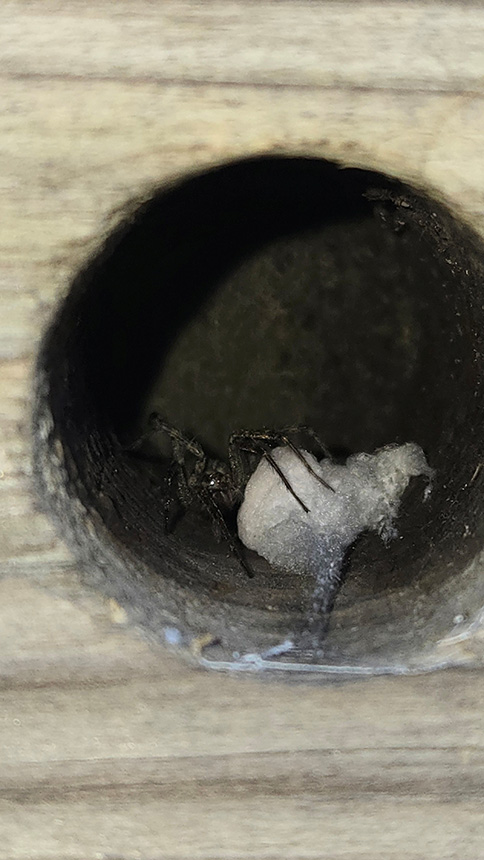
In the fall, a friend of my mom's called me over to remove a grass spider and her egg sac on her patio table umbrella (she knows I'm an animal lover and protector, haha, and I'm thankful she called me instead of killing her, which is sadly what most would do). I delicately brought her and her egg sac back to my house, and I gave them shelter in a wooden block with a just-big-enough hollowed out tunnel in the middle.
She ran right to her babies and covered them, which was touching to see (attached a picture). This was in September. I considered bring her in, but I knew she'd want to be by her babies, and I knew her lifecycle was predetermined. However, I will wanted to try to help her as much as I could. I wrapped the wood block in roadside insulating blanket wraps, I kept them in a larger outdoor shelter wrapped in tarps, and I tried to give her water using a cotton ball.
I went out today to change her water cotton ball, and sadly, she was gone 😔 And most touching, she even died with one appendage on top of her babies, which, truthfully caused me to tear up. I was actually just tonight going to order a heating pad to put underneath the wood block.
I know about the lifecycle, and I know she probably outlived expectations, but in the back of my mind, I just wonder if there was more I could have done. This is why I wanted to contact - is there a scenario through which I could've helped her survive even longer, or was it just a foregone conclusion no matter what I tried? I suppose at the very least, I got her a few extra weeks with her babies 😢 I will certainly leave them outside in the same protected area and check on them regularly. The least I can do is ensure all her babies get a safe start to their lives in the spring.
Like you, I have a deep appreciation for all of God's creation, even the tiny things that most people fear irrationally like spiders (I always protect them where possible). Thank you for what you do,for bringing awareness, and for caring about that which society has seemed to unfairly cast out. God Bless!
Mary Jo Reuter |
||
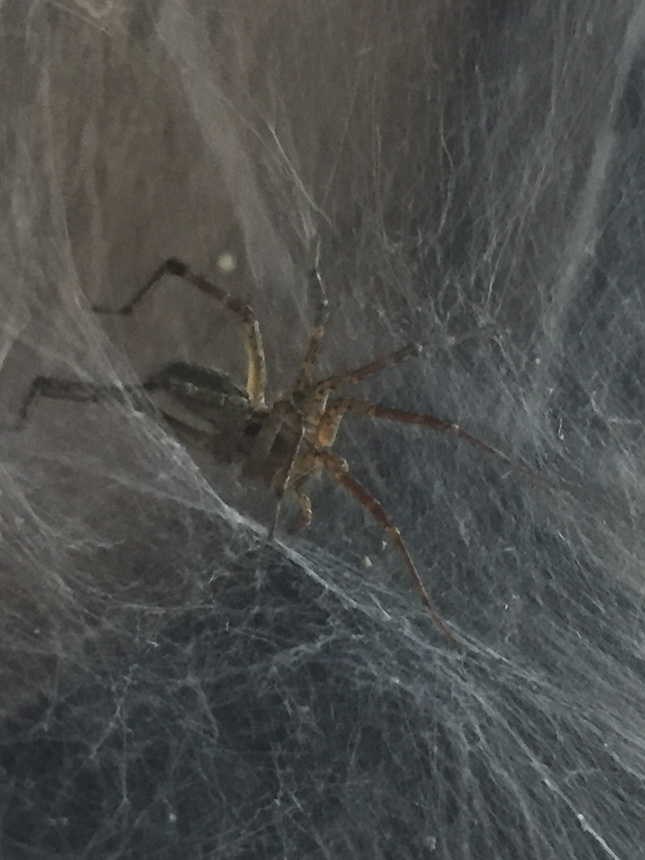
Below are the pictures that accompany the report I sent separately from these pictures. Inbetween my mobile home windows. Lindstrom Mn October 15. Thought it was a Brown Recluse at first until taking a better picture to identify it was not the “violin” on the cephathorax (sp?!). Please let me know otherwise if not grass spider as I have to take my AC unit out tomorrow!! Thanks It is about 3/4” body with the main part that has two black parts with a white stripe down the middle, the abdomen is dark grayish. Has very long legs, two antennas next to the weird eyes. The legs look translucent except it has dark markings on the legs also. I sent three pictures to this email address also today. Please I would appreciate if this is not a grass spider to let me know asap, as I have to take out my AC units and have the window edges taped up heavily because I don’t want that coming into my house!! I am deathly afraid of spiders and may have to move if that comes in until it is found!! At first I thought this was a brown recluse because I could not see close enough if that was a violin on its main part. But today I was finally able to shoot a picture and zoom in enough to see it did not appear to be a violin and was thankful that it was not a brown recluse...from my uneducated guess. |
||
 |
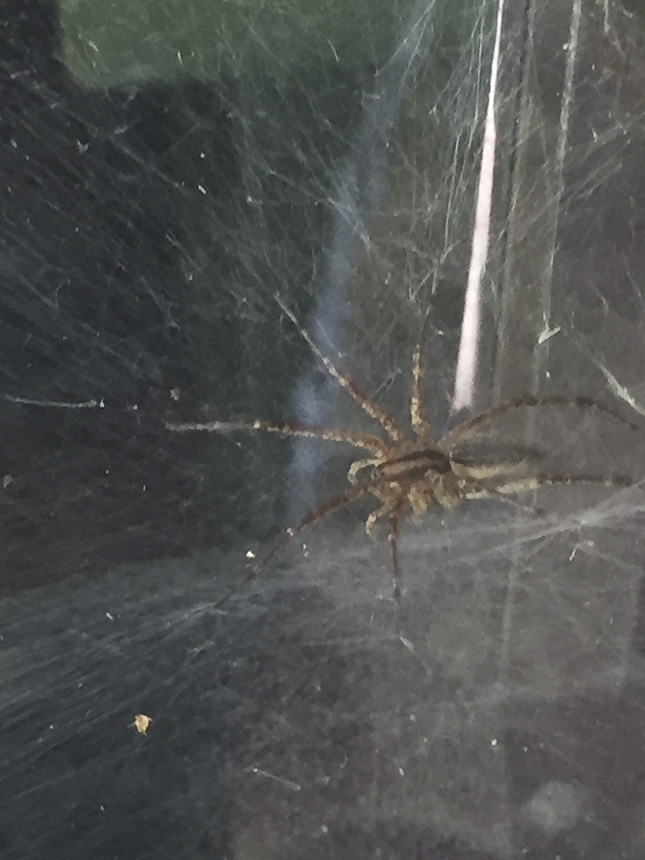 |
|
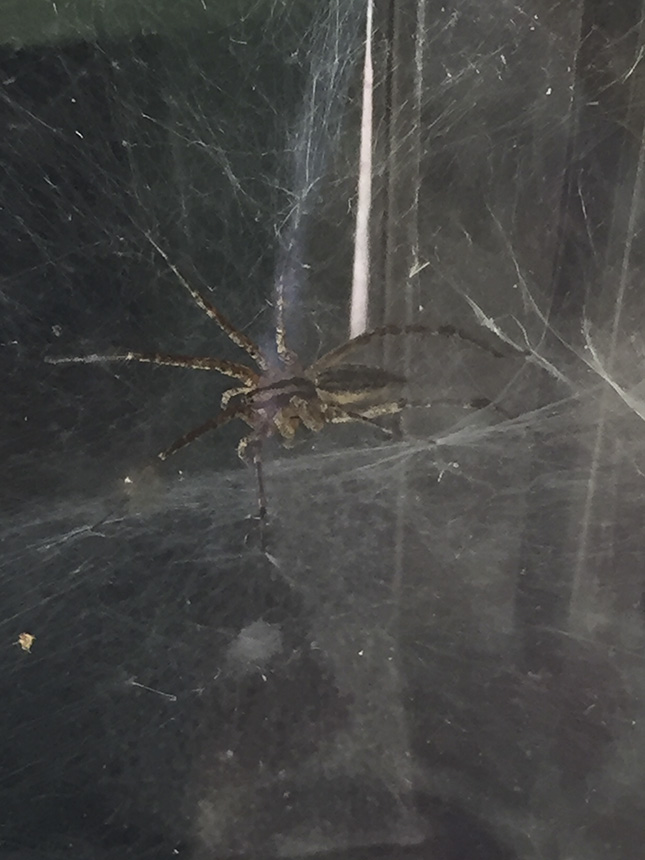 |
||
Any suggestions how to get him out as it will probably run right into the seam where the window and window frame meet. His fangs are about 1/8th “ as I was able to get a good picture of those last night. |
||
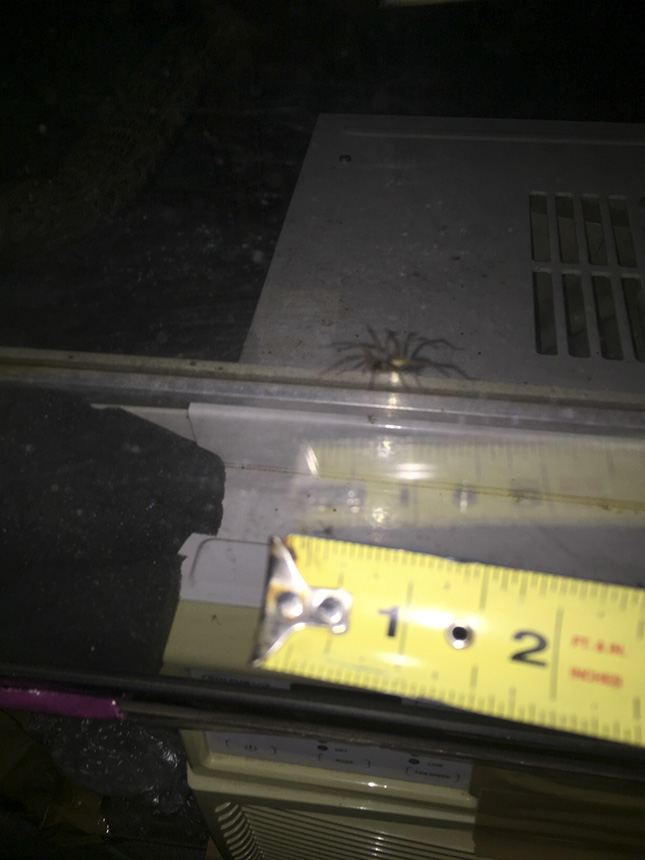 |
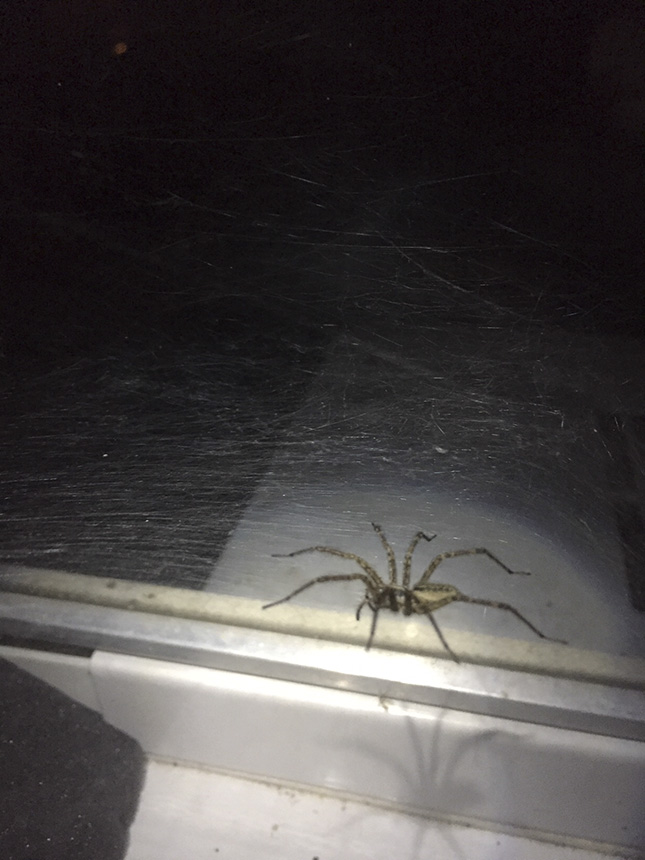 |
|
MinnesotaSeasons.com Photos
|
 |
|
 |

Slideshows

Visitor Videos
Share your video of this arachnid.
This button not working for you?
Simply email us at info@MinnesotaSeasons.com.
Attach a video, a YouTube link, or a cloud storage link.
Other Videos
American Grass Spider facts: the harmless funnel weavers | Animal Fact Files
Animal Fact Files
Grass Spider (Agelenidae: Agelenopsis) on Nest
Carl Barrentine
Agelenopsis "species" Funnel Web Weaver feeding
Ron's Spiders

Visitor Sightings
Report a sighting of this arachnid.
This button not working for you?
Simply email us at info@MinnesotaSeasons.com.
Be sure to include a location.
Justin B.
12/1/2025

Location: SE WI
Hello!
My name is Justin, and I live in SE WI with my wife, Amy. I happened to see some information you have online about grass spiders, and I knew you would be the place to reach out to.
In the fall, a friend of my mom's called me over to remove a grass spider and her egg sac on her patio table umbrella (she knows I'm an animal lover and protector, haha, and I'm thankful she called me instead of killing her, which is sadly what most would do). I delicately brought her and her egg sac back to my house, and I gave them shelter in a wooden block with a just-big-enough hollowed out tunnel in the middle.
She ran right to her babies and covered them, which was touching to see (attached a picture). This was in September. I considered bring her in, but I knew she'd want to be by her babies, and I knew her lifecycle was predetermined. However, I will wanted to try to help her as much as I could. I wrapped the wood block in roadside insulating blanket wraps, I kept them in a larger outdoor shelter wrapped in tarps, and I tried to give her water using a cotton ball.
I went out today to change her water cotton ball, and sadly, she was gone 😔 And most touching, she even died with one appendage on top of her babies, which, truthfully caused me to tear up. I was actually just tonight going to order a heating pad to put underneath the wood block.
I know about the lifecycle, and I know she probably outlived expectations, but in the back of my mind, I just wonder if there was more I could have done. This is why I wanted to contact - is there a scenario through which I could've helped her survive even longer, or was it just a foregone conclusion no matter what I tried? I suppose at the very least, I got her a few extra weeks with her babies 😢 I will certainly leave them outside in the same protected area and check on them regularly. The least I can do is ensure all her babies get a safe start to their lives in the spring.
Like you, I have a deep appreciation for all of God's creation, even the tiny things that most people fear irrationally like spiders (I always protect them where possible). Thank you for what you do,for bringing awareness, and for caring about that which society has seemed to unfairly cast out. God Bless!
John Valo
12/2/2025
Justin.
As you suggested, if she lived outdoors in Wisconsin, her life cycle was predetermined. Grass spiders do not survive the harsh winters in Minnesota or the somewhat milder winters in southeastern Wisconsin. Short of moving the entire block indoors in a terrarium, giving her a source of water and an occasional feeding of a live or recently deceased insect, there was little you could do to extend her life through the winter.
You can take comfort in knowing that you extended her life a little, and you are protecting her eggs from predators, harsh weather, and accidental destruction by humans.
Mary Jo Reuter
10/16/2021
Location: Lindstrom, MN, Chisago County
Any suggestions how to get him out as it will probably run right into the seam where the window and window frame meet. His fangs are about 1/8th “ as I was able to get a good picture of those last night.
John Valo
10/16/2021
My suggestion not to remove your AC unit was just to say that the spider was not a danger to you. I wouldn't want a spider this size to spend the winter in my house either.
Mary Jo Reuter
10/15/2021
Location: Inbetween my windows, Lindstrom, MN/Chisago County. My AC unit
It is about 3/4” body with the main part that has two black parts with a white stripe down the middle, the abdomen is dark grayish. Has very long legs, two antennas next to the weird eyes. The legs look translucent except it has dark markings on the legs also. I sent three pictures to this email address also today.
Please I would appreciate if this is not a grass spider to let me know asap, as I have to take out my AC units and have the window edges taped up heavily because I don’t want that coming into my house!! I am deathly afraid of spiders and may have to move if that comes in until it is found!!
At first I thought this was a brown recluse because I could not see close enough if that was a violin on its main part. But today I was finally able to shoot a picture and zoom in enough to see it did not appear to be a violin and was thankful that it was not a brown recluse...from my uneducated guess.
John Valo
10/15/2021
It is not a brown recluse, as you noted.
Wolf spiders and grass spiders looks similar, but wolf spiders don't make webs. This is a grass spider. I will look closer tomorrow to see if I can determine the species. In the meantime, don't take out your AC unit. Here is information from Smith's Pest Management:
While grass spiders are not poisonous, they (like all spiders) are venomous. In most cases, their venom is not a risk to people. Instead of biting unsuspecting gardeners, grass spiders use their venom to subdue prey. Grass spiders have very small fangs that cannot generally puncture human skin. Aug 27, 2021
MinnesotaSeasons.com Sightings