Grass Choke Disease
(Epichloe typhina)
Information
Conservation • Description • Habitat • Ecology • Distribution • Taxonomy
Conservation Status
IUCN Red List
not listed
NatureServe
not listed
Minnesota
not listed
Description
Epichloe is a genus of fungi that live as endophytes (organisms that live within the plant’s tissues) in grasses. The species within this genus are classified into three types based on their relationship with the host plant. Types II and III are largely mutualistic, providing benefits to the grass such as increased resistance to pests and drought. Type I species are pathogenic; they form a reproductive structure called a stroma that physically “chokes” the grass, preventing the plant from flowering and producing seeds. Epichloe typhina is a Type I species.
Epichloe typhina is native to Europe, and it has been introduced in North America. It now occurs in the United States and southern Canada from the East Coast through the Great Plains and in the Pacific Northwest, with scattered populations in between.
Epichloe typhina has no official common name, though it is frequently referred to as Choke or the Choke Fungus. These names are derived from Grass Choke, the disease the fungus causes when its visible growth prevents the emergence of the grass seed head. While many of the 40+ species in the Epichloe genus are host-specific to a single grass genus, E. typhina is notable for its broad host range, infecting many different genera of cool-season grasses. In Minnesota, common hosts include bluegrasses, orchard grass, perennial ryegrass, timothy, and wood millet.
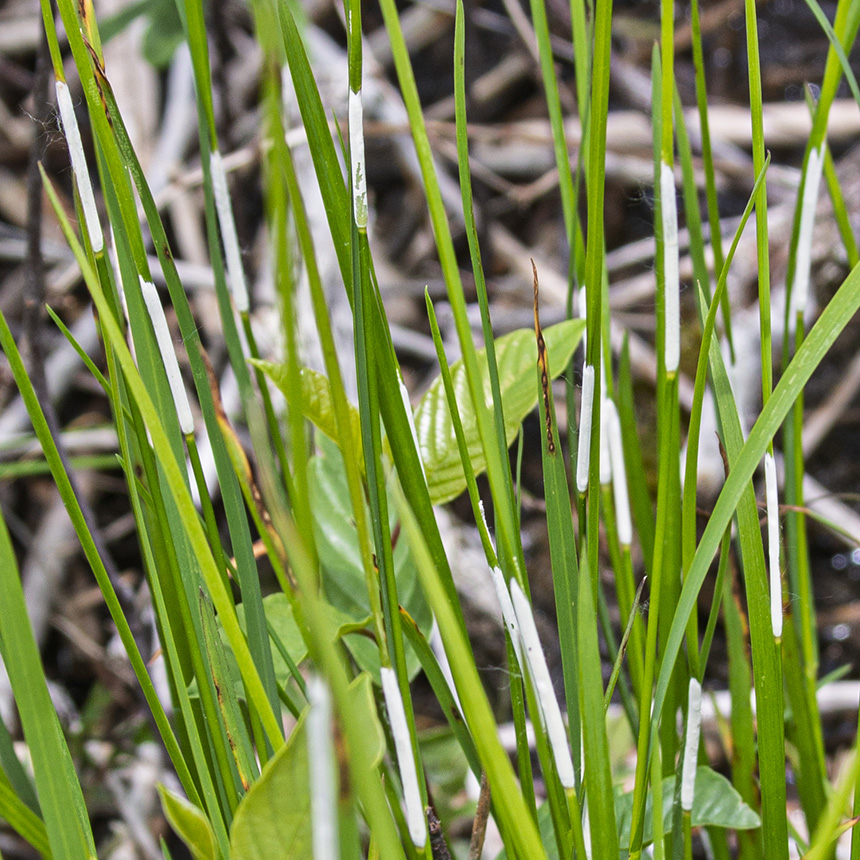
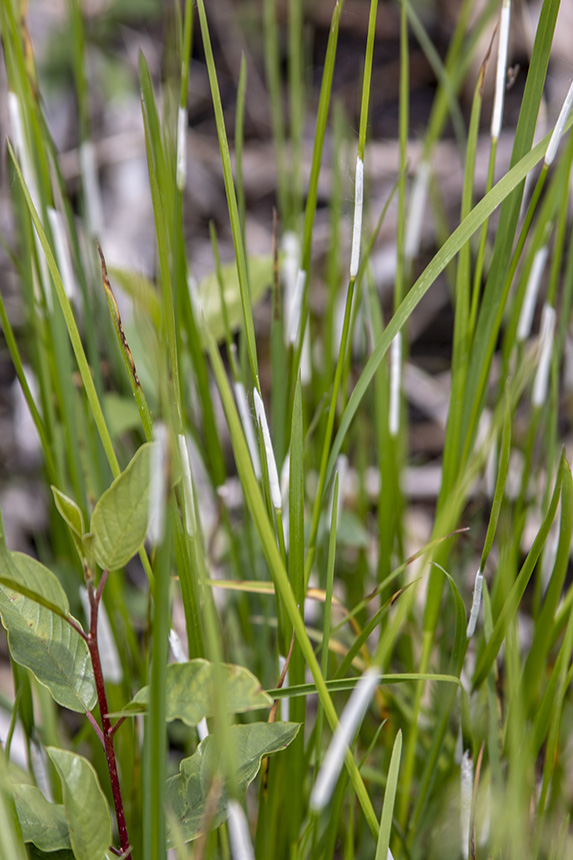
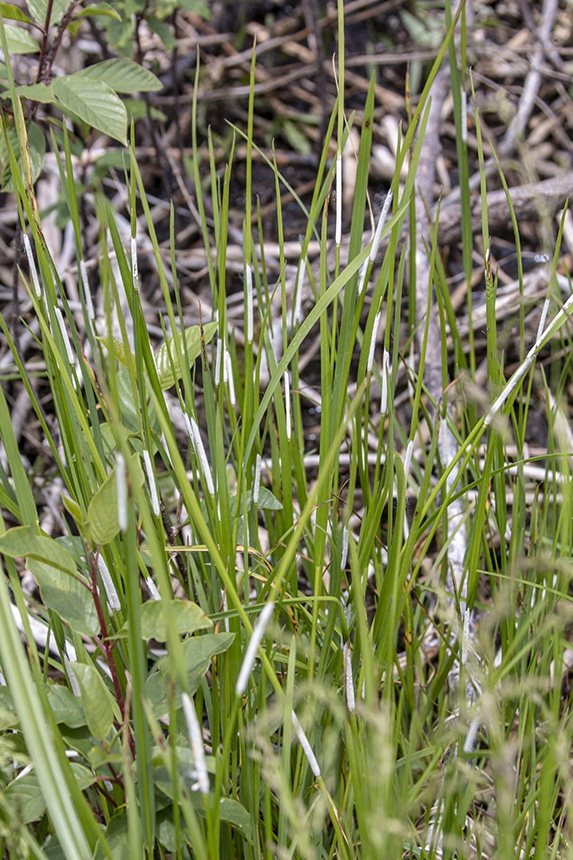
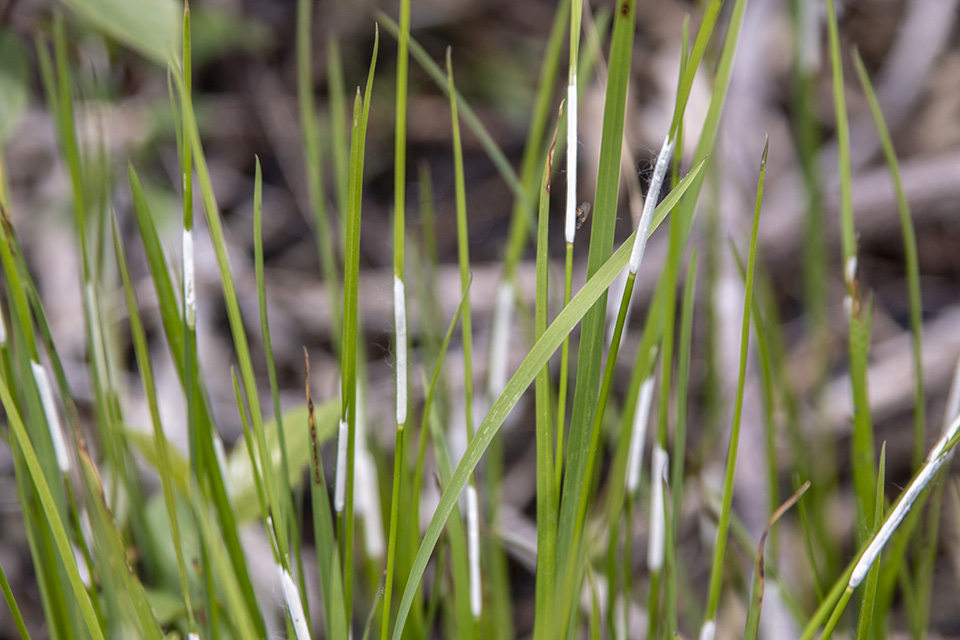
When it first appears, the fungus forms a smooth, white, waxy or felt-like cylindrical collar—known as a stroma—around the sheath of the uppermost leaf. During this early stage, the fungus is producing asexual spores (conidia).
As it matures, the stroma changes significantly, turning golden yellow to bright orange. The surface becomes noticeably granular or “bumpy” as the fungus develops tiny, pin-point fruiting bodies (perithecia) for sexual reproduction.
Later in the season, the mass turns dark brown or grayish-brown and may appear weathered or cracked as it begins to decay. This recognizable structure typically measures 1″ to 3″ (2.5 to 7.5 cm) in length and completely encases the developing seed head. By physically “choking” the grass in this manner, the fungus prevents the inflorescence (panicle) from emerging, which renders the plant sterile.
Similar Species
Habitat and Hosts
Cool season grasses, including bluegrasses (Poa spp.), perennial ryegrass (Lolium perenne), orchard grass (Dactylis glomerata ssp. glomerata), timothy (Phleum pratense ssp. pratense), wood millet (Milium effusum),
Ecology
Season
Distribution
Occurrence
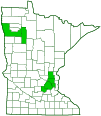
Infrequent and localized
Taxonomy
Kingdom
Fungi (Fungi)
Subkingdom
Dikarya
Phylum
Ascomycota (Sac Fungi)
Subphylum
Pezizomycotina
Class
Sordariomycetes
Subclass
Hypocreomycetidae
Order
Hypocreales
Family
Clavicipitaceae
Genus
Epichloe (Choke)
Subordinate Taxa
Synonyms
Acremonium typhinum var. ammophilae
Acremonium typhinum var. bulliforme
Acremonium typhinum var. fasciculatum
Claviceps typhina
Claviceps typhinum
Cordyceps typhina
Dothidea typhina
Epichloe typhina var. aonikenkana
Epichloe typhina var. canariensis
Epichloe typhina
Epichloe typhina ssp. typhina
Hypocrea typhina
Nemania typhina
Neotyphodium typhinum var. canariense
Polystigma typhinum
Sphacelia typhina
Sphacelia typhina ssp. aeruginosa
Sphacelia typhina var. agropyrina
Sphaeria spiculifera
Sphaeria typhina
Stromatosphaeria typhina
Typhodium typhinum
Common Names
Epichloe typhina has no official common name, but it is popularly referred to in non-technical literature by the disease which it causes—Grass Choke, or Grass Choke Disease.
Photos
Visitor Photos
Share your photo of this fungus.
This button not working for you?
Simply email us at info@MinnesotaSeasons.com.
Attach one or more photos and, if you like, a caption.
Minnesota Seasons Photos
Slideshows
Slideshows
Videos
Visitor Videos
Share your video of this fungus.
This button not working for you?
Simply email us at info@MinnesotaSeasons.com.
Attach a video, a YouTube link, or a cloud storage link.
Other Videos
Mufka źdźbłowa (Epichloe typhina) – 06.06.2021, Nowa Huta, Kraków.
Grzyby w Nowej Hucie
Sightings
Visitor Sightings
Report a sighting of this fungus.
This button not working for you?
Simply email us at info@MinnesotaSeasons.com.
Be sure to include a location.