Mealy Pixie Cup - Species Profile
Conservation • Description • Ecology • Distribution • Taxonomy
Conservation Status
IUCN Red List
not listed
NatureServe
NNR - Unranked
SNR - Unranked
Minnesota
not listed
Description
Mealy Pixie Cup is a common, cosmopolitan lichen. It occurs worldwide on every continent except Antarctica. In the United States it is common in the east and in the west, but it is mostly absent from the deep south, the desert southwest, the Great Plains, and the Great Basin. It grows under full sun or partial shade, on humus and mineral soil, on rotten wood, and on tree trunks.
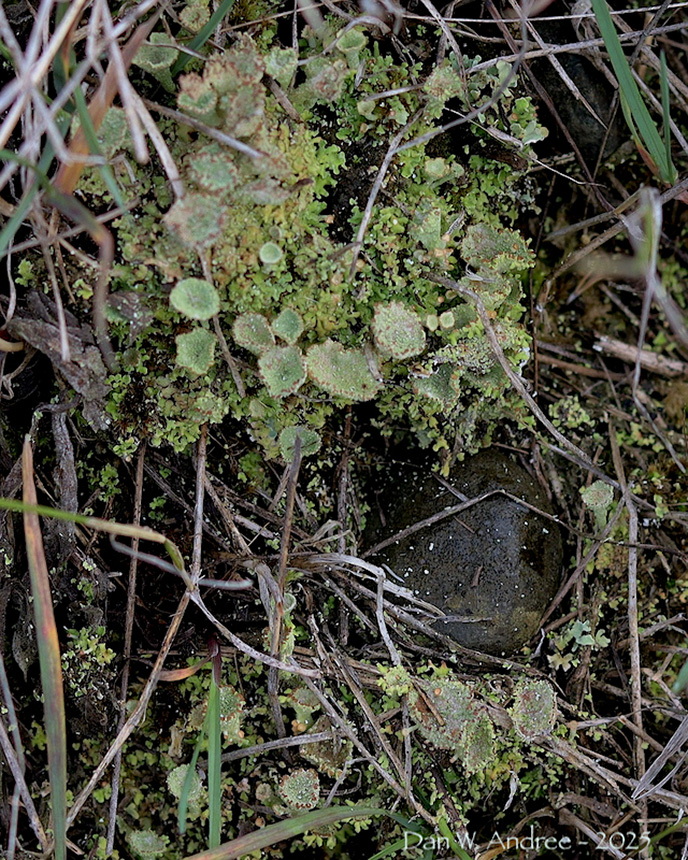
Mealy Pixie Cup produces two types of vegetative growth (thallus). The primary thallus consists of numerous leaf-like scales (squamules) that often form a dense, carpet-like mat on the substrate. The squamules are ⅛″ to ¼″ (3 to 6 mm) long and 1⁄16″ to ⅛″ (2 to 4 mm) wide, and they are ascending or raised at the margins.The margins have irregular, rounded lobes or teeth. The upper side is grayish green and the underside is white, but the color darkens toward the base. The squamules are persistent, remaining as the secondary thallus matures.
The secondary thallus is a vertical, unbranched, stout or more or less slender stalk (podetium) rising from the primary thallus. It is grayish green to brownish-green and 1⁄16″ to ⅝″ (2 to 15 mm) tall, and does not darken or turn black at the base (non-melanotic). At the tip of the stalk there is a 1⁄16″ to ¼″ (2 to 6 mm) wide cup that gradually tapers to the stalk. The cup is undivided and the margin is unlobed, though it may appear lobed when fruiting structures are present. The layer of protective tissue (cortex) is typically absent or is present just at the very base. As the lichen develops, the cortex breaks up and gives rise to fine, asexual reproductive structures (soredia). These soredia are mealy in texture and cover the outer surface and the interior of the cup.
Egg-shaped to top-shaped (turbinate) reproductive, flask-like structures (pycnidia) are very common on the margin. Disk-shaped, 1⁄16″ to ⅛″ (2 to 4 mm) in diameter, brown, reproductive structures (apothecia) rising from the margin are uncommon.
Mealy Pixie Cup contains fumarprotocetraric acid, which causes a red reaction during standard lichen spot testing (the P+ red test).
Similar Species
Pebbled Pixie Cup (Cladonia pyxidata) is covered in coarser, pebble-like or scale-like granules. However, identification is not always definitive. Juvenile specimens that haven't fully developed soredia, or very old (senescent) specimens where the surface has eroded, can look identical. Because these two species exist on a morphological gradient, some lichenologists argue they should be treated as a single variable species. Both species are often found growing right next to each other.
Trumpet Lichen (Cladonia fimbriata) soredia are significantly finer, resembling a coating of white flour. The cups are typically taller, narrower, and more “trumpet-shaped.”
Ecology
Substrate
Ground
Growth Form
Fruticose
Habitat
Hosts
Distribution
Sources
Biodiversity occurrence data published by: Minnesota Biodiversity Atlas (accessed through the Minnesota Biodiversity Atlas Portal, bellatlas.umn.edu. Accessed 3/7/2026).
The Consortium of North American Lichen Herbaria (CNALH) https://lichenportal.org/cnalh/index.php. Accessed 3/7/2026.
Mycology Collections Portal (MyCoPortal) https://www.mycoportal.org/portal/collections/index.php). Accessed 3/7/2026.
Cladonia chlorophaea (Flörke ex Sommerf.) Spreng. in GBIF Secretariat (2023). GBIF Backbone Taxonomy. Checklist dataset https://doi.org/10.15468/39omei accessed via GBIF.org. Accessed 3/7/2026.
Fink, B. (1910). The Lichens of Minnesota. United States: U.S. Government Printing Office.
Occurrence
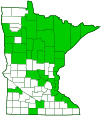
Common
Taxonomy
Kingdom
Fungi (Fungi)
Subkingdom
Dikarya
Phylum
Ascomycota (Sac Fungi)
Subphylum
Pezizomycotina
Class
Lecanoromycetes (Common Lichens)
Subclass
Lecanoromycetidae (Shield Lichens, Sunburst Lichens, Rosette Lichens, and Allies)
Order
Lecanorales (Shield Lichens, Rim Lichens, and Allies)
Family
Cladoniaceae (Spindles and Structured Lichens)
Genus
Cladonia (Pixie Cup and Reindeer Lichens)
Mycobiont
Cladonia chlorophaea
Photobiont
green algae other than Trentepohlia
Species
Cladonia chlorophaea was long treated as a subspecies or variety of the Pebbled Pixie Cup (Cladonia pyxidata). Recent phylogenetic studies and taxonomic revisions have seen it raised to full species status.
Species Complex
Modern lichenology treats C. chlorophaea as a species complex rather than a single, uniform species. It belongs to a group of “cryptic species”—taxa that are morphologically identical but chemically and genetically distinct.
In Minnesota, a specimen identified in the field as C. chlorophaea may actually be one of several sibling species, most notably Gray’s Pixie Cup (C. grayi). These cannot be reliably separated by sight; they require Thin-Layer Chromatography (TLC) to detect specific secondary metabolites (acids). Because these species are indistinguishable to the naked eye, many older records and field observations group them under the broad “Mealy Pixie Cup” (C. chlorophaea) umbrella.
Subordinate Taxa
Synonyms
Cenomyce chlorophaea
Cladonia chlorophaea
Cladonia chlorophaea var. chlorophaea
Cladonia chlorophaea var. pachyphyllina
Cladonia pyxidata subsp. chlorophaea
Cladonia pyxidata var. chlorophaea
Patellaria fimbriata var. chlorophaea
Common Names
Mealy Pixie Cup
Mealy Pixie Cup Lichen
Mealy Pixie-cup
