


Striped Skunk - Species Profile
Conservation • Description • Habitat • Ecology • Distribution • Taxonomy
Conservation Status |
|
||||
| IUCN Red List | LC - Least Concern |
||||
| NatureServe | N5 - Secure SNR - Unranked |
||||
| Minnesota | not listed |
||||
Description
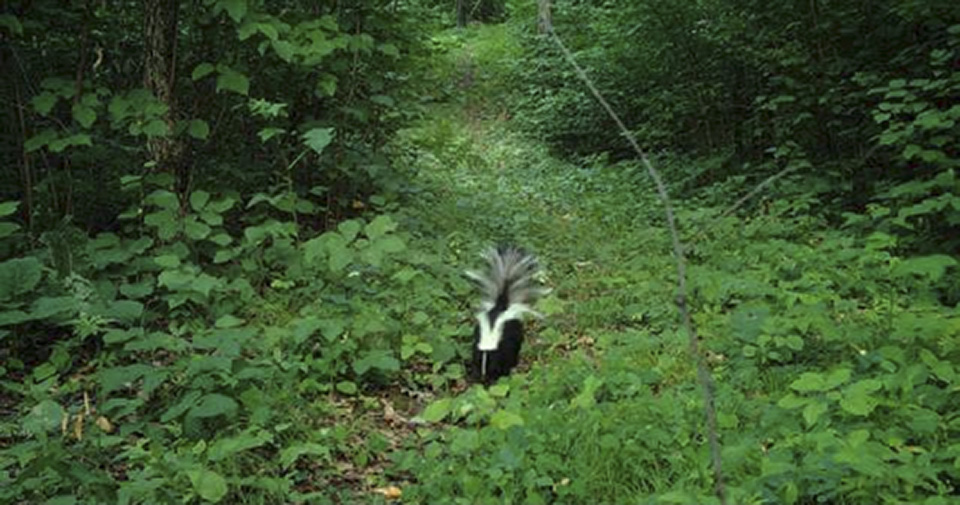
Striped Skunk is a common, widely recognized, medium-sized mammal. Average size and weight measurements vary greatly in published literature, possibly due in part to geographic variation among the 13 recognized subspecies. Adults are 20″ to 30″ long, including the tail, and weigh 4 to 10 pounds. Males are about 10% larger than females and may weigh up to 12 pounds just before denning for the winter.
The body is stout and shaped somewhat like a cat. The fur (pelage) is black with conspicuous white markings. There is a white stripe on the back (dorsum) that splits into a V-shape at the shoulders and continues as two stripes to the rump. The width of the white area varies and some individuals are mostly black. Two highly developed scent glands on either side of the anus are modified for defense. They each contain about ½ ounce of yellowish musk. The musk contains seven sulfur compounds (thiols), is highly odoriferous, and causes nausea and burning in the eyes of predators.
The tail is bushy and 8½″ to 11″ long. On some individuals the dorsal stripes continue unbroken along the edges of the tail to the tip. On others, the tail is mostly black but there are usually at least some white hairs on the edge of the tail.
The legs are short and stout. The feet are small. The front feet have five long curved claws modified for digging. The claws on the hind feet are shorter and straighter.
The head is small and triangular. There is a thin white stripe on the center of the snout and forehead, and a prominent white patch on the nape of the neck. The ears are short. The eyes are black. The jaws hold 34 teeth.
Size
Total length: 20″ to 30″
Tail: 8½″ to 11″
Sign
The tracks of Striped Skunks are unusually small for an animal its size. The palm pads are continuous, not segmented. The long nails of the forefeet leave impressions well ahead of the toe pads. The trails are in a 2-2 pattern, with the hind foot just ahead of the front foot.
Similar Species
Plains Spotted Skunk (Spilogale interrupta) is smaller and more slender. Its shape is more like a weasel. It has four narrow white stripes that break into spots on the hindquarters.
Habitat
A variety of habitats, including woodland openings, prairies, ravines, suburban areas, and especially cultivated areas.
Ecology
Behavior
Striped Skunk is solitary and nocturnal. In the summer they spend the day alone in an above-ground den in a hollow log or tree, a rock or brush pile, or under a building. In colder months they use an underground den, usually one dug and abandoned by another animal.
When threatened, the skunk will face the opponent, arch its back, raise its tail, hiss, and stomp the ground with its forelegs. If these warnings prove insufficient, the skunk will bend its body around so that both the hindquarters and the head are facing the opponent and spray. The musk can be sprayed with high accuracy up to 10′, with less accuracy up to 15′. The mist thrown off the spray travels much farther.
Lifespan
6 to 7 years
Life Cycle
There is just one litter per year. Breeding takes place in late February or March. Gestation takes 59 to 77 days. A litter of usually 4 to 7 young (kits) is born about mid-May to early June. The kits are weaned in 42 to 56 days and leave the den at age 2½ to 3 months, but remain with the mother until age 6 to 12 months. Most kits die in their first year from predation or disease. Those that survive can live up to 6 or 7 years.
Around mid-November they enter an underground den to spend the winter. They do not hibernate. They spend the winter inside the den, often in groups of two or more females and sometimes a single male. During this time they enter into a state of low metabolic activity and low body temperature to conserve energy, rarely if ever emerging to forage. Both sexes lose about half of their body mass during the winter due to fat metabolization.
Disease Vector
Striped Skunk is an important vector of the rabies virus, mostly in corn-producing areas of the state. Rabies is more common in Striped Skunk than in any other mammal in Minnesota.
Food
Mostly insects, including grasshoppers, beetles, crickets, and caterpillars, but also small mammals, bird eggs and chicks, fruits, and human garbage.
Distribution |
||
|
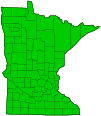
Sources Biodiversity occurrence data published by: Minnesota Biodiversity Atlas (accessed through the Minnesota Biodiversity Atlas Portal, bellatlas.umn.edu, 12/2/2025). Timm, R. M. 1975. Distribution, natural history, and parasites of mammals of Cook County, Minnesota. Occasional Papers, Bell Museum of Natural History, University of Minnesota 14:1–56. Hazard, Evan B. 1982. The Mammals of Minnesota. University of Minnesota Press, Minneapolis, Minnesota. 280 pp. The counties in light green lack modern records but have historic county or township specimens or records. |
|
| 12/2/2025 | ||
Occurrence |
||
Common and widespread |
||
Taxonomy
Class
Subclass
Theria
Infraclass
Placentalia (Placental Mammals)
Magnorder
Boreoeutheria
Superorder
Laurasiatheria (Ungulates, Carnivorans, and Allies)
Order
Carnivora (Carnivorans)
Suborder
Caniformia (Dog-like Carnivores)
Infraorder
Arctoidea
Parvorder
Mustelida
Family
Mephitidae (Skunks and Stink Badgers)
Subfamily
Mephitinae (True Skunks)
Genus
Mephitis (Striped and Hooded Skunks)
Subordinate Taxa
Arizona Skunk (Mephitis mephitis estor)
California Skunk (Mephitis mephitis occidentalis)
Canada Skunk (Mephitis mephitis mephitis)
Cascade Skunk (Mephitis mephitis notata)
Eastern Skunk (Mephitis mephitis nigra)
Florida Skunk (Mephitis mephitis elongata)
Great Basin Skunk (Mephitis mephitis major)
Illinois Skunk (Mephitis mephitis avia)
Long-tailed Texas Skunk (Mephitis mephitis varians)
Louisiana Skunk (Mephitis mephitis mesomelas)
Northern Plains Skunk (Mephitis mephitis hudsonica) 
Puget Sound Skunk (Mephitis mephitis spissigrada)
Southern California Skunk (Mephitis mephitis holzneri)
Synonyms
Mephitis mesomelas
Viverra mephitis
Common Names
Northern Plains Skunk
Northern Plains Striped Skunk
Striped Skunk
Glossary
Pelage
The coat of a mammal, consisting of fur, wool, or hair, and including a soft undercoat and stiff guard hairs.