



Indian meal moth
(Plodia interpunctella)
Conservation • Description • Habitat • Ecology • Distribution • Taxonomy
Hodges #
6019
Conservation Status
IUCN Red List
not listed
NatureServe
NNR - Unranked
SNR - Unranked
Minnesota
not listed
Description
Indian meal moth is a common, small to medium-sized, exotic, knot-horn moth. It is native to South America. It now occurs worldwide on every continent except Antarctica. It occurs throughout the United States and southern Canada. It is found wherever dried foods are stored, including in grain bins, in food storage warehouses, grocery stores, pet stores, restaurants, and people’s homes.
Indian meal moth is a serious pest of all kinds of stored and vegetable products, including birdseed, bread, cereal, dried fruits, flour, nuts, pasta, rice, soup mixes, spices, and plant based dry pet food. These products are shipped around the world and stored in large quantities in warehouses near heavily populated urban areas, furthering the spread of this pest. Sealed containers can become infested because the larvae are able to chew through plastic and cardboard. They are often responsible for the webbing seen in packaged products like flour, corn meal, spices, cocoa, coffee, and even instant coffee. Once established, they are difficult to eradicate.
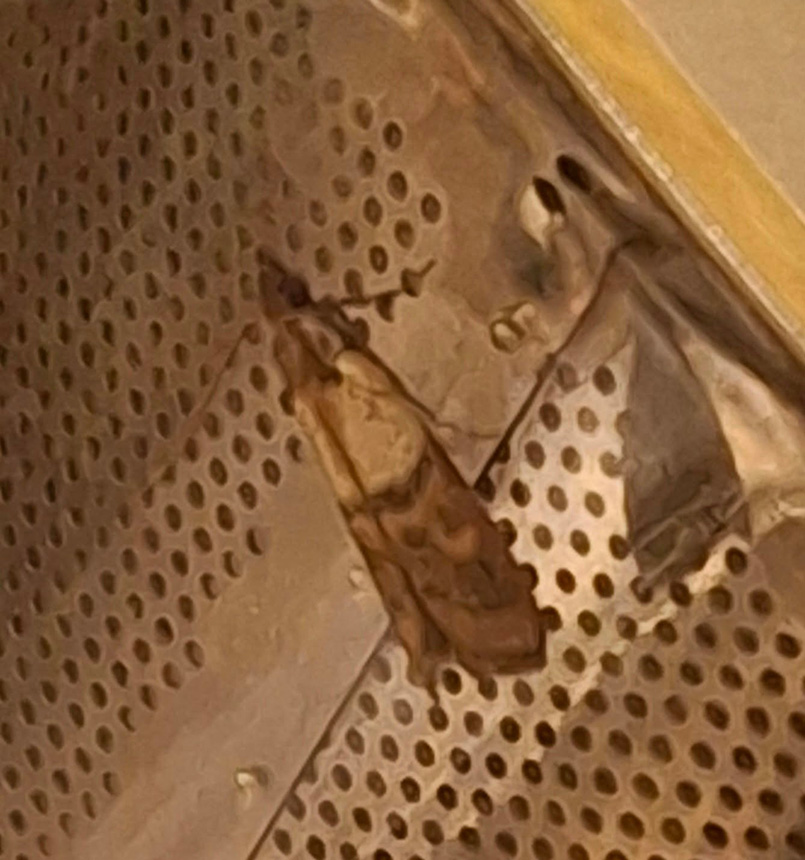
Adults are 5⁄16″ to ⅜″ (8 to 10 mm) in length and have a 11⁄16″ to ¾″ (18 to 20 mm) wingspan. The forewing length is 3⁄16″to 5⁄16″ (5.0 to 8.5 mm). The body is long and narrow.
The head appears small. In both sexes, the antennae are simple, not plumose, and the sensory appendages (palps) attached to the upper lip (labrum) are long and projected forward in front of the head. There are two large compound eyes and three small simple eyes (ocelli).
The wings are long and narrow. When at rest they folded flat and overlapped, giving the moth a streamlined appearance. The forewing color is variable, yellowish brown, reddish brown, grayish brown, or gray. The front half is pale, the rear half is dark and mottled, and the two areas are separated by a bold, black or dark, oblique, antemedial line. The postmedial and subterminal lines are often inconspicuous due to the dark mottling.
The hindwing is pale gray with a slightly darker terminal line.
Size
Total length: 5⁄16″ to ⅜″ (8 to 10 mm)
Forewing length: 3⁄16″to 5⁄16″ (5.0 to 8.5 mm)
Wingspan: 11⁄16″ to ¾″ (18 to 20 mm)
Similar Species
Habitat
Grain bins, food storage warehouses, grocery stores, pet stores, restaurants, and people’s homes
Ecology
Season
Year-round
Behavior
Life Cycle
Larva Food/Hosts
All kinds of dried, plant-based foodstuffs
Adult Food
Adults do not feed
Distribution |
||
|
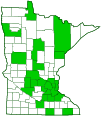
Sources Biodiversity occurrence data published by: Minnesota Biodiversity Atlas (accessed through the Minnesota Biodiversity Atlas Portal, bellatlas.umn.edu, 12/14/2025). |
|
| 12/14/2025 | ||
Occurrence |
||
Common and widespread |
||
Taxonomy
Order
Lepidoptera (Butterflies and Moths)
Superfamily
Pyraloidea (Pyralid and Crambid Snout Moths)
Family
Pyralidae (Pyralid Snout Moths)
Subfamily
Phycitinae (Knot-horn Moths)
Tribe
Genus
Plodia
Subordinate Taxa
Synonyms
Ephestia glycinivora
Ephestia interpunctella
Phycis interpunctella
Plodia americana
Plodia castaneella
Plodia glycinivora
Plodia glycinivorella
Plodia latercula
Plodia zea
Tinea interpunctella
Tinea zeae
Unadilla latercula
Common Names
Indian meal moth
Indianmeal moth
Indian-meal moth
pantry moth
Glossary
Ocellus
Simple eye; an eye with a single lens. Plural: ocelli.
Palp
Short for pedipalp. A segmented, finger-like process of an arthropod; one is attached to each maxilla and two are attached to the labium. They function as sense organs in spiders and insects, and as weapons in scorpions. Plural: palpi or palps.
Plumose
Feathery; having fine, pinnately arranged, lateral bristles or hairs arranged on both sides of an axis.
Visitor Photos
Share your photo of this insect.
This button not working for you?
Simply email us at info@MinnesotaSeasons.com.
Attach one or more photos and, if you like, a caption.
Luciearl |
|
|
Unknown moth in kitchen. Probably from all the geraniums I bring in. |
MinnesotaSeasons.com Photos
|

Slideshows

Visitor Videos
Share your video of this insect.
This button not working for you?
Simply email us at info@MinnesotaSeasons.com.
Attach a video, a YouTube link, or a cloud storage link.
Other Videos
Complete Life Cycle of the Indianmeal Moth
Insects Limited
How to Eliminate Indian Meal Moths like a Pro! DIY Pantry Pest Control
Unipest Pest and Termite Control Inc.
Indian Mealmoth: Beautiful pest - Life cycle - Plodia interpunctella - One-minute lifecycle
Bart Coppens

Visitor Sightings
Report a sighting of this insect.
This button not working for you?
Simply email us at info@MinnesotaSeasons.com.
Be sure to include a location.
Luciearl
12/10/2025

Location: Lake Shore, MN
Probably from all the geraniums I bring in.
Minnesota Seasons Sightings