


Leonard’s Skipper
(Hesperia leonardus)
Conservation • Description • Habitat • Ecology • Distribution • Taxonomy
Conservation Status |
|
||||
| IUCN Red List | not listed |
||||
| NatureServe | N4 - Apparently Secure S3 - Vulnerable |
||||
| Minnesota | Special Concern Species in Greatest Conservation Need |
||||
Description
Leonard’s Skipper is a large, late season, branded skipper. It occurs in North America east of the Rocky Mountains. It is listed as a Special Concern species in Minnesota, where it is declining due to habitat loss, insecticide drift from nearby croplands, and prescribed burning of managed prairies and savannas.
There are three subspecies of Leonard’s Skipper, two of which occur in Minnesota. The western subspecies, Pawnee skipper (Hesperia leonardus pawnee), is found in prairies in the west. The eastern subspecies, Leonard’s Skipper (Hesperia leonardus leonardus), is found in dry prairies, savannas, open woodlands, and woodland openings in the east. The ranges of the subspecies overlap in eastern Minnesota, western Iowa, and western Wisconsin. In these areas the subspecies interbreed, producing “blended” offspring that are closer in appearance to Leonard’s Skipper. The Leonard’s Skippers in eastern Minnesota are all or mostly “blended”.
Adults fly from early August to mid-September. They feed on nectar from many flowers, especially blazing stars in the west and New England aster in the east, but also on other asters, wild bergamot, heal-all, round-headed bush clover, goldenrods, spotted knapweed, prairie ironweed, thistles, Joe-pye weed, and sunflowers. Larva feed on grasses.
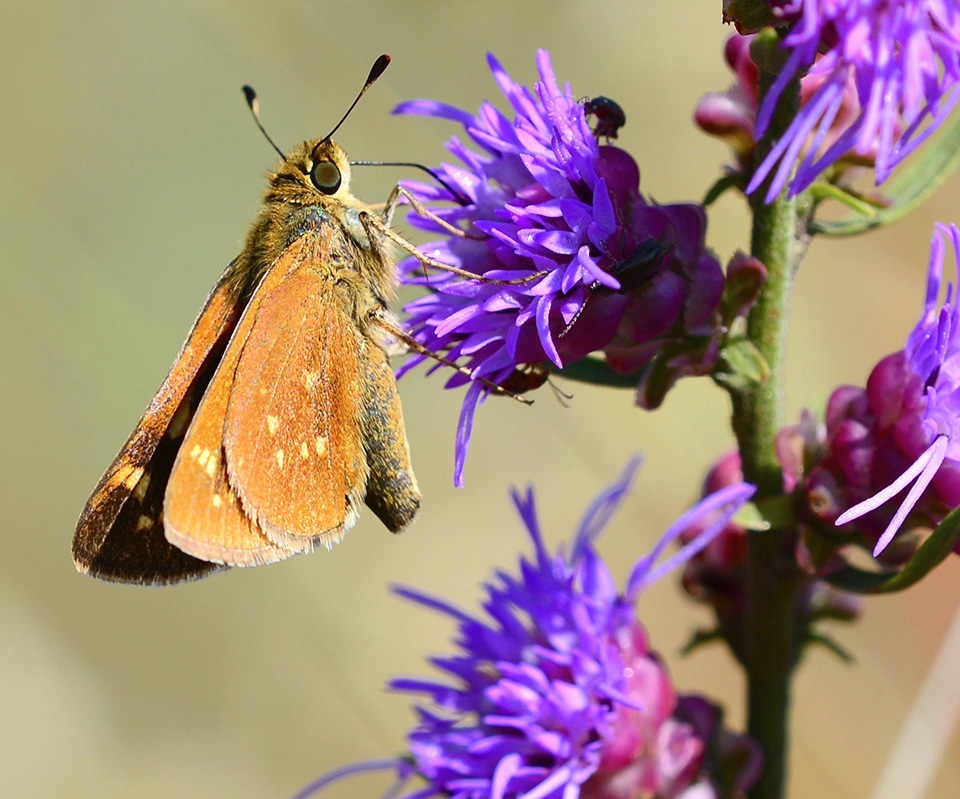
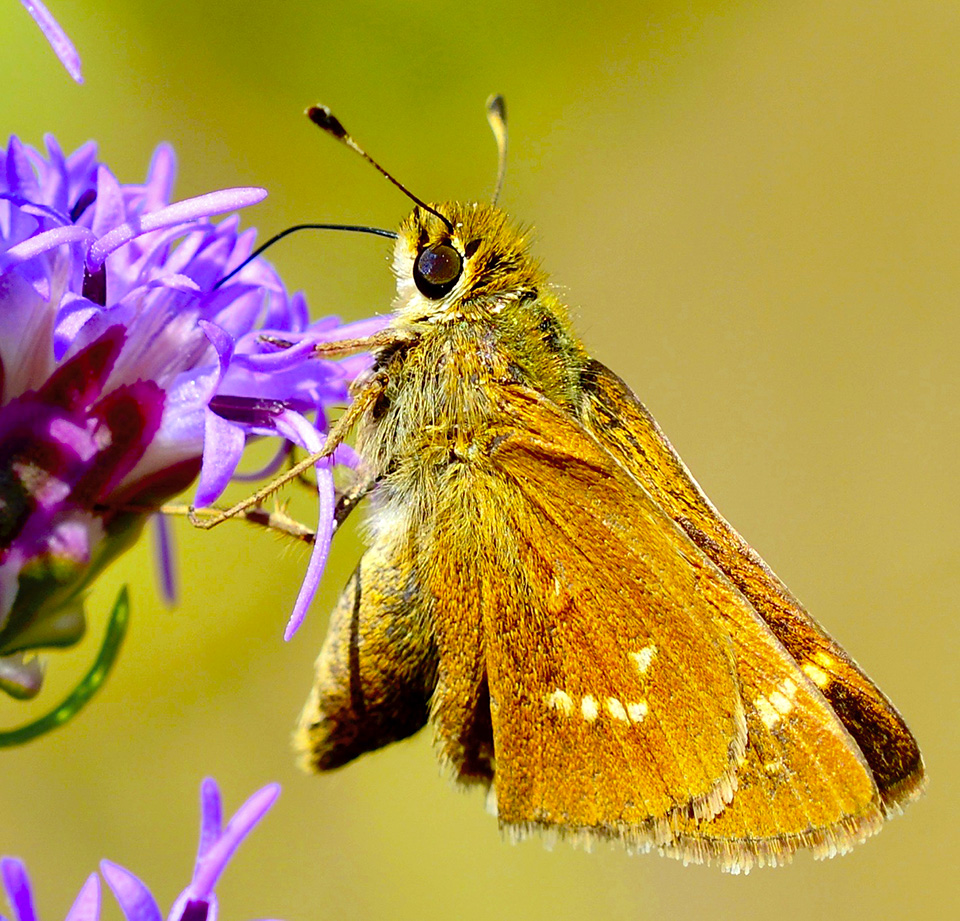
Adults have a 1¼″ to 1¾″ (32 to 45 mm) wingspan. On the male the forewings are angular and narrow. The upper side of the forewing on the male is reddish-orange with broad black borders. Near the middle of the wing there is a narrow, pointed area of black, specialized, scent scales (stigma). This is the “brand” that gives the genus its common name. On the female the basal area is darker and there is a row of squarish, orangish-yellow spots. As with many skippers, there is also a row of three small pale spots, the “wrist bracelet”, near the costal margin in the subapical area. The upper side of the hind wing on both sexes has a row of orangish-yellow spots.
The underside of both wings is rust-red. On the hind wing there is a row of prominent light brownish-yellow or white spots.
The antennae are short and barred. Each antenna has a swelling (club) at the tip, and a pale, thin, hooked extension (apiculus) at the end of the club. There is not a white band below the club.
Size
Wingspan: 1¼″ to 1¾″ (32 to 45 mm)
Similar Species
Habitat
Leonard’s Skipper: dry prairies, savannas, open woodlands, and woodland openings
Pawnee skipper: prairies
Ecology
Season
One generation per year: early August to mid-September
Behavior
Leonard’s Skipper is a fast flier. In flight the wings appear as a blur.
Life Cycle
First stage (instar) larvae overwinter. They continue feeding in the spring and pupate in July. Adults emerge in August.
Larva Food/Hosts
Grasses
Adult Food
Nectar from many flowers, especially blazing stars in the west and New England aster in the east, but also on other asters, wild bergamot, heal-all, round-headed bush clover, goldenrods, spotted knapweed, prairie ironweed, thistles, Joe-pye weed, and sunflowers.
Distribution |
||
|
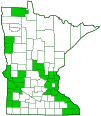
Sources 21, 24, 27, 29, 30, 75, 82, 83. Biodiversity occurrence data published by: Minnesota Biodiversity Atlas (accessed through the Minnesota Biodiversity Atlas Portal, bellatlas.umn.edu, 11/29/2025). Rider, D., G. Fauske, and P. Tinerella. 2000. Effects of standard management practices on, and faunistics of native prairies: a study of three sites in western Minnesota. Conservation Biology Research Grants Program, Division of Ecological Services, Minnesota Department of Natural Resources. |
|
| 11/29/2025 | ||
Occurrence |
||
Uncommon in Minnesota |
||
Taxonomy
Order
Lepidoptera (Butterflies and Moths)
Superfamily
Papilionoidea (Butterflies)
Family
Hesperiidae (Skippers)
Subfamily
Hesperiinae (Grass Skippers)
Tribe
Hesperiini
Subtribe
Hesperiina (Branded Grass Skippers)
Genus
Hesperia (Branded Skippers)
Superfamily
Skippers have traditionally been placed in their own superfamily Hesperioidea because of their morphological similarity. Recent phylogenetic analysis (Kawahara and Breinholt [2014]) suggests that they share the same common ancestor as other butterfly families, and thus belong in the superfamily Papilionoidea.
Subordinate Taxa
Eastern Leonard’s Skipper (Hesperia leonardus leonardus) 
Mountain skipper (Hesperia leonardus montana)
Pawnee skipper (Hesperia leonardus pawnee)
Synonyms
Hesperia leonardi
Hesperia lidia
Hesperia stallingsi
Common Names
Leonard’s Skipper
Glossary
Apiculus
A thin hooked or pointed extension at the ends of each antenna just beyond the club of all skippers except skipperlings (subfamily Heteropterinae).
Costal margin
The leading edge of the forewing of insects.
Instar
The developmental stage of arthropods between each molt; in insects, the developmental stage of the larvae or nymph.
Stigma
In plants, the portion of the female part of the flower that is receptive to pollen. In Lepidoptera, an area of specialized scent scales on the forewing of some skippers, hairstreaks, and moths. In other insects, a thickened, dark, or opaque cell on the leading edge of the wing.
Visitor Photos
Share your photo of this insect.
This button not working for you?
Simply email us at info@MinnesotaSeasons.com.
Attach one or more photos and, if you like, a caption.
Nancy Falkum |
||
 |
 |
|
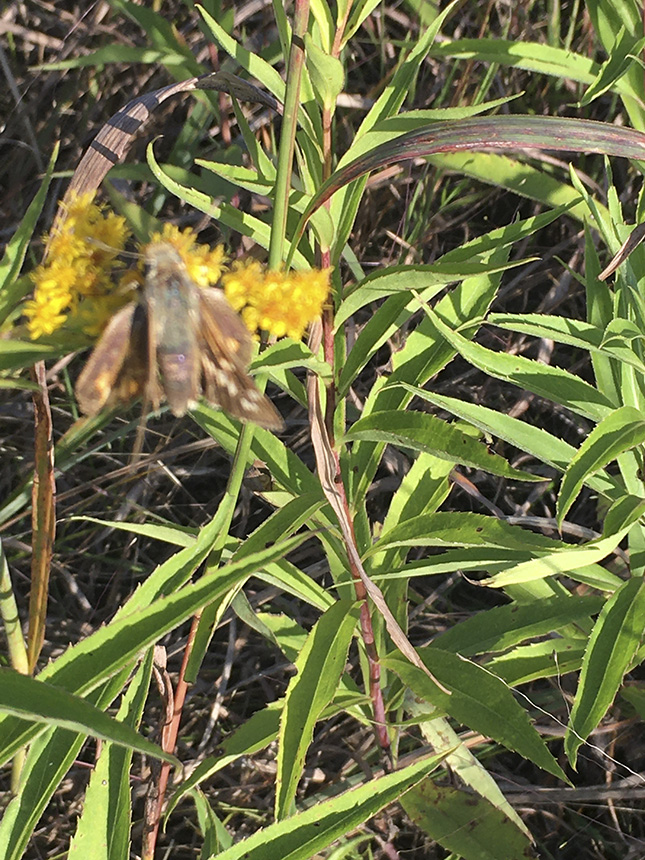
Golden Rod with Leonard’s Skipper |
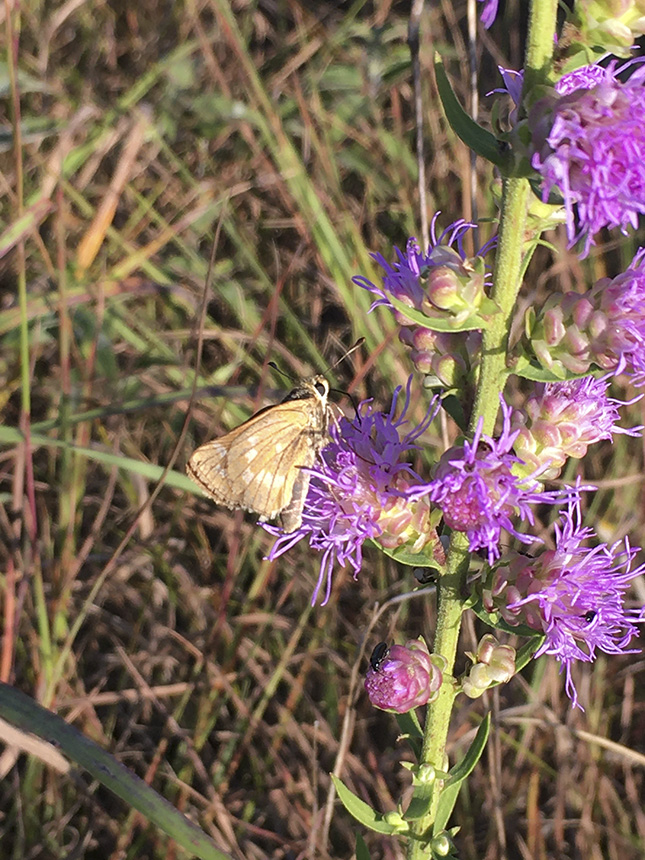
Blazing Star, Rough Liatris aspera w/Hesperia leonardus Leonard’s Skipper |
|
Scott Leddy |
||
 |
 |
|
MinnesotaSeasons.com Photos
|
|

Slideshows
Leonard's Skipper
Cory Gregory

Visitor Videos
Share your video of this insect.
This button not working for you?
Simply email us at info@MinnesotaSeasons.com.
Attach a video, a YouTube link, or a cloud storage link.
Other Videos
Leonard's Skipper Butterfly
Laurett Garden
Late Flying Skippers
Dick Walton

Visitor Sightings
Report a sighting of this insect.
This button not working for you?
Simply email us at info@MinnesotaSeasons.com.
Be sure to include a location.
Nancy Falkum
9/18/2021
Location: Kellogg Weaver Dunes SNA, Weaver Dunes Unit
Blazing Star, Rough Liatris aspera w/Hesperia leonardus Leonard’s Skipper
Scott Leddy
9/10/2017
Location: Fillmore County, MN
Minnesota Seasons Sightings