Texas striped sweat bee
(Agapostemon texanus)
Information
Conservation • Description • Habitat • Ecology • Distribution • Taxonomy
No Image Available
Conservation Status
IUCN Red List
not listed
NatureServe
NNR - Unranked
SNR - Unranked
Minnesota
not listed
Description
Texas striped sweat bee is a small bee. In the Great Plains of the United States from Minnesota and Nebraska, south to Arkansas and eastern Texas. Unconfirmed observations on iNatuiralist.org suggest that its range could extend as far west as the Rocky Mountains and north into southern Canada. Records and observations from Mexico and Guatemala are suspect and may represent other members of the Agapostemon texanus complex. The Texas striped sweat bee is uncommon in Minnesota. It is found in mostly in native prairie remnants, rarely in urban gardens or forested areas.
The Texas striped sweat bee (Agapostemon texanus) was long considered part of a “species complex” alongside the nearly identical A. angelicus and A. subtilior. For over a century, these species were grouped together, making accurate identification—especially of females—nearly impossible. Recent research (Portman et al., 2024) has not only identified the microscopic traits needed to separate them but has also redefined their ranges. While A. texanus was once thought to be widespread across the East, it is now understood to be primarily a specialist of native prairie regions; most historical records of this bee in other habitats actually refer to the recently reinstated fine striped sweat bee (A. subtilior).
Females are 7⁄16″ (11 mm) in length. The entire head, thorax, and abdomen are brilliant green or bluish green. The hairs on the head and thorax are pale yellowish brown above, becoming whitish below.
The plate on the face above the upper lip (clypeus) is mostly green, black just on the lower third. It is flat down to the bottom, where the lower margin sharply turns down and may slightly overhang the fringe in the upper lip. On the cheeks (genae) there is a series of fingerprint-like ridges (genal striations) behind the eyes. The ridges are extremely coarse and rather wavy and irregular, and the valleys between the ridges are so deep that it is difficult to see the bottom. Five to eight of the large striae extend straight to the raised rim (the carina) that borders the underside of the head. The tongue is short. The compound eyes are light gray. The antennae have 12 segments: the long scape at the base, a short, more or less round segment (pedicel), and a whip-like third section (flagellum) with 10 segments (flagellomeres). Below the base of each antenna there is a single groove (antennal suture).
The largest plate on the upper side of the thorax is the scutum and the plate behind that is the scutellum. The scutum is dull and densely doubly punctate, meaning that it has pits (punctures) of two different sizes: scattered, relatively sparse, deep punctures, intermixed with many more minute, densely spaced punctures. The scutellum is also doubly punctate. The last part of the thorax (propodeum), anatomically the first segment of the abdomen fused to the thorax, is encircled by a raised ridge. The cap-like plate over each wing base (tegula) is yellowish.
The legs are mostly brownish black except for the first segment (coxa), which is more or less greenish. On the front and middle legs, the third segment (femur) has yellow spots at the tip.
The wings are clear with yellowish veins. The basal vein is strongly curved.
The abdomen has 6 segments. The hairs on the abdomen are almost entirely whitish except for the hairs on the last segment, which are pale yellowish brown. On segments 2 through 4, the upper surface (tergite) has a whitish, powdery (pruinose) band on the front margin. The punctures on all tergites are separated with shiny areas between them.
Males are ⅜″ (9 to 10 mm) in length. The antennae have 13 segments, including 11 flagellomeres. The first flagellomere is two-thirds to three-quarters the length of the second. The scutum is not doubly punctate. The propodeum is not encircled by a raised ridge. On the hind legs, the femur is thicker than that of a typical bee but only moderately enlarged compared to some other members of the genus; it also has a small tooth on the underside. The femur and the fourth segment (tibia) of each leg are mostly yellow with dark areas and spots. On the hind legs, there is a dark spot on the underside of the tibia. The spot takes up at least the lower half of the tibia and often more. The abdomen has 7 segments and it is striped yellow and black. On the underside of the abdomen, the plate on the fourth segment (S4) has a swelling that reaches the rear edge of the plate on each side.
Size
Female total length: 7⁄16″ (11 mm)
Male total length: ⅜″ (9 to 10 mm)
Similar Species
Angeles striped sweat bee (Agapostemon angelicus)
Fine striped sweat bee (Agapostemon subtilior) is much more common and widespread. The genal striations are fine to moderately coarse. The clypeus is slightly convex and it is smoothly curved at the bottom. On the male, the dark spot on the underside of the hind tibia can range from taking up the lower half of the tibia to being completely absent.
Habitat
Ecology
Season
April to November in the south
Behavior
Life Cycle
Larva Food/Hosts
Adult Food
Distribution
Sources
30.
Portman Z.M., Arduser M., Powley M.E. & Cariveau D.P. 2024. Taxonomy of Agapostemon angelicus and the A. texanus species complex (Hymenoptera, Halictidae) in the United States. European Journal of Taxonomy 958: 203–241.
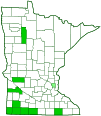
There is one unconfirmed observation from Ramsey County on iNaturalist.org (light green on the map).
Occurrence
Uncommon in Minnesota
Taxonomy
Order
Hymenoptera (Ants, Bees, Wasps, and Sawflies)
Suborder
Apocrita (Narrow-waisted Wasps, Ants, and Bees)
Infraorder
Aculeata (Ants, Bees, and Stinging Wasps)
Superfamily
Apoidea (Bees and Apoid Wasps)
Epifamily
Family
Halictidae (Sweat Bees)
Subfamily
Halictinae (Sweat and Furrow Bees)
Tribe
Halictini
Subtribe
Caenohalictina
Genus
Agapostemon (Striped Sweat Bees)
Subgenus
Agapostemon
Species split
For over a century, the Texas striped sweat bee (Agapostemon texanus) and the Angeles striped sweat bee (A. angelicus) were considered a “species complex”, an informal grouping for species so physically similar that they are nearly impossible to distinguish. This taxonomic puzzle particularly plagued the identification of females, leaving many specimens a “best guess.”
A recent review of the complex (Portman et al., 2024) has finally provided a roadmap for telling these species apart. In the process of untangling the complex, researchers discovered that A. texanus actually consists of two distinct species, and they reinstated the name Agapostemon subtilior for the new one. The study also revealed that the “true” A. texanus is largely restricted to prairie regions; most of the bees previously recorded as the Texas striped sweat bee are actually the newly recognized A. subtilior.
The reinstatement of Agapostemon subtilior as a valid species was very recent, October 7, 2024. Many older records and some global online databases still list this bee under A. texanus.
Subordinate Taxa
Synonyms
Agapostemon texanus iowensis
Common Names
Texas striped sweat bee
Photos
Visitor Photos
Share your photo of this insect.
This button not working for you?
Simply email us at info@MinnesotaSeasons.com.
Attach one or more photos and, if you like, a caption.
Minnesota Seasons Photos
Slideshows
Slideshows
Videos
Visitor Videos
Share your video of this insect.
This button not working for you?
Simply email us at info@MinnesotaSeasons.com.
Attach a video, a YouTube link, or a cloud storage link.
Other Videos
Sightings
Visitor Sightings
Report a sighting of this insect.
This button not working for you?
Simply email us at info@MinnesotaSeasons.com.
Be sure to include a location.
Minnesota Seasons Sightings