Brown waterscorpion
(Ranatra fusca)
Information
Conservation • Description • Habitat • Ecology • Distribution • Taxonomy
Conservation Status
IUCN Red List
not listed
NatureServe
NNR - Unranked
Minnesota
not listed
Description
Brown waterscorpion is a common, large, predacious waterbug. It occurs across the northern United States and southern Canada. It is the most widespread and common waterscorpion (Family Nepidae) in North America. It is common in Minnesota.
Brown waterscorpions are found in slow-flowing streams and rivers, with sand, silt, and organic sediments, as well as in lakes, ponds, and river pools, along the shoreline. They are seen on aquatic vegetation, in debris, and on terrestrial plants that overhang and extend into the water. Though common, they are often overlooked because their stick-like appearance provides highly effective camouflage, and they often remain immobile for hours. They are occasionally found in swimming pools and stock tanks.
Brown waterscorpions are generalist predators, feeding on a wide array of vertebrates and invertebrates. For young nymphs, this includes small invertebrates. Their primary food source is small crustaceans, including Daphnia (water fleas), copepods, and ostracods. Mature adults feed on almost any prey they are large enough to capture that swims or lands on the water surface nearby. This includes mosquito larvae, backswimmers, mayfly nymphs, water striders, flies, tadpoles, and small fish. In areas of high density, they even feed on other water scorpions.
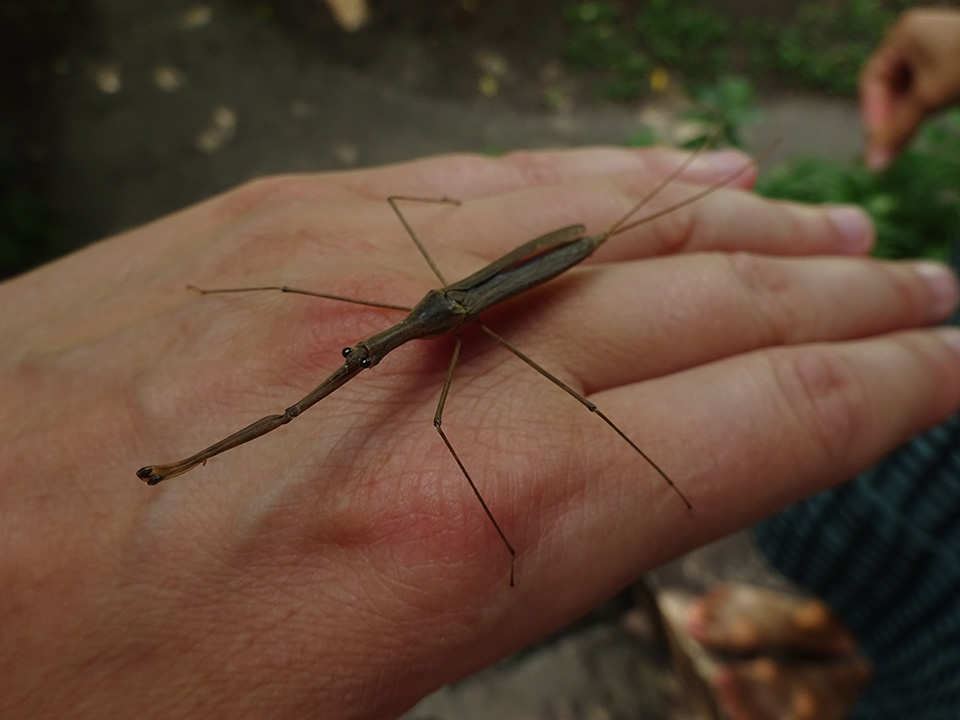
The body is stick-like—long, slender, cylindrical, and dark yellowish brown. In popular accounts and lay literature, this insect is often reported to be 3″ to 4″ long. The body length of the adult is 1¼″ to 1⅝″ (32 to 42 mm). The tail-like respiratory siphon is about 1″ to 1⅜″ (25 to 35 mm) long, almost as long as the body. The forelegs, which are often stretched forward, are about 1¼″ to 1⅝″ (30 to 40 mm) long. Taken together, this gives a silhouette that can be 3½″ (90 mm) long or longer.
On the head there are two large compound eyes and no simple eyes (ocelli). The width of each eye is less than the distance between the eyes. The mouthparts are short and stout, and they are optimized for piercing and sucking. The antennae are very short, shorter than the head. They are tucked into specialized grooves (foveae) on the underside of the head and are not visible from above. Although rarely seen, they are important features for distinguishing between the species in this genus. There are three antennal segments; the second segment has a lateral projection that is about four-fifths as long as the third segment.
The plate covering the first segment of the thorax (the pronotum) is much longer than it is wide, narrowed in the middle, and widened in front. The front portion is 1.5 to 2.5 times wider than the rear portion when measured at the midline. The front side corners are not wider than the head, including the compound eyes.
Located along the underside of the abdomen are three pairs of specialized oval structures (hydrostatic sense organs). These function as biological pressure sensors, allowing the insect to monitor its depth and adjust its position relative to the water's surface. The last abdominal segment has a long, tail-like respiratory siphon (consisting of two slender filaments) extending from the tip for breathing underwater. In males, it also has a specialized sound-producing apparatus on the underside.
The legs are very long. The front legs are modified for grasping and holding prey (raptorial). They are often held stretched forward. On the nominal subspecies Ranatra fusca fusca, the only one found in Minnesota, the third segment (femur) has a single tooth-like spine on the underside near the middle. The spine is at most slightly longer than wide, and it is usually no longer than three-fourths the width of the femur at that point. A deep groove extends from the tooth to the tip of the femur. The notch at the tip of the femur is more than twice as wide as deep.
Size
Total length: 1¼″ to 1⅝″ (32 to 42 mm)
Similar Species
Habitat
Slow-flowing streams and rivers with sand, silt, and organic sediments; lakes, ponds, and river pools
Ecology
Season
April to October
Behavior
Though they live in the water, they are poor swimmers, and they are classed as climbers. Adults cling head down to reeds, cattails, or other emergent vegetation. They can remain motionless for hours, then grab the first unlucky insect to pass nearby.
They use their forelegs to grasp the prey, pierce the body with their mouthparts, inject saliva that contains both neurotoxins to paralyze the prey and proteolytic enzymes to break down proteins, and finally suck out the resulting fluids. They can deliver a painful bite if handled by humans.
When disturbed or swept up with plant material, they feign death for several minutes, and their stick-like appearance makes them difficult to detect.
In the winter, adults survive by moving to deeper water that does not freeze solid, often remaining active—albeit at a much slower pace—beneath the ice.
Life Cycle
Nymph Food/Hosts
Small crustaceans, including Daphnia (water fleas), copepods, and ostracods
Adult Food
Anything they can capture, including mosquito larvae, backswimmers, mayfly nymphs, water striders, flies, tadpoles, small fish, and sometimes other water scorpions.
Distribution
Occurrence
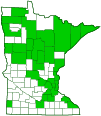
Common and widespread
Taxonomy
Order
Hemiptera (True bugs, Hoppers, Aphids, and Allies)
Suborder
Heteroptera (True Bugs)
Infraorder
Nepomorpha (Water Bugs)
Superfamily
Nepoidea
Family
Nepidae (Waterscorpions)
Subfamily
Ranatrinae
Genus
Ranatra
Subordinate Taxa
brown waterscorpion (Ranatra fusca edentula)
brown waterscorpion (Ranatra fusca fusca) 
Synonyms
Ranatra americana
Ranatra bessomi
Common Names
brown waterscorpion
Photos
Visitor Photos
Share your photo of this insect.
This button not working for you?
Simply email us at info@MinnesotaSeasons.com.
Attach one or more photos and, if you like, a caption.
Nicole Rojas-Oltmanns
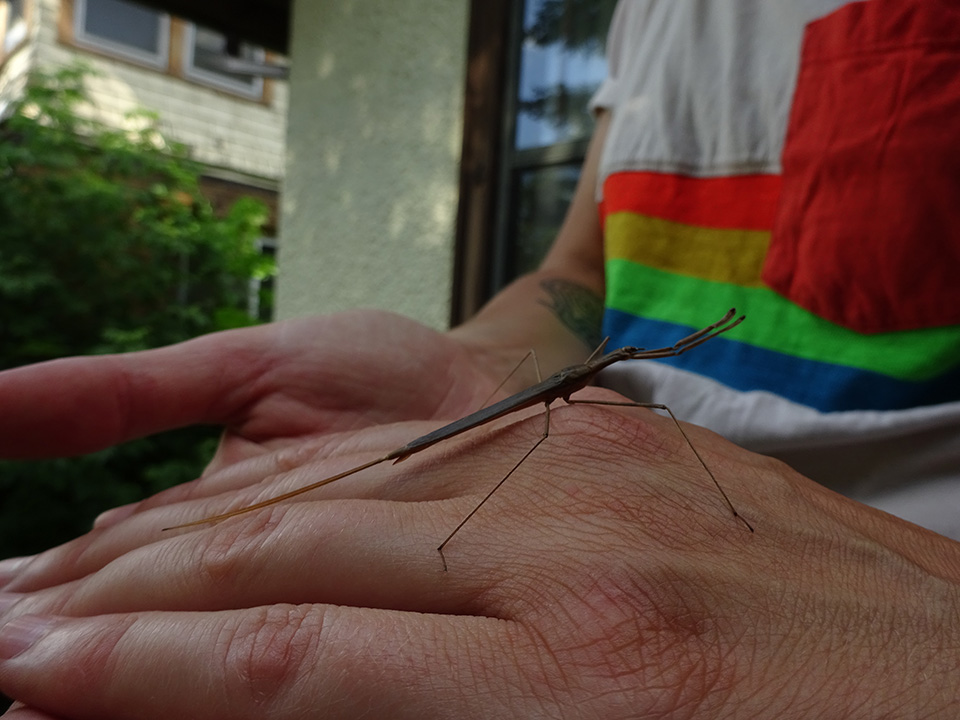
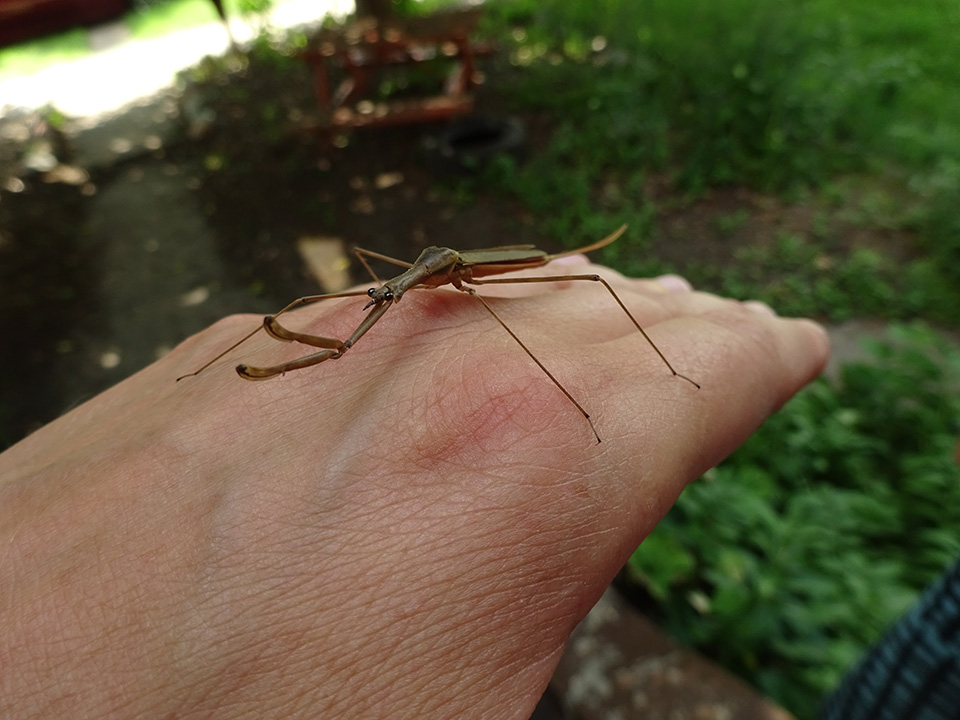
Found hiding in a sprinkler. After it dried off, it stood up higher, and then flew off my hand.
Minnesota Seasons Photos
Slideshows
Slideshows
Nepidae (Water Scorpions)
Andrew Hoffman
Videos
Visitor Videos
Share your video of this insect.
This button not working for you?
Simply email us at info@MinnesotaSeasons.com.
Attach a video, a YouTube link, or a cloud storage link.
Other Videos
Brown Water Scorpion (Nepidae: Ranatra fusca) Locomotion
Carl Barrentine
Water Scorpion - close views of anatomy plus ovipositing (Ranatra species)
Nature in Motion
Northern Water Scorpion (Ranatra fusca)
Mark Berman
Sightings
Visitor Sightings
Report a sighting of this insect.
This button not working for you?
Simply email us at info@MinnesotaSeasons.com.
Be sure to include a location.
Nicole Rojas-Oltmanns
7/12/2020

Location: Hennepin County, Minneapolis
Found hiding in a sprinkler. After it dried off, it stood up higher, and then flew off my hand.
Minnesota Seasons Sightings