


Dogwood sawfly
(Macremphytus tarsatus)
Conservation • Description • Habitat • Ecology • Distribution • Taxonomy
Conservation Status |
|
|||
| IUCN Red List | not listed |
|||
| NatureServe | not listed |
|||
| Minnesota | not listed |
|||
Description
Macremphytus tarsatus is a large sawfly. It occurs on the United States and southern Canada from the east coast to the Great Plains. It is most common in the northeast, uncommon in the southeast.
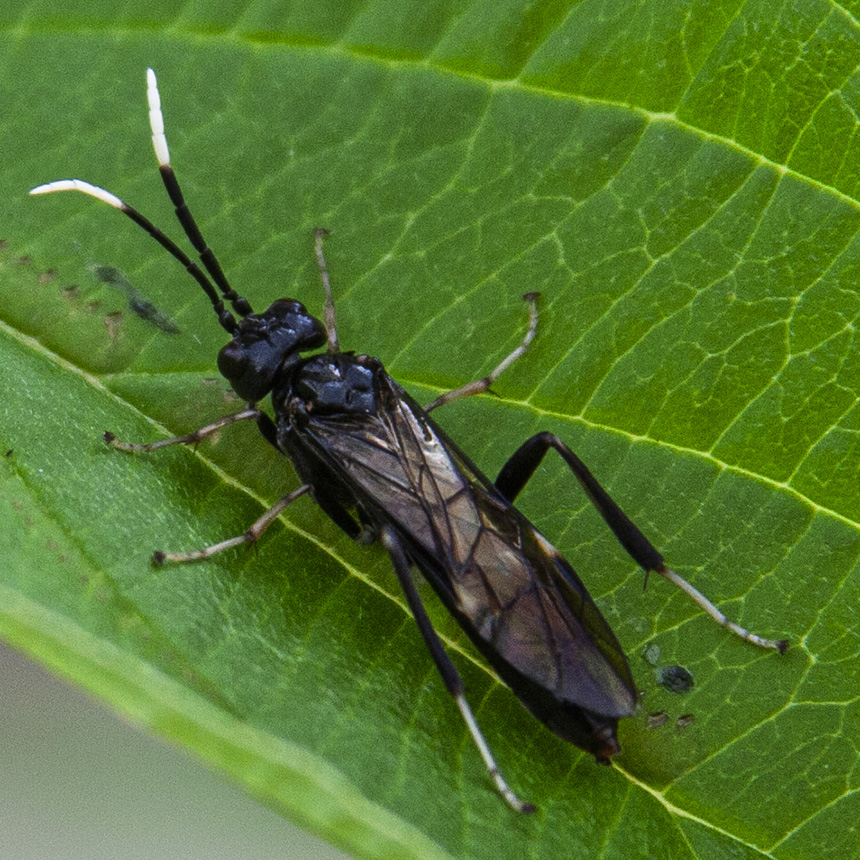
Adults are wasp-like in appearance but the abdomen is broadly joined to the thorax and they do not sting. Females are 7⁄16″ to ½″ (10.8 to 11.8 mm) in length. Males are a little smaller, 7⁄16″ to ½″ (10.8 to 11.8 mm) in length.
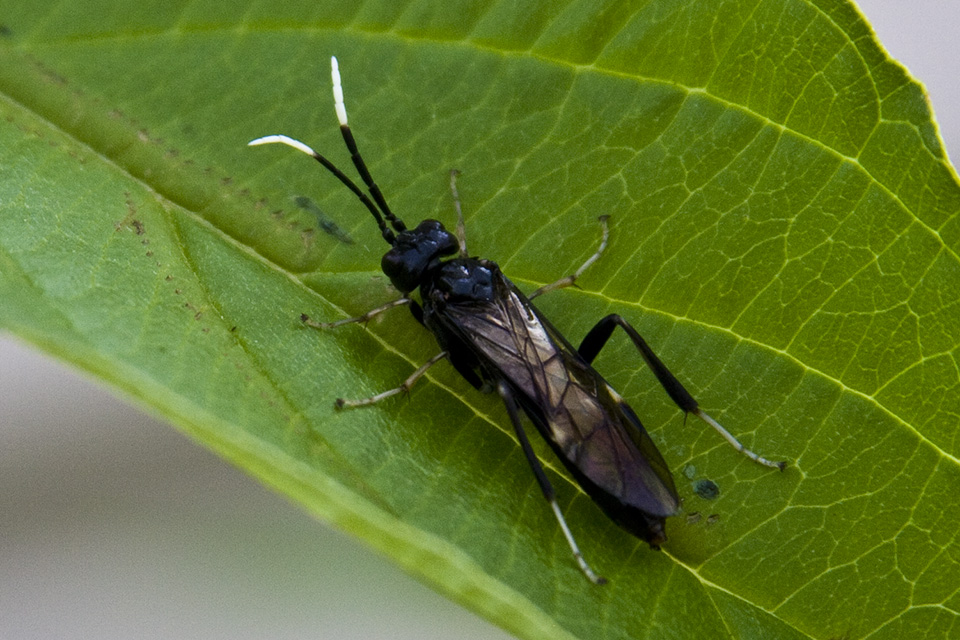
The head and body are black. The second section of the thorax is pitted and does not have conspicuous white spots.
The antennae are bicolored and have 9 segments. The first 5 segments (nearest the head) are black. The remaining segments are bright white. The second segment is very short, as wide or wider than long.
The legs are bicolored. The femur and tibia of the two hind legs are black. The femur and tibia of the four other legs may be black or whitish. The tarsi of all legs are white.
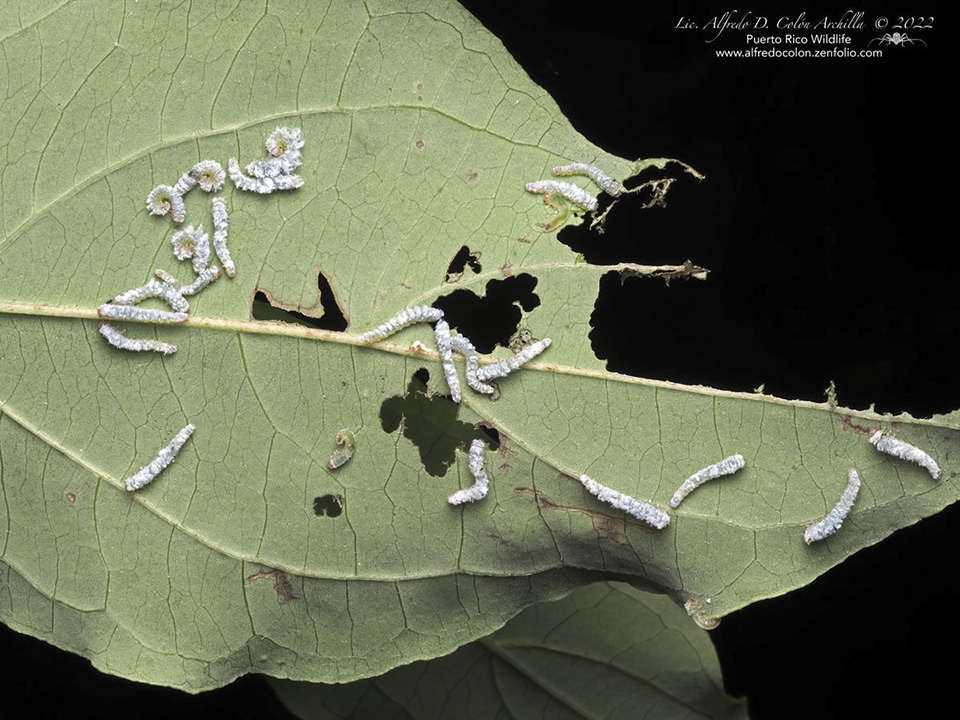
The newly hatched larva is translucent yellow. After molting a second time it is covered with a powdery, white, waxy coating that looks like bird droppings. After the final molting they are about 1″ long, have a shiny black head, are yellow below, and are white with a single row of black spots above. The black spots are broad and have a white center.
Size
Male: ⅜″ to 7⁄16″ (9.7 to 10.5 mm)
Female: 7⁄16″ to ½″ (10.8 to 11.8 mm)
Similar Species
Dogwood sawfly (Macremphytus testaceus) is mostly reddish-brown.
Habitat
Deciduous and mixed forests, yards with ornamental dogwoods.
Ecology
Season
Late May to July. One generation.
Behavior
Life Cycle
Females lay up to 100 or more eggs on the underside of a single dogwood leaf. The eggs hatch in July and feed on the leaf, skeletonizing it. The final instar larva seeks rotted wood, or house siding, to make a cocoon, in which it overwinters. Adults emerge in late May to July.
Larva Food/Hosts
Dogwood leaves
Adult Food
Distribution |
||
|
Sources |
|
| 11/27/2025 | ||
Occurrence |
||
|
||
Taxonomy
Order
Hymenoptera (Ants, Bees, Wasps, and Sawflies)
Suborder
Symphyta (Sawflies, Horntails, and Wood Wasps)
Superfamily
Tenthredinoidea (Typical Sawflies)
Family
Tenthredinidae (Common Sawflies)
Subfamily
Allantinae
Tribe
Allantini
Genus
Subordinate Taxa
Synonyms
Common Names
This species has no common name. The common name for the genus Macremphytus is dogwood sawflies, and it is used here for convenience.
Glossary
Femur
In insects, the largest, most robust segment of the leg, coming immediately before the tibia. In humans, the thigh bone.
Tarsus
The last five sections of an insect’s leg, attached to the tibia; the foot.
Tibia
The fourth segment of an insect leg, after the femur and before the tarsus (foot). The fifth segment of a spider leg or palp. Plural: tibiae.
Visitor Photos
Share your photo of this insect.
This button not working for you?
Simply email us at info@MinnesotaSeasons.com.
Attach one or more photos and, if you like, a caption.
Alfredo Colon |
||
 |
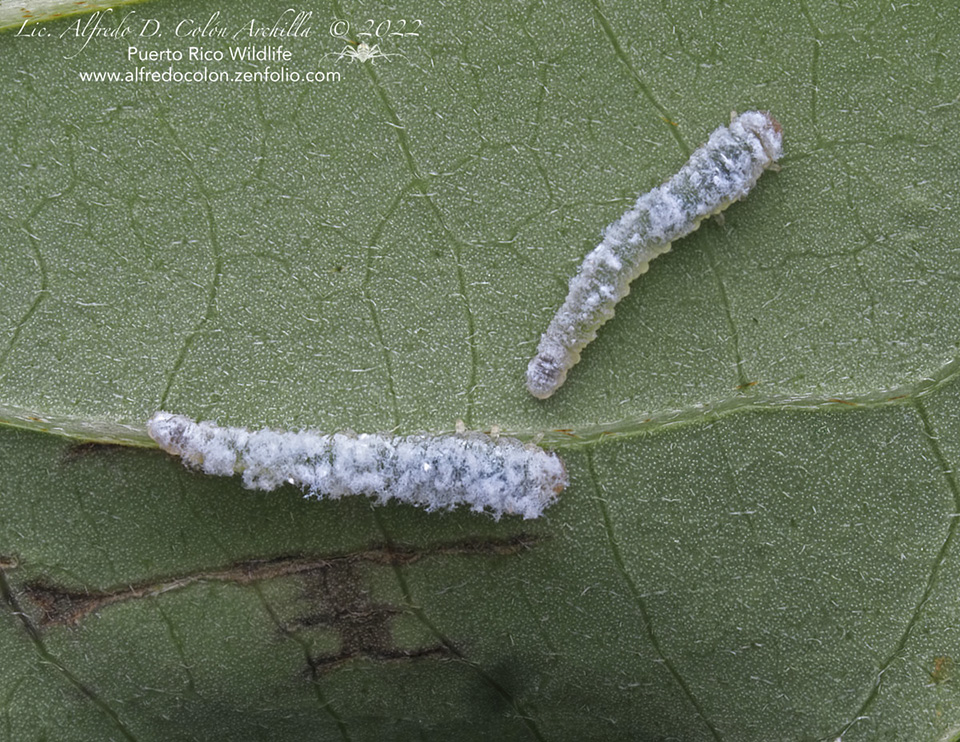 |
|
Laura O’Halloran (with Cian and Grady) |
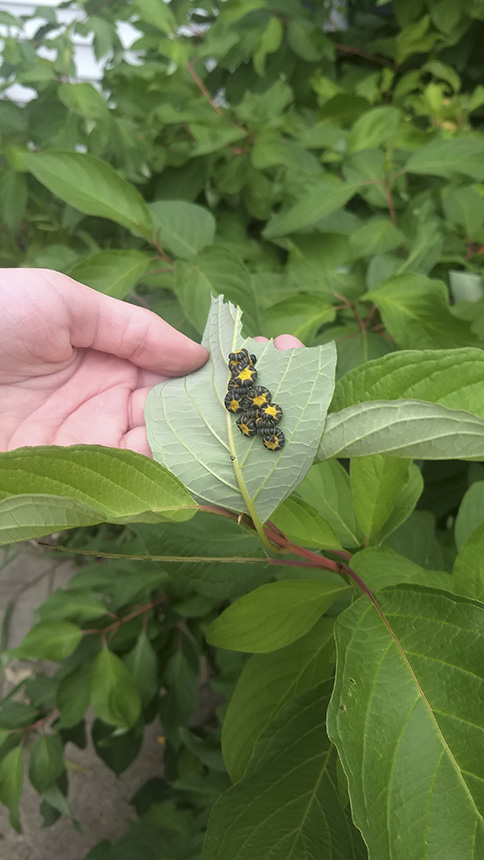 |
This is an ornamental Dogwood. And should we be doing something? It's the only dogwood on the property. Thanks! |
MinnesotaSeasons.com Photos
 |

Slideshows
Visitor Videos
Share your video of this insect.
This button not working for you?
Simply email us at info@MinnesotaSeasons.com.
Attach a video, a YouTube link, or a cloud storage link.
Other Videos
Dogwood Sawfly Larvae
Carol Snow Milne

Visitor Sightings
Report a sighting of this insect.
This button not working for you?
Simply email us at info@MinnesotaSeasons.com.
Be sure to include a location.
Alfredo Colon
8/10/2022
Location: Albany, NY
Laura O'Halloran
(with Cian and
Grady)
9/2/2019
Location: Lindstrom, MN
This is an ornamental Dogwood. And should we be doing something? It's the only dogwood on the property. Thanks!
John Valo
9/4/2019
The Ohio State University has recommendations for managing dogwood sawflies. Here is the link:
Be Alert for Dogwood Sawfly
Minnesota Seasons Sightings