Eastern red-rimmed dendrocoris
(Dendrocoris humeralis)
Information
Conservation • Description • Habitat • Ecology • Distribution • Taxonomy
Conservation Status
IUCN Red List
not listed
NatureServe
NNR - Unranked
Minnesota
not listed
Description
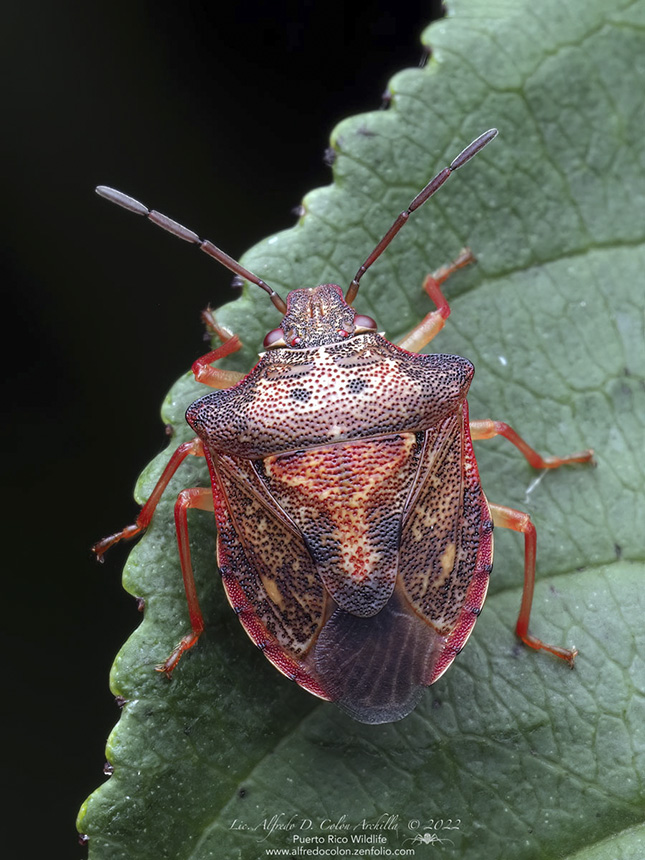
Eastern red-rimmed dendrocoris is a common, small, easily recognized, stink bug. It occurs in the United States and southern Canada east of the Great Plains, and there are scattered records west to California. It is the most common member of the genus Dendrocoris and the only one found in the eastern U.S.
Adults are active from late May to early September in Minnesota. They are found mostly on oak and hickory, but they have also been reported on pine and hazel.
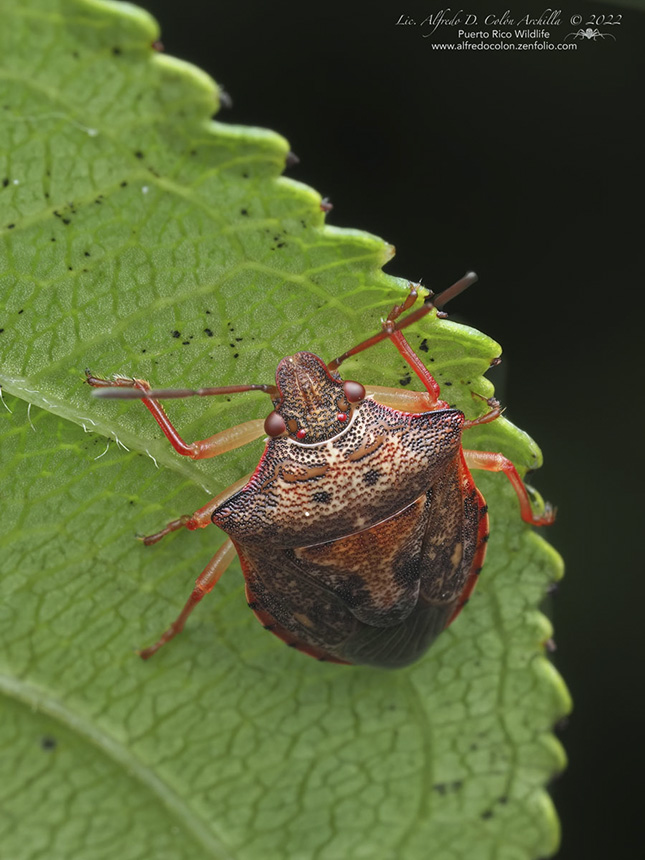
Adults are ¼″ to 5⁄16″ (6.0 to 8.5 mm) in length. The body is roundish and depressed. The upper side is reddish or orange with dark brown mottling.
The head is small and narrow, much narrower than the thorax. It is tucked into a concave groove in the margin of the pronotum, leaving no visible “neck” when viewed from above. The top of the head (vertex) is flat. On the front of the head, the side lobes (juga) are longer than the central lobe (tylus) and meet (are contiguous) in front of it, giving the snout a rounded appearance. The margins of the juga are not toothed.
There are two large, bulging, compound eyes and two small simple eyes (ocelli). The mouth parts are optimized for piercing and sucking, and take the form of a thick, curved, 4-segmented beak (rostrum). The rostrum is longer than the head and fits into a groove on the underside of the body (venter) when not in use. The antennae are exposed, conspicuous, and slender; they are much longer than the head but shorter than the body. There are five antennal segments. The second segment is short, much shorter than the third, and the shortest of all the antennal segments. This is a defining feature of this species.
The exoskeletal plate covering the thorax (pronotum) is wide, giving the body a broad-shouldered appearance. The angles in the shoulder (humeral) area on each side are rounded but distinctly prominent.
There are two pairs of wings, and they are held flat over the body when at rest. The forewings (hemelytra) are as long as the abdomen but do not completely cover its sides. The hemelytra have a thickened section at the base and a thin membranous section at the tip with a clear dividing line between the two. The thickened basal part is comprised of a narrow area (clavus) behind the scutellum, and a broad marginal area (corium).
The sides of the abdomen (connexivum) are exposed. They are typically the same color as the venter, and there is usually a black or dark mark on each segment. Depending on the individual, these marks may appear as a series of distinct black dots or, if the pigment is more spread out, as conspicuous stripes.
Between and at the wing bases there is a triangular plate (scutellum). The scutellum is longer than wide, but it is not longer than the corium—it usually reaches just about the middle of the abdomen. It is broad at the base, narrows significantly at the rear third, and then tapers to a rounded tip.
The hindwings are thin, membranous, and concealed under the hemelytra.
The legs uniformly colored, usually orange, yellow, or tan, without dark spots or stripes.
Size
Total length: ¼″ to 5⁄16″ (6.0 to 8.5 mm)
Similar Species
Habitat
Ecology
Season
Late May to early September (CCESR)
Behavior
Life Cycle
Nymph Food
Adult Food
Oak, hickory, pine, and hazel
Distribution
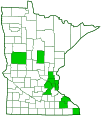
Occurrence
Infrequent but sometimes locally abundant
Taxonomy
Order
Hemiptera (True bugs, Hoppers, Aphids, and Allies)
Suborder
Heteroptera (True Bugs)
Infraorder
Pentatomomorpha
Superfamily
Pentatomoidea (Stink Bugs, Shield Bugs, and Allies)
Family
Subfamily
Pentatominae
Tribe
Procleticini
Genus
Dendrocoris
Subordinate Taxa
Synonyms
Liotropis humeralis
Common Names
eastern dendrocoris stink bug
eastern red-rimmed dendrocoris
Photos
Visitor Photos
Share your photo of this insect.
This button not working for you?
Simply email us at info@MinnesotaSeasons.com.
Attach one or more photos and, if you like, a caption.
Minnesota Seasons Photos
Slideshows
Slideshows
Videos
Visitor Videos
Share your video of this insect.
This button not working for you?
Simply email us at info@MinnesotaSeasons.com.
Attach a video, a YouTube link, or a cloud storage link.
Other Videos
Sightings
Visitor Sightings
Report a sighting of this insect.
This button not working for you?
Simply email us at info@MinnesotaSeasons.com.
Be sure to include a location.
Alfredo Colon
8/8/2022

Location: Albany, NY
Minnesota Seasons Sightings