Sources
Biodiversity occurrence data published by: Minnesota Biodiversity Atlas (accessed through the Minnesota Biodiversity Atlas Portal, bellatlas.umn.edu. Accessed 12/24/2025).




(Hylephila phyleus)
Conservation • Description • Habitat • Ecology • Distribution • Taxonomy
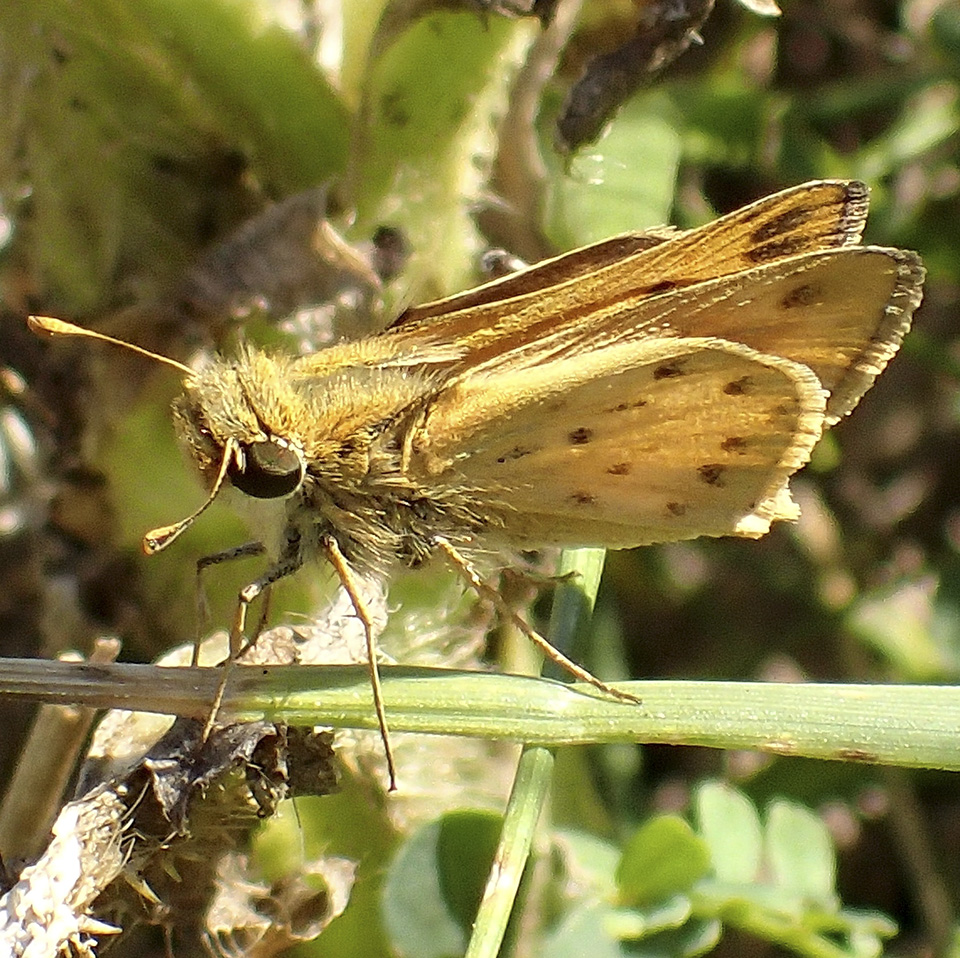
not listed
N5 - Secure
not listed
Fiery skipper is a common, easily recognized, grass skipper. It occurs in North America and South America. In the United States it occurs from New Hampshire to Florida, west to South Dakota and California. It is one of just a few skippers that migrate north each year. It arrives in Minnesota usually in late August and September, but sometimes as early as late July. It does not survive the winter. It rarely migrates as far north as Lake Superior.
Fiery skipper is found in open areas, including meadows, fields, roadsides, gardens, and weedy lawns. Larvae feed on a variety of grasses, including Bermuda grass, crabgrass, and bent grass. Adults feed on flower nectar.
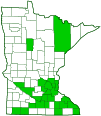
Adults are about 1″ (25 mm) in length and have a 1″ to 1¼″ (25 to 31 mm) wingspan. Females are slightly larger than males. The antennae are knobbed and very short, less than half as long as the forewing.
On the male the upperside of the forewing is bright orangish-yellow or yellowish-orange with brown markings. The intensity of the spots is variable, from faint dull brown to sharp black. There is a narrow, very dark border on the outer margin with several narrow, elongated spots extending forward, making it appear toothed. Near the middle of the wing there is a large patch of brown, specialized, scent scales (stigma). There is a similar but smaller patch between the stigma and the wingtip. The upperside of the hindwing is similar but it has a broad band on the inner margin and a large patch on the leading edge (costal margin). The underside of both wings is orangish-yellow or yellowish-orange with several scattered small brown spots representing the medial, postmedial, and submarginal bands. This is a uniquely identifying feature. No other skipper in our area has this pattern on the underside of the hindwing.
The female is dark brown above with orangish-yellow or yellowish-orange spots. The postmedial band is a row of large rectangular spots. The spot in the middle extends toward and sometimes connects with a similar spot in the basal area. Together, the spots create an inward pointing “arrow”. There is also a row of three small spots, the “wrist bracelet”, near the costal margin in the subapical area. The underside of both wings is similar to the male.
Total length: about 1″ (25 mm)
Wingspan: 1″ to 1¼″ (25 to 31 mm)
Meadows, fields, roadsides, gardens, weedy lawns
Late August to early October
Fiery skipper is a fast flier.
Grasses
Flower nectar
Order
Lepidoptera (Butterflies and Moths)
Superfamily
Papilionoidea (Butterflies)
Family
Hesperiidae (Skippers)
Subfamily
Hesperiinae (Grass Skippers)
Tribe
Hesperiini
Subtribe
Hesperiina (Branded Grass Skippers)
Genus
Hylephila
Superfamily
Skippers have traditionally been placed in their own superfamily Hesperioidea because of their morphological similarity. Recent phylogenetic analysis (Kawahara and Breinholt [2014]) suggests that they share the same common ancestor as other butterfly families, and thus belong in the superfamily, Papilionoidea.
Fiery Skipper (Hylephila phyleus eureka)
Fiery Skipper (Hylephila phyleus muertovalle)
northern Fiery Skipper (Hylephila phyleus phyleus) 
Hylephila bucephalus
Hylephila hala
Papilio phyleus
Fiery Skipper
Glossary
Costal margin
The leading edge of the forewing of insects.
Stigma
In plants, the portion of the female part of the flower that is receptive to pollen. In Lepidoptera, an area of specialized scent scales on the forewing of some skippers, hairstreaks, and moths. In other insects, a thickened, dark, or opaque cell on the leading edge of the wing.
Wizards
Fiery skipper, sachem, and whirlabout (which does not occur in Minnesota) are three orange skippers that are very common in the south and often appear together. Together they are referred to as the “wizards”, apparently because with their fast darting flight it requires a wizard to identify them in the field.
This button not working for you?
Simply email us at info@MinnesotaSeasons.com.
Attach one or more photos and, if you like, a caption.


This button not working for you?
Simply email us at info@MinnesotaSeasons.com.
Attach a video, a YouTube link, or a cloud storage link.
Rob Curtis
GoTrails
Edward Garrity

This button not working for you?
Simply email us at info@MinnesotaSeasons.com.
Be sure to include a location.
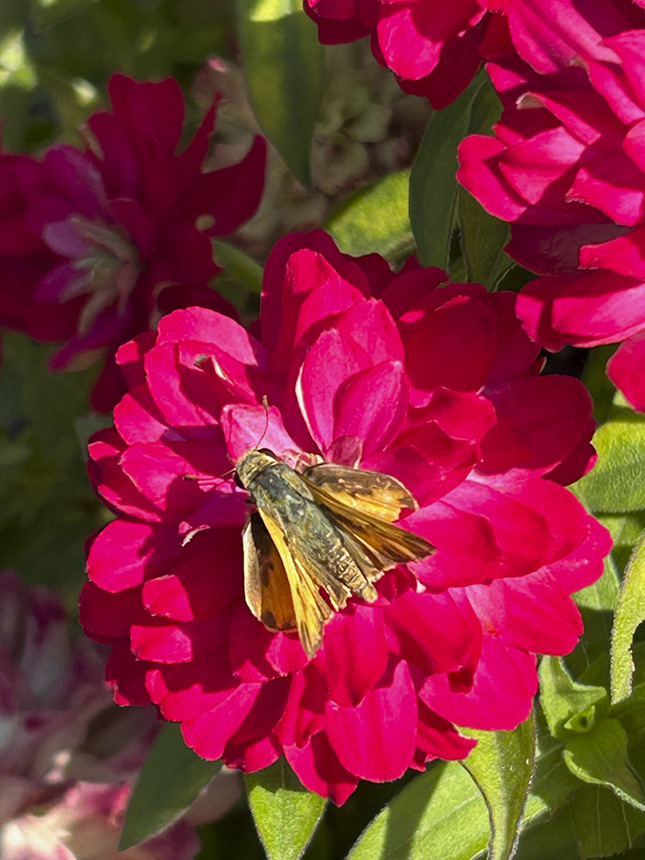
9/17/2023
Location: Eden Prairie, MN
I’m not sure what this moth is - saw it today in Eden Prairie near Purgatory wetland area and thought I’d send this photo over to you.
8/11/2022
Location: Barnes Prairie Remnant, Racine Co., WI