


Gorgone checkerspot
(Chlosyne gorgone)
Conservation • Description • Habitat • Ecology • Distribution • Taxonomy
Conservation Status
IUCN Red List
not listed
NatureServe
N5 - Secure
SU - Unrankable
Minnesota
not listed
Description
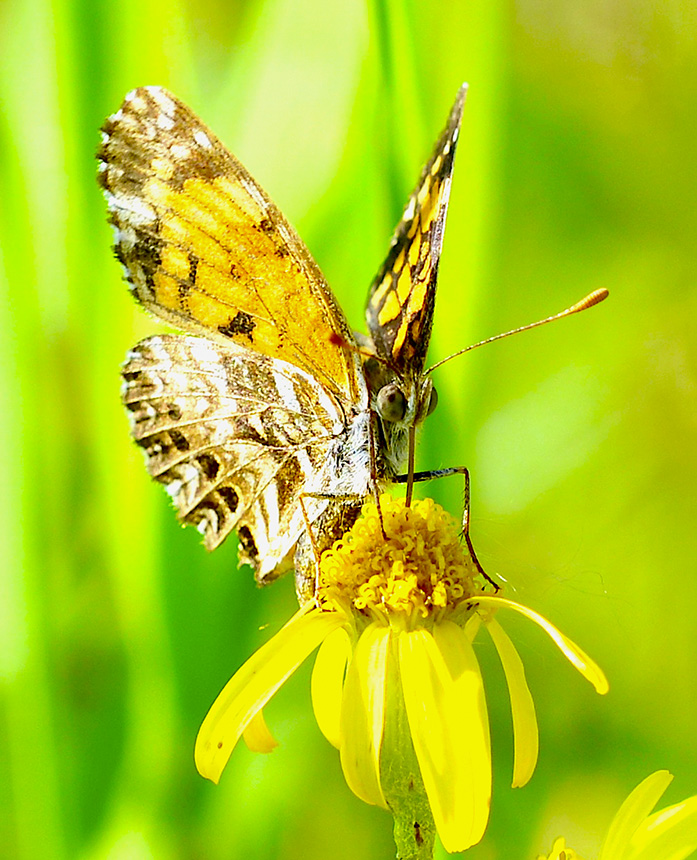
Gorgone checkerspot is medium-sized brushfooted butterfly. It occurs in the United States and southern Canada between the Rocky Mountains and the Appalachians. It is found in open areas, including prairies, old fields, open hardwood forests, forest edges, and streamsides. Larvae feed on the underside of leaves of plants in the Aster (Asteraceae) family, including sunflowers, asters, black-eyed Susans, giant ragweed, and giant sumpweed. Adults are short-lived. They feed on the nectar of yellow flowers. Its numbers can vary greatly, from uncommon one year to “extremely common/abundant” the next. It is a species of special concern in Wisconsin and Michigan, but is not given a conservation status in Minnesota.
Adults have a wingspan of 1¼″ to 1¾″ (32 to 45 mm).
The upperside of both wings is orange with a broad black margin, a black and white fringe, and other heavy black markings. The basal area is mostly black with a few irregular orange spots. The discal area is mostly orange with heavy, irregular black spots and jagged lines. The median area is orange crossed with black veins. On the forewing, the postmedial area is black with a row of orange spots. The subterminal area is black and has a row of mostly small white spots, the middle spot being large and pale orange. On the hindwing there is a postmedial row of orange eyespots with black pupils, set apart by a bold, unbroken, black line above. All of the pupils are completely surrounded by orange. There is also a subterminal row of pale orange chevrons. On both wings the border is black and the fringe is checkered black and white.
The underside of the forewing mirrors the upperside but with less heavy black markings. The outer margin is black with white striping between the veins. The underside if the hindwing is the best way to identify the Gorgone Checkerspot. It is whitish-gray with brown spots, a median band of white chevrons, and black banding in a zigzag pattern.
Size
Wingspan: 1¼″ to 1¾″ (32 to 45 mm)
Similar Species
Habitat
Open areas, including prairies, old fields, open hardwood forests, forest edges, and streamsides
Ecology
Season
One generation per year: Late May to late July
Behavior
Young caterpillars feed in groups
Life Cycle
In the spring the female lays a cluster of pale whitish-green eggs on the underside of a leaf of a host plant.
Third stage (instar) caterpillars overwinter.
Larva Food/Hosts
Leaves of plants in the Aster (Asteraceae) family, including sunflowers, asters, black-eyed Susans, giant ragweed, and giant sumpweed
Adult Food
Nectar of yellow flowers
Distribution
Occurrence
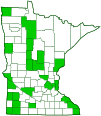
Uncommon
Its numbers can vary greatly, from uncommon one year to “extremely common/abundant” the next.
Taxonomy
Order
Lepidoptera (Butterflies and Moths)
Superfamily
Papilionoidea (Butterflies)
Family
Nymphalidae (Brush-footed Butterflies)
Subfamily
Nymphalinae (Checkerspots, Anglewings, Peacocks, and Allies)
Tribe
Melitaeini (Checkerspots)
Subtribe
Chlosynina
Genus
Chlosyne (Patches and Allies)
Subordinate Taxa
Historically two subspecies were recognized, C. g. carlota, with a widespread distribution, and C. g. gorgone, restricted to a small region in Georgia and possibly South Carolina. The exact distribution of the nominate subspecies has not been satisfactorily clarified. A recent article (Calhoun, John V., 2018) found that the morphological features used to separate the two subspecies are unreliable, and that the separation of the subspecies based on biology is challenged by available evidence.
Synonyms
Chlosyne gorgone carlota
Melitaea nycteis
Phyciodes carlota
Phyciodes gorgone
Phyciodes ismeria
Phyciodes nigra
Common Names
Gorgone Checkerspot
Glossary
Instar
The developmental stage of arthropods between each molt; in insects, the developmental stage of the larvae or nymph.
Visitor Photos
Share your photo of this insect.
This button not working for you?
Simply email us at info@MinnesotaSeasons.com.
Attach one or more photos and, if you like, a caption.

MinnesotaSeasons.com Photos
|

Slideshows
Gorgone Checkerspot
Cory Gregory
Visitor Videos
Share your video of this insect.
This button not working for you?
Simply email us at info@MinnesotaSeasons.com.
Attach a video, a YouTube link, or a cloud storage link.
Other Videos
Gorgone Checkerspot on Gray-headed Coneflower
margy stewart
Gorgone Checkerspot
mnwindchill

Visitor Sightings
Report a sighting of this insect.
This button not working for you?
Simply email us at info@MinnesotaSeasons.com.
Be sure to include a location.
Scott Leddy
5/31/2018
Location: Fillmore County
Minnesota Seasons Sightings