Perennial mason wasp
(Parancistrocerus perennis)
Information
Conservation • Description • Habitat • Ecology • Distribution • Taxonomy
Conservation Status
IUCN Red List
not listed
NatureServe
NNR - Unranked
Minnesota
not listed
Description
Perennial mason wasp is a common, small, predatory wasp. It occurs in the United States east of the Great Plains and in southern Ontario Canada. It is uncommon in Minnesota.
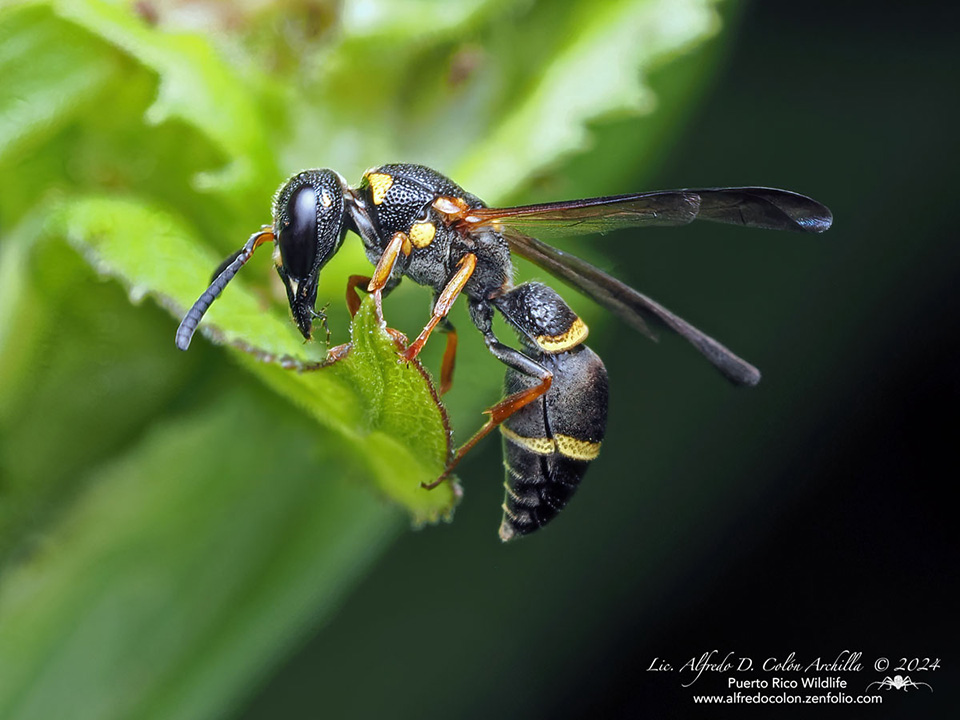
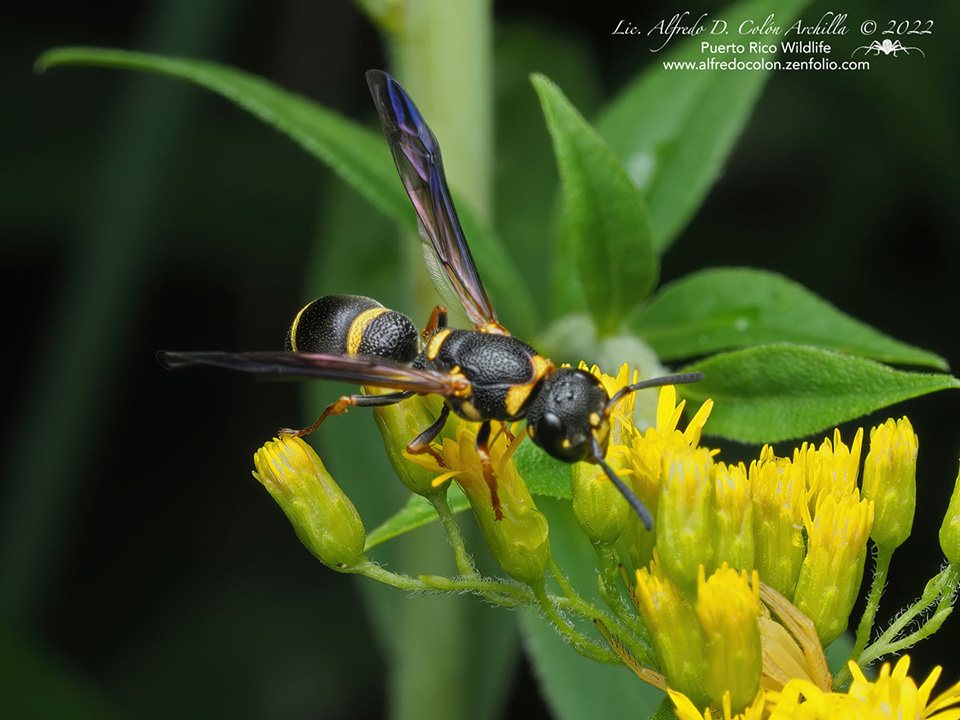
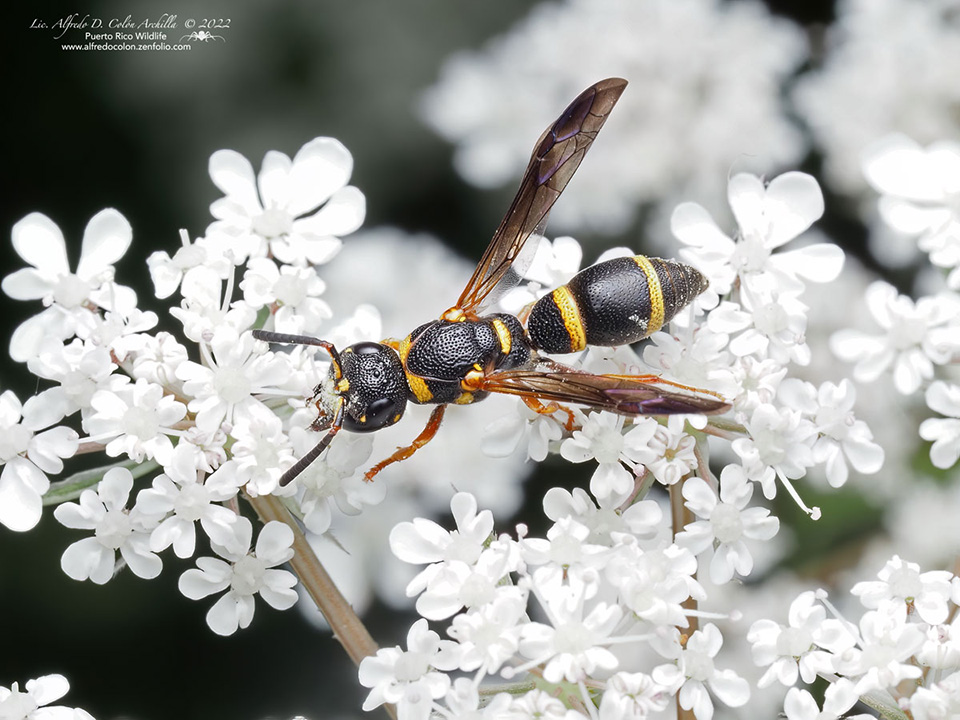
Wasp size is often given in terms of the length of the forewing. The female of this species has a forewing length of ¼″ to 5⁄16″ (6.5 to 8.0 mm). The body is black with bright yellow markings. The front part of the body (mesosoma) is connected to the rear part (metasoma) by a narrow waist (petiole).
The head is black. There are two large compound eyes, one on each side of the head, and three small simple eyes (ocelli) in a triangular pattern at the top of the head between the compound eyes. The inner margin of each compound eye is notched. The middle ocellus is not bordered with a fine, eyelid-like crease at the rear. The antennae are thread-like and have 12 segments, including a long first segment (scape) at the base, a short second segment (pedicel), and a whip-like section (flagellum) with 10 segments (flagellomeres). The upper side of all antennal segments is black. The underside of the scape is yellow. The underside of the pedicel and each flagellum is yellowish-brown. The last flagellum is not hooked at the tip. The jaws (mandibles) are long and knife-like. The plate on the face (clypeus) is black with a broad, slightly arched, yellow band on the upper margin that does not quite reach the lateral margins. There is a yellow spot on the head between the antennae bases; a small, yellow, dash-like spot behind each compound eye; and a small spot in the notch (ocular sinus) of each compound eye.
The thorax is black and has three segments, the prothorax, mesothorax, and metathorax. However, the first segment of the abdomen (propodeum) is fused to the thorax, giving the thorax the appearance of having four segments. The front of the metasoma forms a short, neck-like petiole that connects the abdomen to the thorax.The upper plate on the prothorax (pronotum) is short and collar-like. It does not have a narrow transverse ridge (carina). It extends rearward on the sides to the plate at the base of each wing (tegula). It appears horseshoe-shaped when viewed from above, triangular when viewed from the side. It is mostly black except for a relatively broad yellow band on the front margin of the upper (dorsal) surface. The band is widest toward the middle and tapers narrowly to each side. It may be complete or interrupted in the middle. On the forward-facing surface of the pronotum, just behind the head, there is a pair of deep pits. On the mesothorax, the large front plate (mesoscutum or scutum), and the smaller rear plate (scutellum) are both entirely black, with no yellow markings. The scutum has two small projections at the rear corners called parategula, a feature common to all potter or mason wasps (family Eumeninae). The tegula touches the parategula at the tip. On the upper surface of the metathorax (metanotum) there is a straight, horizontal, yellow line. There is a small yellow spot at the base of each forewing and a larger yellow spot on the side of the thorax below the wing bases.
The metasoma has six segments. The first segment is wider than long and only half as long as the second segment. The second segment is almost as long as the remaining segments combined. The upper side (tergum) of the first and second segments (T1 and T2) have a broad yellow band at the rear margin. There is a smooth depression at the base of T2 that serves as a shelter for beneficial mites. The mites feed on fungi in the wasp’s nest, fungi that would otherwise harm the offspring or their provisions. There are no parallel ridges at the end of the second segment. T3 and T4 rarely have a thin, faint, poorly defined, yellow band at the rear. T5 and T6 are entirely black. The underside of the second abdominal segment (sternite) does not have a longitudinal crease in the middle. When viewed from the side, it is bluntly angled behind the groove at its base.
The wings are tinted smoky brown with dark veins. On the forewing, the first discoidal cell is very long, about half the total length of the wing. There are three submarginal cells.
The legs are black and yellow. The second segment (trochanter) is not divided – it has just one segment. The last part of each leg (tarsus), corresponding to the foot, has five segments. There is a pair of claws at the tip of each tarsus. The claws are split (cleft) at the end.
The male is similar but smaller, with a ¼″ (6.0 to 7.0 mm) forewing length. The antennae have 13 segments. The thirteenth antennal segment forms hook at the tip. The underside of the flagellomeres is yellow. The clypeus is entirely yellow. The metasoma has seven visible segments. Sternum 3 sometimes has a narrow remnant of a yellow band in the middle. T7 is entirely black.
The description above refers to the subspecies P. p. perennis, which has yellow markings and is common and widespread in the eastern U.S. The subspecies P. p. anacardivora has red markings and is probably restricted to the Florida Peninsula.
Size
Female forewing length: ¼″ to 5⁄16″ (6.5 to 8.0 mm)
Male forewing length: ¼″ (6.0 to 7.0 mm)
Similar Species
Habitat
Ecology
Season
June to October
Behavior
Life Cycle
The female creates a nest by boring into a twig.
Larva Food/Hosts
Adult Food
Distribution
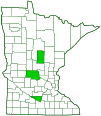
Occurrence
Uncommon in Minnesota
Taxonomy
Order
Hymenoptera (Ants, Bees, Wasps, and Sawflies)
Suborder
Apocrita (Narrow-waisted Wasps, Ants, and Bees)
Infraorder
Aculeata (Ants, Bees, and Stinging Wasps)
Superfamily
Vespoidea (Vespoid Wasps)
Family
Vespidae (Hornets, Paper Wasps, Potter Wasps, and Allies)
Subfamily
Eumeninae (Potter and Mason Wasps)
Genus
Parancistrocerus
Subordinate Taxa
perennial mason wasp (Parancistrocerus perennis anacardivora)
perennial mason wasp (Parancistrocerus perennis perennis) 
Synonyms
Odynerus mennesotaensis
Odynerus minnesotaensis
Common Names
perennial mason wasp
Photos
Visitor Photos
Share your photo of this insect.
This button not working for you?
Simply email us at info@MinnesotaSeasons.com.
Attach one or more photos and, if you like, a caption.
Minnesota Seasons Photos
Slideshows
Slideshows
Videos
Visitor Videos
Share your video of this insect.
This button not working for you?
Simply email us at info@MinnesotaSeasons.com.
Attach a video, a YouTube link, or a cloud storage link.
Other Videos
Perennial Mason Wasp (Parancistrocerus perennis)
Diana Sironi
Potter Wasp Hunting a Caterpillar
cocokitty
Sightings
Visitor Sightings
Report a sighting of this insect.
This button not working for you?
Simply email us at info@MinnesotaSeasons.com.
Be sure to include a location.
Alfredo Colon
6/21/2024

Location: Albany, NY
Alfredo Colon
8/17/2022

Location: Albany, NY
Alfredo Colon
8/8/2022

Location: Albany, NY
Minnesota Seasons Sightings